
Review · WAR HISTORY & SIEGE TOURS
Sarajevo: Start of The First World War Tour
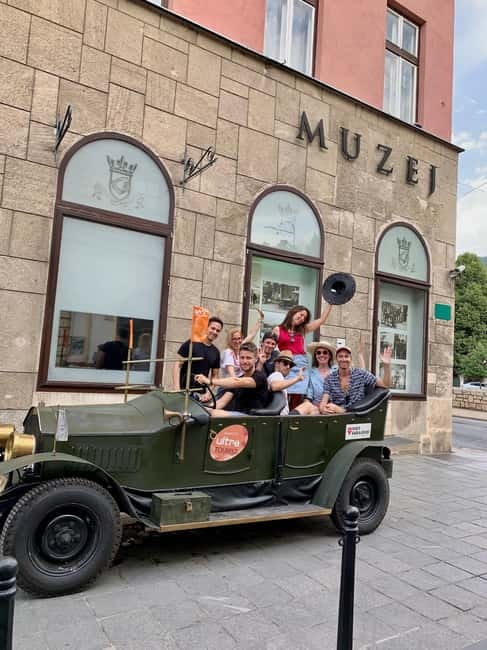
The world changed on one Sarajevo street. This three-hour tour connects the assassination of Archduke Franz Ferdinand and Sophie to the political tensions of 1914, while taking you to Sarajevo City Hall and the Latin Bridge. I especially like the small group, limited to eight people, and the way the route combines walking with vehicle transfers to reach sites outside central Sarajevo. I also like that the guides explain both the imperial viewpoint and the Bosnian and South Slavic response, rather than presenting Princip as a simple hero or villain.
The main consideration is the pace. You cover several locations in three hours, and some stops are short photo visits or drive-bys. People with mobility problems, heart conditions, and children under two should choose another activity. English is the tour language, though guide Alan was able to explain the subject in German for two guests who only partly understood English.
In This Review
- Key points to know before booking
- Why Sarajevo makes the right classroom for 1914
- Starting at the chapel of the Vidovdan heroes
- Ilidža and the imperial setting beyond the center
- Hotel Austria and Bosna, where the visit took shape
- East Sarajevo and the Princip statue
- Sarajevo City Hall and the planned imperial reception
- Ćumurija Bridge and the failed first attempt
- Latin Bridge and the shot heard across Europe
- The Sarajevo Museum 1878 to 1918
- How the guides shape the experience
- What $58 buys you in three hours
- Who should book this Sarajevo tour
- Should you book the Shot that Changed the World Tour?
- FAQ
- How long does the Sarajevo First World War tour last?
- What language is the tour conducted in?
- How many people can join the group?
- What is included in the activity?
- Does the tour visit the assassination site?
- Which museum does the tour visit?
- Does the tour visit a monument to Gavrilo Princip?
- Is transportation used during the tour?
- Can I cancel for a refund?
Key points to know before booking
- The assassination site is only one part of the story: You visit the Latin Bridge, Ćumurija Bridge, Appel Quay, City Hall, and the Sarajevo Museum 1878 to 1918.
- The route reaches East Sarajevo: The statue of Gavrilo Princip gives you a useful look at how his memory is treated differently across Bosnia and the Balkans.
- You get both walking and vehicle sightseeing: This makes it possible to reach Hotel Austria and Bosna, Ilidža, the chapel, and East Sarajevo within three hours.
- The political background receives serious attention: The guide discusses Austro-Hungarian rule, Young Bosnia, the Black Hand, and the failed first attempt on Franz Ferdinand.
- The group is small: With no more than eight participants, you have a better chance to ask questions and hear the guide clearly.
- The price is reasonable for the route: At $58 per person, the tour offers a guide, walking tour, transport between scattered locations, and a focused lesson in Sarajevo’s role in World War I.
Why Sarajevo makes the right classroom for 1914
Sarajevo is not just the place where Franz Ferdinand was killed. It is the place where several political pressures met: Austro-Hungarian imperial rule, South Slavic nationalism, religious and ethnic tensions, and the ambitions of secret organizations.
That is what makes this tour useful. You are not simply shown the spot where Gavrilo Princip fired his shots. You are given the setting needed to understand why the visit mattered, why June 28 carried such weight, and why a local assassination led to a war involving much of Europe.
The guide explains that Franz Ferdinand came to Bosnia and Herzegovina to inspect the imperial armed forces. His visit also fell on June 28, a date connected to the First Battle of Kosovo and his wedding anniversary. Those overlapping meanings made the day politically and personally charged before the motorcade even reached the Latin Bridge.
I like that the tour gives room to the wider Southern Slavic question. You learn how Austro-Hungarian rule affected Bosnian society and why groups such as Young Bosnia opposed imperial control. The Black Hand, a secret Serbian organization, also enters the story, helping you see that the assassination plot did not grow from one man’s sudden decision.
Other tours covering the siege years and their sites:
- Fall of Yugoslavia, Sarajevo War Tour with Tunnel of Hope Museum and Frontlines
★ 5.0 · 1,314 reviews - Sarajevo: Tunnel Museum Yugoslavia War Tour with War Veteran
★ 5.0 · 1,111 reviews - ROSES OF SARAJEVO (Official WAR + CITY tour)- Story of a Survivor
★ 5.0 · 770 reviews
Starting at the chapel of the Vidovdan heroes
The tour begins with a visit to Kapela Vidovdanskih heroja, commonly described as the Chapel of the Vidovdan Heroes. This stop brings Gavrilo Princip and the other conspirators into the story before you reach the most famous assassination sites.
It works as an opening because it raises an important question: how should a city remember people who caused an event with terrible consequences but were also part of a nationalist struggle? The answer is not simple, and the tour does not treat Princip’s memory as fixed or universally accepted.
Expect a visit and photo stop rather than a long museum session. If you want detailed time at every location, the three-hour format may feel tight. If you prefer a clear route that builds the story step by step, this early stop gives the rest of the tour a useful frame.
Ilidža and the imperial setting beyond the center
The route passes through Ilidža, one of the areas outside central Sarajevo included in the vehicle sightseeing portion. The information provided does not promise a long stop here, so treat it as part of the wider view of Sarajevo rather than a separate attraction.
This is one reason the tour is easier than following the route alone. The assassination story is spread across central Sarajevo, the old Austro-Hungarian quarter, and locations reached by car. You can watch the city change as the guide links places that are not all within a short walk of one another.
The drive also keeps the tour moving. You spend your limited time on the locations that need explanation instead of using the entire morning or afternoon to get between them.
Hotel Austria and Bosna, where the visit took shape
Hotel Austria and Bosna receives time for sightseeing, a walk, photographs, and a break. This location helps explain the practical setting of Franz Ferdinand’s visit and the presence of imperial officials in Sarajevo.
The stop is valuable because famous historical events often seem detached from ordinary logistics. A royal visit required accommodation, official arrangements, military inspection, and a public route through the city. Looking at the hotel site helps put the assassination back into that real-world setting.
This is also a good place to ask questions. Guides Ahmed Huseinović, Alan, and Arna received especially strong praise for clear explanations and patient answers. Ahmed was noted for moving comfortably between academic detail and plain English, which is useful when the subject includes unfamiliar political groups and Balkan place names.
Same corner of the country, a different kind of day:
- Sarajevo: Mostar, Konjic, Blagaj Tekke, Pocitelj & Waterfall
★ 4.9 · 1,666 reviews - Sarajevo: Grand Walking Tour Through Time and Cultures
★ 4.8 · 1,236 reviews - Sarajevo: Mostar, Konjic, Sufi House, Pocitelj & Kravice Falls
★ 5.0 · 1,179 reviews - Sarajevo: Tunnel of Hope Tour – Survival and Resilience
★ 4.8 · 630 reviews
East Sarajevo and the Princip statue
The route continues through East Sarajevo and stops at Park Gavrilo Princip, including a visit to the Gavrilo Princip monument. This is one of the tour’s most interesting choices because it shows that Princip’s image changes depending on the community and political setting.
In one telling, he is an assassin whose act helped set off a catastrophic war. In another, he is a young South Slavic nationalist who resisted Austro-Hungarian rule. A useful guide will not force you to choose one label without explaining the period around it.
The statue is also a reminder that public memory is part of history. Monuments, chapels, plaques, and missing memorials can reveal how later governments and communities judged the same person. The tour specifically addresses how Princip and the other conspirators have been memorialized, and how they have not been memorialized.
You have free time and a photo stop here. The exact amount of time is not specified, so do not expect a long independent visit. Still, this is an important stop for anyone interested in how Bosnia and the wider Balkans continue to argue about the meaning of 1914.
Sarajevo City Hall and the planned imperial reception
Sarajevo City Hall, or Vijećnica, is one of the tour’s strongest stops. The building dates from the Austro-Hungarian period and was intended to host Franz Ferdinand and Sophie during their visit.
The guide leads you through the building and explains its part in the official visit. That detail changes how you see the place. City Hall is not just a grand Austro-Hungarian building; it was connected to the arrival of the couple whose deaths would make Sarajevo known around the world.
The architecture also gives you a direct feel for imperial ambitions in Bosnia and Herzegovina. Austro-Hungarian rule brought new institutions, construction, administration, and military control. The buildings could look impressive while the political relationship remained unequal and contested.
I would pay close attention here to the contrast between public ceremony and private tension. Franz Ferdinand’s visit was meant to display imperial authority. The tour explains how that display collided with local opposition and the nationalist aims of Young Bosnia.
Ćumurija Bridge and the failed first attempt
The stop at Ćumurija Bridge adds an important detail that is easy to miss in a quick Sarajevo walk. The assassination was not a single smooth action. The first attempt failed, and the motorcade continued.
That failure matters because it shows how chance shaped the day. Had the first attempt succeeded, or had the motorcade followed a different route afterward, the later encounter with Princip might never have happened in the same way.
The bridge is a short sightseeing and photo stop, so the guide’s explanation is the main reason to visit. Ask about the sequence of the motorcade and the failed attack. The value comes from understanding the chain of errors and decisions, not from expecting a large display at the site.
Latin Bridge and the shot heard across Europe
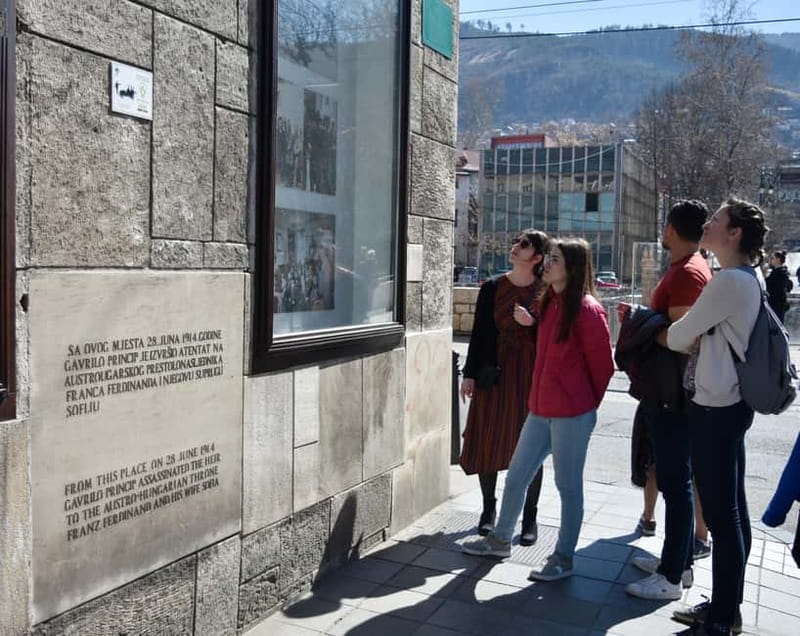
At the Latin Bridge, you reach the central scene of the tour. This is where Gavrilo Princip fired the shots that killed Franz Ferdinand and Sophie.
The setting is striking because it is easy to imagine how ordinary the street must have looked. There is no battlefield here, no grand palace courtyard, and no obvious sign that the course of world politics was about to change. The tour places the event in its exact urban setting and explains how Princip came to be there after the failed first attempt.
The assassination did not cause World War I by itself. The guide’s job is to show the chain that followed: the political crisis between Austria-Hungary and Serbia, the demands placed on Serbia, the declarations of war, and the alliances that pulled other powers into the conflict.
That distinction is one of the tour’s strengths. A simple story says one shot started the war. A better explanation shows that the shot triggered a crisis inside an already tense European system.
Expect a walking and photo stop here. The site is essential, but it is not presented as a long standalone attraction. The meaning comes from the guide’s narration and from connecting the bridge to the earlier stops.
The Sarajevo Museum 1878 to 1918
The final major stop is the Sarajevo Museum 1878 to 1918, located by the assassination area. Its focus on the period of Austro-Hungarian rule makes it a fitting place to bring the story together.
You have time to visit and look around independently. The museum adds physical material to the spoken explanation, helping you connect dates and political events with the period’s objects and presentation.
The date range is useful. It begins with the start of Austro-Hungarian administration and reaches beyond the assassination itself, so you can consider the broader effects of imperial rule rather than treating June 28, 1914 as an isolated moment.
Because this is a three-hour tour, your free time at the museum may be limited by the rest of the route. If you are especially interested in museum displays, ask the guide how much time is planned here and consider returning independently later if your schedule allows. The tour’s main goal is the connected story, not an extended museum study.
How the guides shape the experience
The guides are the strongest part of this activity. Ahmed Huseinović was praised for explaining both the assassination and the wider history of Sarajevo and Bosnia and Herzegovina with clarity. He also handled detailed questions patiently and adjusted his English between formal historical terms and everyday explanation.
Alan received praise for adapting to guests who spoke only partial English. His German helped two participants follow the discussion fully, though English remains the stated tour language.
Arna was praised for conducting the route with warmth, answering questions carefully, and working well with the driver. The driver also received positive comments for being friendly, comfortable, and safe.
This matters because the subject is not easy. Names, organizations, borders, and political loyalties can blur together. A guide who welcomes questions can make the difference between a list of dates and a story you can actually follow.
The small group, capped at eight people, supports that style. You are less likely to be lost at the back of a large crowd, and you have a better chance to ask about the parts that interest you most. In one booking, the group was only two people, making the experience feel almost private. That cannot be guaranteed, but the group limit gives you a fair chance of a personal discussion.
What $58 buys you in three hours
At $58 per person, this is not the cheapest way to spend three hours in Sarajevo. You could walk to the Latin Bridge and City Hall on your own for much less.
The value is in the full route and the interpretation. Your fee covers the guide and walking tour, while the vehicle portion helps connect central Sarajevo with Ilidža, Hotel Austria and Bosna, the chapel, and East Sarajevo. You also get a planned sequence rather than a collection of disconnected sights.
I consider the price fair for readers who want context, transport between scattered places, and a small group. It is less compelling for someone who has already studied the 1914 crisis and only wants to photograph the Latin Bridge.
The reserve now and pay later option also gives you flexibility, and free cancellation is available up to 24 hours before the tour for a full refund. Starting times depend on availability, so check the schedule before planning other visits around it.
Who should book this Sarajevo tour
I would choose this experience if you:
- Want a focused explanation of the Sarajevo Assassination and its link to World War I
- Prefer a guide to explain political context rather than reading plaques alone
- Want to see both central Sarajevo and the Princip monument in East Sarajevo
- Appreciate a small group with time for questions
- Are interested in how Bosnia remembers the Austro-Hungarian period and Gavrilo Princip
- Have only three hours but still want more than one historic stop
I would think twice if you want a relaxed city stroll, long time at each museum, or a tour built around architecture alone. The subject includes violence, nationalism, empire, and war, so it suits adults and older children better than very young children. The activity is not suitable for children under two, people with mobility impairments, or people with heart problems.
Wear comfortable shoes for the walking sections and keep your questions ready. The tour has enough historical material for a curious participant to shape the discussion, especially with a guide such as Ahmed who is willing to explain beyond the basic route.
Should you book the Shot that Changed the World Tour?
Book it if you want to understand why Sarajevo mattered in 1914, not simply stand where Princip fired his pistol. The combination of City Hall, the bridges, the museum, the hotel area, the chapel, and East Sarajevo gives you a fuller picture than a short central walking tour.
I particularly value the attention to competing memories of Princip and the clear explanation of the failed first attempt. Those details replace the familiar one-shot myth with a more accurate chain of events.
For $58, the tour earns its price through transport, a small group, and strong guiding. It is best for history-minded visitors who want clear English, direct answers, and a compact route through the political story behind Sarajevo’s most famous day.
FAQ
How long does the Sarajevo First World War tour last?
The tour lasts three hours.
What language is the tour conducted in?
The live tour guide speaks English.
How many people can join the group?
The group is limited to eight participants.
What is included in the activity?
A guide and a walking tour are included.
Does the tour visit the assassination site?
Yes. The route includes the Latin Bridge, the site associated with the assassination of Archduke Franz Ferdinand and Sophie.
Which museum does the tour visit?
The tour visits the Sarajevo Museum 1878 to 1918.
Does the tour visit a monument to Gavrilo Princip?
Yes. It visits Park Gavrilo Princip and the Gavrilo Princip monument in East Sarajevo.
Is transportation used during the tour?
Yes. The route includes sightseeing and drive-by portions through places such as Ilidža and East Sarajevo, along with walking stops.
Can I cancel for a refund?
Yes. You can cancel up to 24 hours in advance for a full refund.
Newest around Sarajevo
- Understanding Srebrenica Genocide + Lunch with Local Family★ 4.9 · 14 reviews
- Private Full Day Safari Tour★ 5.0 · 8 reviews
- Sarajevo: Trebević Mountain Summit Hiking Tour★ 4.2 · 2 reviews
- From Sarajevo: Kozice Waterfalls Hiking Experience in Nature★ 5.0 · 2 reviews
- Sarajevo Under Siege: A War History Tour★ 5.0 · 10 reviews
- Mysterious Visoko Pyramids Driving and Walking Tour★ 5.0 · 7 reviews
- WAR TUNNEL – Sarajevo’s only way of a communication during the WAR – Top secret★ 5.0 · 12 reviews
- Ultimate Gastro Experience★ 4.5 · 14 reviews
War History & Siege Tours, compared.
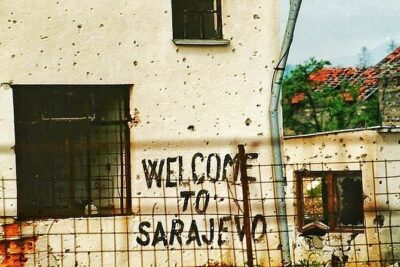
Fall of Yugoslavia, Sarajevo War Tour with Tunnel of Hope Museum and Frontlines
Read our review →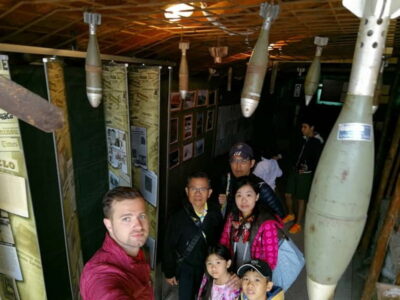
Tunnel Museum Yugoslavia War Tour with War Veteran
Read our review →
ROSES OF SARAJEVO (Official WAR + CITY tour)- Story of a Survivor
Read our review →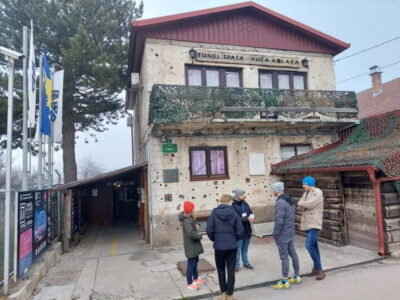
Tunnel Museum: Bosnian & Yugoslav Wars Tour with War Veteran
Read our review →
Bosnian War & Fall of Yugoslavia Tour with Tunnel
Read our review →
Sarajevo War Tour: A Veteran’s Story of the Siege (fees included)
Read our review →Browse the lists this tour appears in