
Review · WALKING TOURS
Sarajevo: Grand Walking Tour Through Time and Cultures
Sarajevo rewards curious walkers. This three-hour tour brings together Ottoman lanes, Austro-Hungarian buildings, religious landmarks, and modern Sarajevo, making it a smart first look at a city shaped by several worlds. I especially like the clear route from the Latin Bridge toward Baščaršija, and the chance to hear local stories from guides such as Kenan, Elma, Bojan, and Masha. The main concern is simple: three hours on foot, with many stops, may be tiring if you have mobility limits or dislike a busy sightseeing pace.
I also like that the tour does more than point at famous buildings. It explains how Sarajevo’s Muslim, Jewish, Catholic, and Orthodox communities influenced one another, while also addressing the assassination of Archduke Franz Ferdinand and the scars of the 1990s siege. You should bring comfortable shoes and clothes, and remember that food, drinks, and any purchases are extra.
In This Review
- Key points to know before you book
- Why this Sarajevo walk works so well
- From the Latin Bridge to the Miljacka River
- City Hall and the House of Spite
- Entering Baščaršija through food and craft streets
- Gazi Husrev-beg Mosque and Sarajevo’s shared city center
- The final stretch: market hall and Eternal Flame
- How the guides shape the experience
- Price, pace, and practical value
- Who should book this Sarajevo tour?
- Should you book it?
- FAQ
- How long is the Sarajevo Grand Walking Tour?
- How much does the tour cost?
- What landmarks are included?
- Does the tour visit Baščaršija?
- Is food included?
- Is a guide included?
- What languages are available?
- Can I book a private or small-group tour?
- Where does the tour start and finish?
- What should I bring?
Key points to know before you book
- A strong first-day orientation: The route links the Latin Bridge, City Hall, Baščaršija, religious sites, markets, and the Eternal Flame.
- History told in layers: You move from Ottoman Sarajevo to Austro-Hungarian rule, Yugoslav-era events, World War I, and the city’s more recent past.
- Local guides make the difference: Guides including Kenan, Elma, Bojan, Tarek, Masha, and Hamza are praised for clear explanations, humor, patience, and useful city advice.
- A good value at $21: For three hours with a licensed guide and a city map, the price is modest, especially for a small group or private booking.
- Expect a full walking route: There are many short photo stops, two visits of about five minutes, and a viewpoint stop lasting about 15 minutes.
- Food is part of the setting, not the ticket: You pass Bravadžiluk, Kazandžiluk, and a baklava shop, but food and drinks are not included.
Why this Sarajevo walk works so well
Sarajevo can feel confusing at first because its central streets change character within a few blocks. One moment you are in an Ottoman market street with copperware and coffee shops. Soon after, you are beside grand Austro-Hungarian facades, a Catholic cathedral, an Orthodox church, or a synagogue site.
I like this tour because it gives those changes a useful order. You are not just collecting photographs. You are learning why the city looks and feels different from one street to the next.
The route also puts major events into physical places. At the Latin Bridge, you hear about the assassination of Archduke Franz Ferdinand and its effect on Europe. At City Hall, you see the scale and style of Austro-Hungarian Sarajevo. In Baščaršija, you get a clearer sense of Ottoman urban life and Sarajevo’s long tradition of trade and craft.
The guides appear to be the biggest strength. Kenan is praised for balancing documented facts with family stories, local anecdotes, and a little humor. Elma is noted for her excellent English and thoughtful explanations. Bojan brings a hopeful view of Sarajevo after the siege, while Masha is praised for turning a large amount of material into an easy, enjoyable walk.
That range matters. Sarajevo’s past includes violence, political upheaval, and religious tension, so a guide who can be factual without becoming cold is valuable. The strongest guides keep difficult subjects respectful while still allowing room for warmth and everyday life.
More Walking Tours in Sarajevo
- Sarajevo: 2 Hours Old Town Walking Tour With Local Guide
★ 5.0 · 505 reviews - Private Walking Tour, Food Tasting and Bosnian Coffee in Sarajevo
★ 5.0 · 255 reviews - Sarajevo Grand Walking Tour
★ 5.0 · 232 reviews
From the Latin Bridge to the Miljacka River
The walk begins with a choice of meeting points connected with UPN BiH and Insider City Tours and Excursions. Check your exact option carefully because the starting point can vary.
The Latin Bridge is an ideal opening stop. It is tied to the 1914 assassination of Archduke Franz Ferdinand, an event commonly linked with the outbreak of World War I. The guide helps you understand the setting rather than treating the bridge as just another old crossing.
This is one of the tour’s best moments for history fans. You can stand in the place connected with an event that changed Europe, then hear how the surrounding streets fit into that story. The guide also helps separate the actual setting from the simplified version often found in short history books.
From there, the route reaches the Emperor’s Mosque. This stop introduces the Ottoman period and gives you a chance to consider how Islamic architecture and religious life became central to Sarajevo. The tour is not limited to one community or one era, which is important in a city often described as a meeting point between East and West.
The route then passes a monastery and the Sarajevo Brewery. Each stop adds another piece to the city’s religious and civic story. The monastery visit is listed as a short stop of about five minutes, as is the brewery stop, so you should expect an explanation and photographs rather than a long interior tour or tasting.
City Hall and the House of Spite
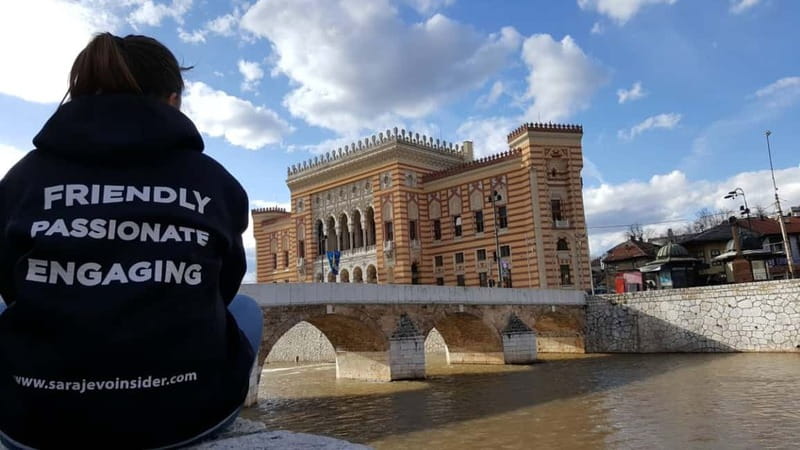
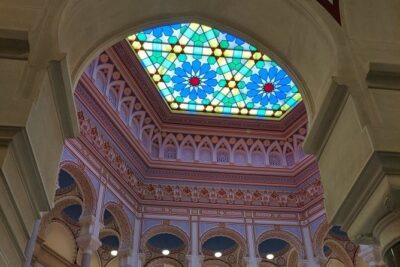
Sarajevo City Hall, known for its neo-Moorish design, is one of the visual highlights. The building gives you a strong example of how Austro-Hungarian authorities used architecture to shape the city while borrowing forms associated with the region’s Islamic past.
You visit City Hall with a guide, rather than simply walking past it. That makes the stop more useful because the building’s appearance raises questions about power, identity, and the way Sarajevo was presented during Austro-Hungarian rule.
Nearby, the House of Spite adds one of Sarajevo’s most memorable local stories. You pass by it while the guide explains its connection to City Hall and the tale behind its name. It is a short stop, but this is exactly the kind of detail that gives a walking tour personality.
I like the contrast here. City Hall is large, formal, and grand. The House of Spite is remembered through a more personal story. Together they show how city building affects ordinary people, not just rulers and architects.
The route includes a viewpoint stop of about 15 minutes. The supplied details do not identify the exact viewpoint, so do not book this expecting a particular panorama. Still, a short pause above or across the central area gives you a chance to place the streets you have walked and take photographs.
Entering Baščaršija through food and craft streets
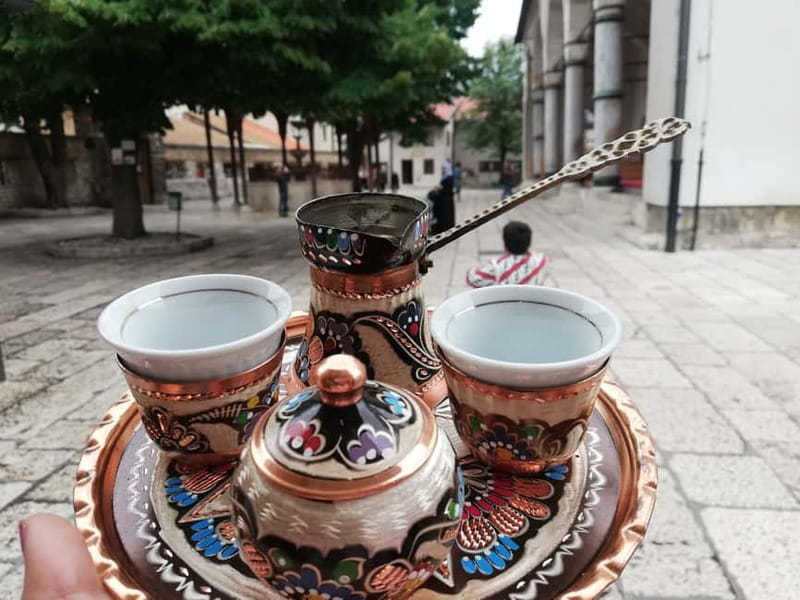
The tour then moves toward Bravadžiluk and Kazandžiluk, two streets that help explain Sarajevo’s marketplace culture. Bravadžiluk is associated with food and local eating traditions, while Kazandžiluk is known for copper craftsmanship and traditional metalwork.
These streets are valuable because they connect history with daily life. You see the kind of commercial activity that makes Baščaršija more than a collection of old buildings. The guide can point out how crafts, shops, food, and social habits fit together.
Food and drinks are not included, but that is not necessarily a weakness. You can listen, take notes, and return later for a meal or snack that suits your budget. Guides are often praised for restaurant and food suggestions, so keep a note on your phone for recommendations.
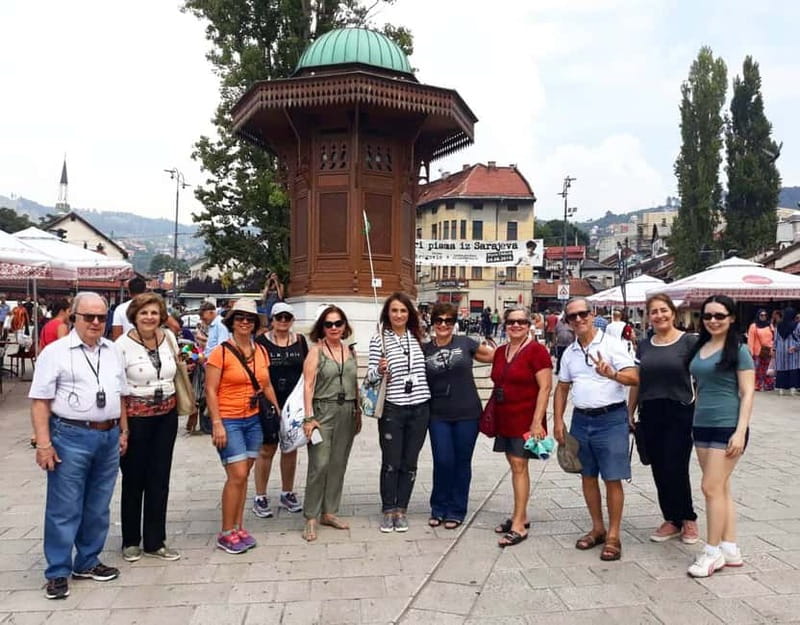
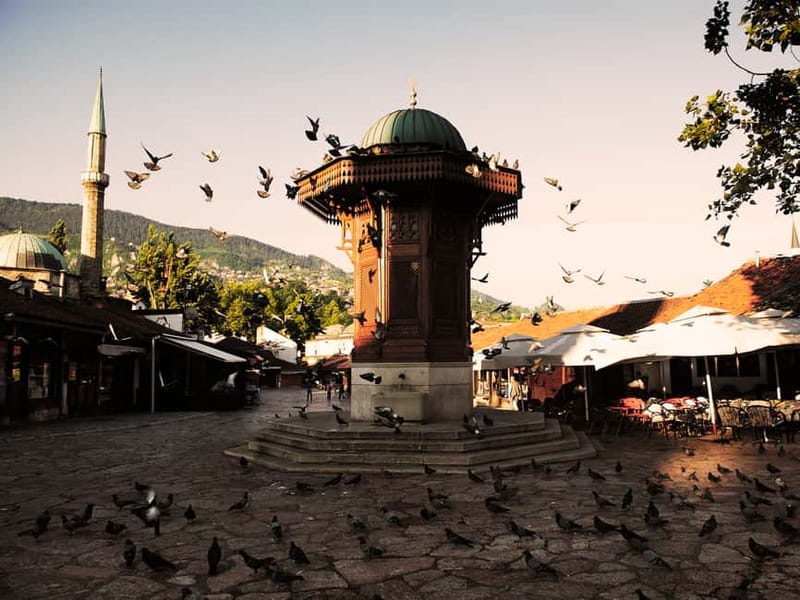
At the Sebilj Fountain, you reach one of the city’s best-known landmarks. This wooden fountain sits at the heart of Baščaršija and is a natural gathering point. It is also one of the tour’s most obvious photo stops.
The fountain can be busy, so you may need patience if you want a clear photograph. Its value is not only visual. It helps you understand the old market district as a social center, where streets, shops, religious buildings, and public meeting places connect.
Morića Han follows as another important Ottoman-era stop. This former inn reflects the role of Sarajevo as a place where merchants and visitors could stay while moving through the region. The guide’s explanation helps you picture the commercial network behind the market streets.
The baklava shop visit adds a small but welcome food connection. You do not receive food as part of the tour, but the stop lets you see one of Bosnia’s familiar sweet traditions and decide if you want to buy something separately.
Same corner of the country, a different kind of day:
- Sarajevo: Mostar, Konjic, Blagaj Tekke, Pocitelj & Waterfall
★ 4.9 · 1,666 reviews - Fall of Yugoslavia, Sarajevo War Tour with Tunnel of Hope Museum and Frontlines
★ 5.0 · 1,314 reviews - Sarajevo: Mostar, Konjic, Sufi House, Pocitelj & Kravice Falls
★ 5.0 · 1,179 reviews - Sarajevo: Tunnel Museum Yugoslavia War Tour with War Veteran
★ 5.0 · 1,111 reviews
Gazi Husrev-beg Mosque and Sarajevo’s shared city center
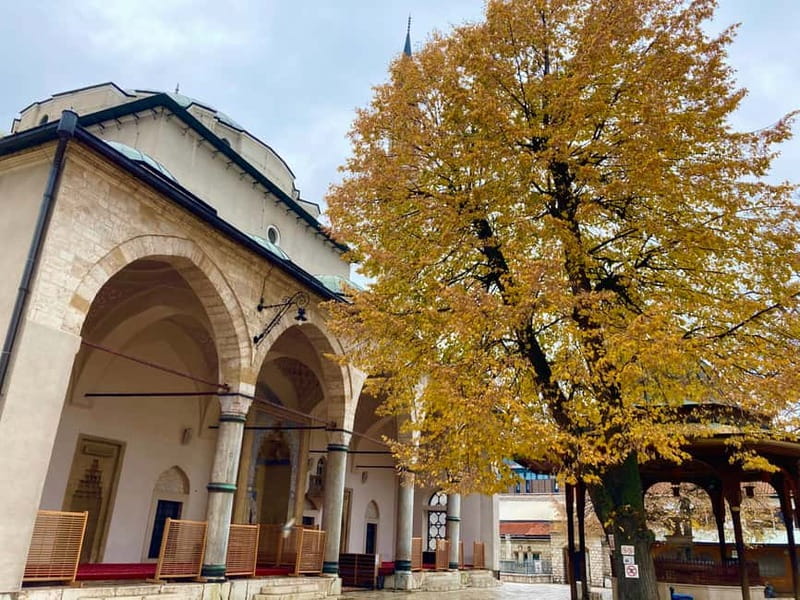
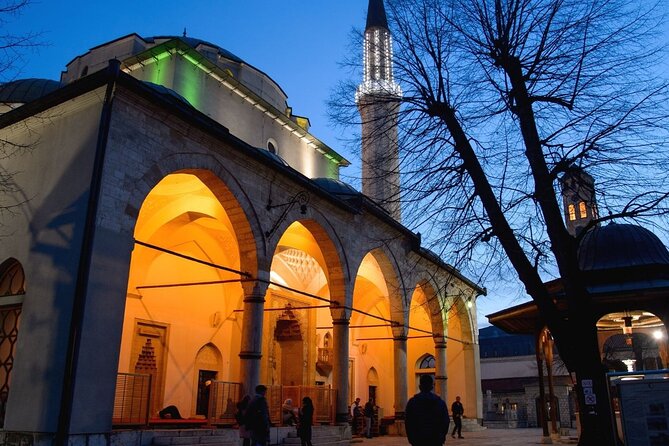
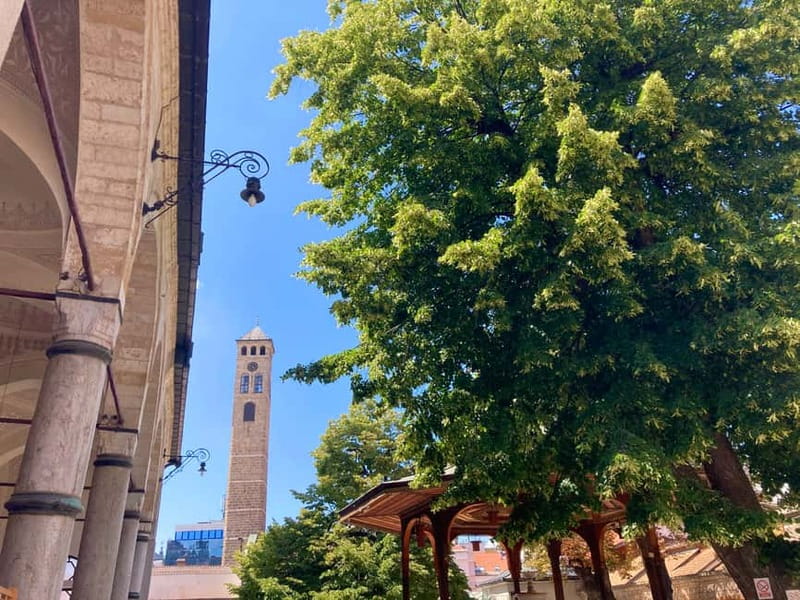
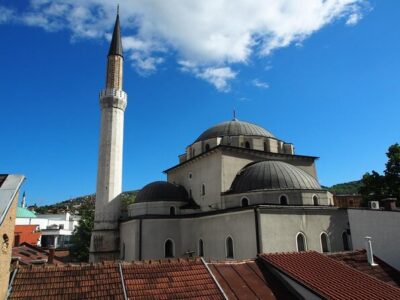
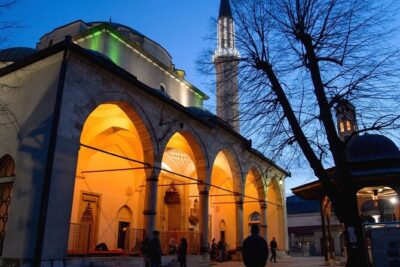
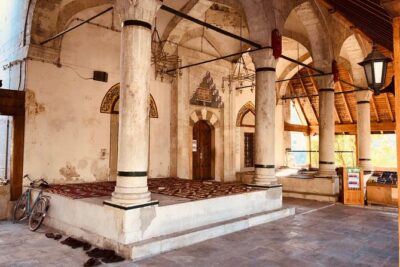
The Gazi Husrev-beg Mosque is one of the central landmarks in Baščaršija. The tour uses it to explain Ottoman religious, educational, and civic life, while also showing how closely the mosque sits beside markets and other city institutions.
You should dress comfortably and respectfully for the religious parts of the route. The supplied information does not spell out interior access rules, so follow your guide’s instructions at each site.
The Sarajevo Meeting of Cultures is one of the clearest visual markers of the city’s changing character. Here, the Ottoman-style market district gives way to the Austro-Hungarian center. The transition happens quickly, which is the point: Sarajevo’s cultural divisions and connections can be read directly in its streets.
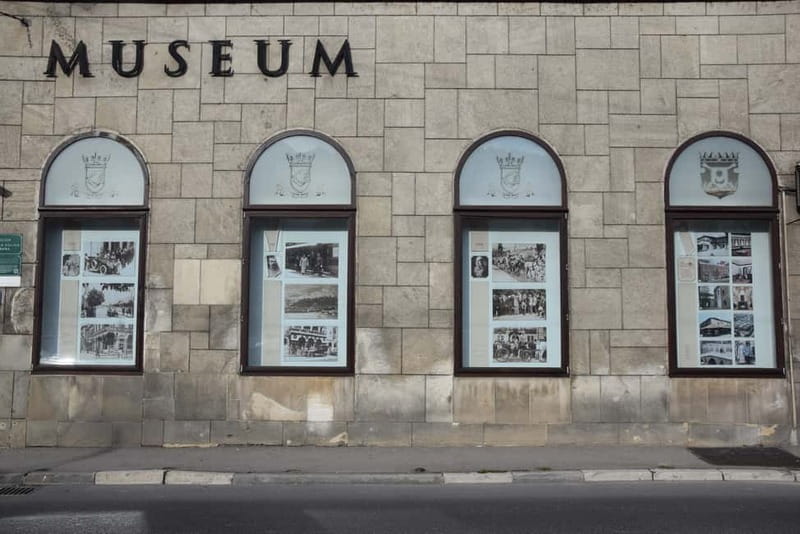
The Museum of the Jews of Bosnia and Herzegovina adds another important voice. Even if the stop is brief, it reminds you that Sarajevo’s story includes a Jewish community alongside its Muslim, Catholic, and Orthodox traditions.
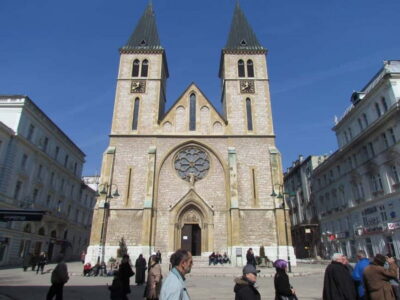
The Sacred Heart Cathedral and the Cathedral Church of the Nativity of the Theotokos provide a direct comparison between Catholic and Orthodox religious architecture. Seeing both on the same walk helps explain why Sarajevo is often associated with religious coexistence.
I appreciate that the tour gives these communities space without pretending that coexistence was always easy. Several guides are praised for presenting difficult subjects in a factual and balanced way, including the war from 1992 to 1995 and its effect on families in the city.
The final stretch: market hall and Eternal Flame
The City Market Hall is a short visit of about five minutes. It adds another layer to Sarajevo’s food and shopping culture, and it gives you a glimpse of a more formal market setting after the craft streets of Baščaršija.
The final stop is the Eternal Flame, a memorial and familiar central landmark. It is a fitting place to finish because it brings together remembrance, public space, and Sarajevo’s continued life after conflict.
The tour’s route is carefully packed. You cover religious buildings, markets, architecture, World War I history, local legends, and recent events in three hours. That is impressive, but it also means the experience favors breadth over long visits inside museums or buildings.
If you want to study one site in detail, you will need to return on your own. I would treat this walk as an introduction that shows you where to spend more time later.
How the guides shape the experience
The strongest praise is directed at the guides’ storytelling. You can expect different personalities because the tour is offered in several languages and by a rotating team, but the recurring strengths are clear: good English, local perspective, patience with questions, and a relaxed sense of humor.
Kenan is praised for a well-planned route and for mixing serious history with urban legends and Sarajevo-style anecdotes. Elma receives especially warm comments for her English, kindness, and ability to explain history, culture, art, and ordinary life. Tarek is praised for humor and for making the city easy to follow.
Other guides named in personal recommendations include Bojan, Hamza, Masha, Mohammed, Emina, Suad, Denis, Tidza, Lejla, and Igor. That does not guarantee a particular guide on your date, but it does show that the provider has a broad team of guides who bring different strengths.
For the best experience, ask questions. The tour is especially well suited to curious visitors who want context, not just a list of dates. Guides have also given useful suggestions for food and further sightseeing, which can help you plan the rest of your stay.
Price, pace, and practical value
At $21 per person, this is good value for a licensed guide, three hours of walking, and a city map. Sarajevo’s central sights are close enough to explore on foot, but a guide saves you from piecing together the connections between them.
The value is highest if this is your first time in Sarajevo or if you have only a short stay. You get a broad orientation, a historical framework, and a list of places worth revisiting.
Private and small-group options are available. A small group gives you more room for questions and may feel more personal. One solo booking even became a private tour, though you should not assume that will happen.
The pace is generally described as comfortable, but the route includes many stops. Wear proper walking shoes, carry water, and be prepared to remain on your feet for much of the three hours. The tour is listed as wheelchair accessible, yet it is also marked as unsuitable for people with mobility impairments, so contact the provider before booking if mobility is a concern.
Free cancellation up to 24 hours before the start and reserve-now, pay-later booking make the plan flexible. Those terms are useful if your Sarajevo schedule may change.
Who should book this Sarajevo tour?
I would choose this walk for first-time visitors, history fans, architecture lovers, solo travelers, and anyone who wants a useful introduction before exploring alone.
It suits visitors who want World War I context but also care about Ottoman Sarajevo, religious diversity, markets, food, and the city’s more recent past. It is also a good choice if you prefer local explanation over reading several guidebooks before arrival.
You may want a different experience if you dislike walking, want long interior visits, or prefer a tour focused only on the 1990s siege. This route covers a great deal, but its strength is the connection between eras rather than a single subject.
Should you book it?
At $21, I think this is an easy recommendation for a first visit to Sarajevo. You see the essential central landmarks, hear the city’s major stories, and gain practical food and sightseeing suggestions from a local guide.
Book it early in your stay so you can return to the places that catch your interest. Choose comfortable clothing, keep an open mind about difficult history, and leave time afterward for your own wander through Baščaršija.
FAQ
How long is the Sarajevo Grand Walking Tour?
The tour lasts three hours.
How much does the tour cost?
The listed price is $21 per person.
What landmarks are included?
The route includes the Latin Bridge, Emperor’s Mosque, Sarajevo Brewery, City Hall, House of Spite, Sebilj Fountain, Morića Han, Gazi Husrev-beg Mosque, the Sarajevo Meeting of Cultures, the Museum of the Jews of Bosnia and Herzegovina, Sacred Heart Cathedral, the Cathedral Church of the Nativity of the Theotokos, City Market Hall, and the Eternal Flame.
Does the tour visit Baščaršija?
Yes. The route includes Baščaršija, the Sebilj Fountain, Bravadžiluk, Kazandžiluk, Morića Han, a baklava shop, and Gazi Husrev-beg Mosque.
Is food included?
No. Food and drinks are not included in the price.
Is a guide included?
Yes. A licensed live tour guide is included.
What languages are available?
Guiding is available in German, French, Italian, Spanish, English, Croatian, and Serbian.
Can I book a private or small-group tour?
Yes. Private and small-group options are available.
Where does the tour start and finish?
The meeting and drop-off locations are connected with UPN BiH and Insider City Tours and Excursions, but the exact option may vary when you book.
What should I bring?
Bring comfortable shoes and comfortable clothes.
Newest around Sarajevo
- Understanding Srebrenica Genocide + Lunch with Local Family★ 4.9 · 14 reviews
- Private Full Day Safari Tour★ 5.0 · 8 reviews
- Sarajevo: Trebević Mountain Summit Hiking Tour★ 4.2 · 2 reviews
- From Sarajevo: Kozice Waterfalls Hiking Experience in Nature★ 5.0 · 2 reviews
- Sarajevo Under Siege: A War History Tour★ 5.0 · 10 reviews
- Mysterious Visoko Pyramids Driving and Walking Tour★ 5.0 · 7 reviews
- WAR TUNNEL – Sarajevo’s only way of a communication during the WAR – Top secret★ 5.0 · 12 reviews
- Ultimate Gastro Experience★ 4.5 · 14 reviews
Walking Tours, compared.
Private Walking Tour, Food Tasting and Bosnian Coffee in Sarajevo
Read our review →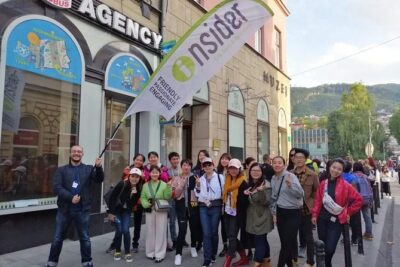
Browse the lists this tour appears in