
Review · WALKING TOURS
Sarajevo : Highlights & Hidden Gems Walking Tour
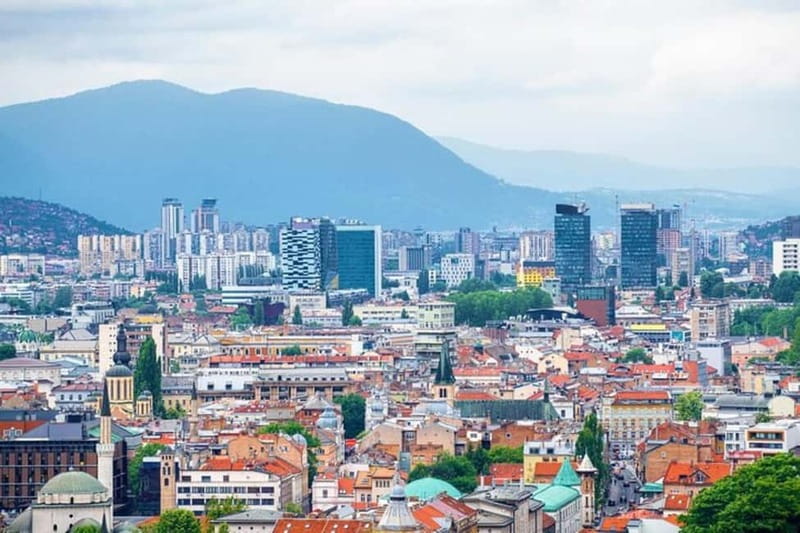
Sarajevo rewards curious walkers. I like this tour because it brings together Ottoman streets and Austro-Hungarian landmarks in a compact route, while a private guide can adjust the pace and focus to suit you. I also like the chance to hear the city’s story through its religious sites, markets, bridges, and memorials instead of seeing Sarajevo as a string of disconnected sights. The main consideration is time: two hours is brisk for such a full route.
The private format is especially useful if you want to ask questions, stop for advice, or spend more time on Sarajevo’s 20th-century story. Enes, one of the guides, was praised for being informative, funny, and kind. Still, the $82 price is best value for couples, families, or small groups who want personal attention, rather than for solo visitors seeking the cheapest introduction.
In This Review
- Key points to know before you book
- Starting at Hotel Europe in central Sarajevo
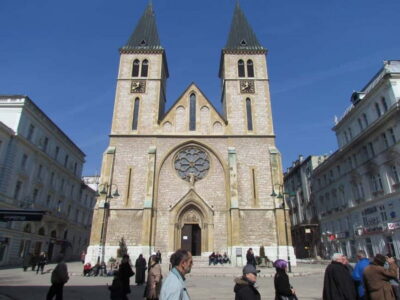
- Sacred Heart Cathedral and the city’s Catholic story
- The Orthodox Cathedral and Sarajevo’s shared identity
- Ferhadija Street, the Eternal Flame, and Tito Street
- Gazi Husrev-beg Madrasa, mosque, and Bezistan Bazaar
- The Clock Tower, Jewel Street, and the Princip story
- Sarajevo City Hall and the Yellow Bastion
- Sebilj and Pijaca Markale
- What $82 buys you
- How to get the best two hours
- Who should book this Sarajevo walk?
- Should you book it?
- FAQ
- Where does the tour begin?
- How long does the tour last?
- Is this a private tour?
- Can the tour be customized?
- What language does the guide speak?
- Are food, drinks, and tickets included?
Key points to know before you book
- The route links several sides of Sarajevo: Ottoman-era streets, Christian cathedrals, Jewish heritage, Austro-Hungarian buildings, wartime symbols, and city viewpoints.
- The tour is private: You will not share the group with other participants, and the route can be customized.
- Hotel Europe is the meeting point: The guide meets you in front of the hotel at Vladislava Skarića 5.
- Two hours goes quickly: Expect a fast-moving overview rather than long visits inside every site.
- The guide speaks English: You can ask for practical suggestions about food, sights, and other things to do in Sarajevo.
- The price is $82 per person: That buys a private experience, local guidance, and help arranging tickets for desired visits, but food and drinks are extra.
Starting at Hotel Europe in central Sarajevo
The tour begins in front of Hotel Europe, at Vladislava Skarića 5. This is a useful meeting point because you are close to the old center, where Sarajevo’s Ottoman streets begin to replace the wider European-style avenues.
I like starting here because the city’s layers appear almost at once. You can move from grand Austro-Hungarian architecture toward smaller lanes, market stalls, religious buildings, and courtyards tied to Sarajevo’s Ottoman period. A local guide gives those changes some order. Without help, it is easy to see the styles but miss why they sit so close together.
Your guide also provides the human part of the tour. The experience is not only about dates and façades. You can ask how the city works today, which neighborhoods are worth your time, and what else belongs on your Sarajevo schedule. Since the group is private, you do not need to hold questions until the end.
The starting point also makes the tour convenient for a first morning in the city. You can use it to get your bearings, then return later to the places that deserve more time. I would not treat the two-hour route as your complete Sarajevo visit. Think of it as a strong introduction that helps you choose where to return.
More Walking Tours in Sarajevo
- Sarajevo: Grand Walking Tour Through Time and Cultures
★ 4.8 · 1,236 reviews - Sarajevo: 2 Hours Old Town Walking Tour With Local Guide
★ 5.0 · 505 reviews - Private Walking Tour, Food Tasting and Bosnian Coffee in Sarajevo
★ 5.0 · 255 reviews
Sacred Heart Cathedral and the city’s Catholic story
The Sacred Heart Cathedral is one of the major religious stops. Its presence helps explain Sarajevo’s Catholic community and gives the walking tour a clear example of the city’s religious variety.
The guide provides a visit and explanation here, but the exact amount of time depends on the day’s pace and the group’s interests. With many stops packed into two hours, you may spend more time learning the building’s place in Sarajevo than studying every interior detail.
I appreciate this stop because it prevents the tour from reducing Sarajevo to Ottoman markets and war memorials. The city’s identity also includes Catholic, Orthodox, Jewish, and Muslim communities, and the route gives you a chance to see those connections in physical form.
If religious buildings matter to you, tell the guide early. The tour is customizable, so your guide may be able to give this part more attention, subject to opening conditions and the time available.
The Orthodox Cathedral and Sarajevo’s shared identity
The Cathedral Church of the Nativity of the Theotokos adds an Orthodox perspective. Along with the Sacred Heart Cathedral, it makes the city’s religious mix visible within a short walk.
This pairing is one of the tour’s strongest features. You are not simply checking off two churches. You are seeing how Sarajevo’s religious communities occupy the same urban center, each with its own traditions and architectural character.
The guide’s role matters here. A quick look at a church can feel like a sightseeing pause, but context connects it to the city around it. Ask about the relationship between the different communities, and you should get more from the stop than a photograph.
Again, the timing is worth keeping in mind. A private tour gives you flexibility, but it cannot make two hours longer. If you want detailed interior visits, ask in advance which sites can receive the most attention.
Ferhadija Street, the Eternal Flame, and Tito Street
Ferhadija Pedestrian Street shifts the mood from religious architecture to public life. It is also associated with the Eternal Flame and Tito Street, two places that point toward Sarajevo’s more recent political story.
The Eternal Flame is a compact but meaningful stop. It represents remembrance and resilience, while Tito Street recalls the period when Sarajevo was part of Yugoslavia. These references can be hard to understand if you see them without a guide. A local explanation helps connect the names to the city’s public memory.
I like this portion because it places history in ordinary streets. You are not standing only in a museum or memorial. You are walking through a working part of town while learning how different periods remain visible in daily life.
The pedestrian setting should make this section easy to follow for most people. Still, the overall route includes several stops, so keep your pace comfortable and wear shoes suited to city walking.
Same corner of the country, a different kind of day:
- Sarajevo: Mostar, Konjic, Blagaj Tekke, Pocitelj & Waterfall
★ 4.9 · 1,666 reviews - Fall of Yugoslavia, Sarajevo War Tour with Tunnel of Hope Museum and Frontlines
★ 5.0 · 1,314 reviews - Sarajevo: Mostar, Konjic, Sufi House, Pocitelj & Kravice Falls
★ 5.0 · 1,179 reviews - Sarajevo: Tunnel Museum Yugoslavia War Tour with War Veteran
★ 5.0 · 1,111 reviews
Gazi Husrev-beg Madrasa, mosque, and Bezistan Bazaar
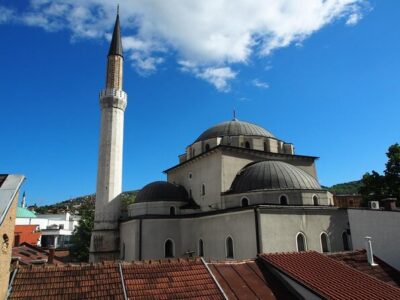
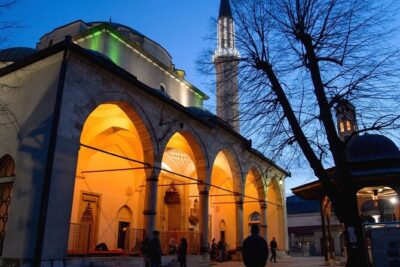
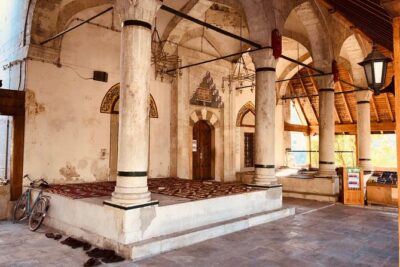
The Gazi Husrev-beg Madrasa introduces one of the central Ottoman-era areas. The nearby Gazi Husrev-Beg Mosque and Bezistan Bazaar offer a more intimate view of Sarajevo’s older commercial and religious center.
This is where the route feels most connected to the city’s Ottoman foundations. Streets become tighter, and the experience shifts toward courtyards, shops, religious buildings, and long-standing urban patterns. The guide can explain how the madrasa, mosque, and bazaar fit together rather than treating them as separate photo stops.
The Bezistan Bazaar is especially useful for understanding trade. It is not merely a place to walk through on the way to something else. Its presence shows how commerce shaped the center and why this part of Sarajevo still feels different from the wider streets near Hotel Europe.
The tour information allows for help booking tickets for desired visits. That is useful if you want to enter selected sites, though tickets, food, and drinks are not included in the tour price. Ask the guide what can realistically fit into the two-hour schedule.
The Clock Tower, Jewel Street, and the Princip story
The Clock Tower and Jewel Street continue the old-city section. These places carry a sense of continuity, with the tower serving as a familiar marker and the jewelry area reflecting Sarajevo’s long connection with craft and trade.
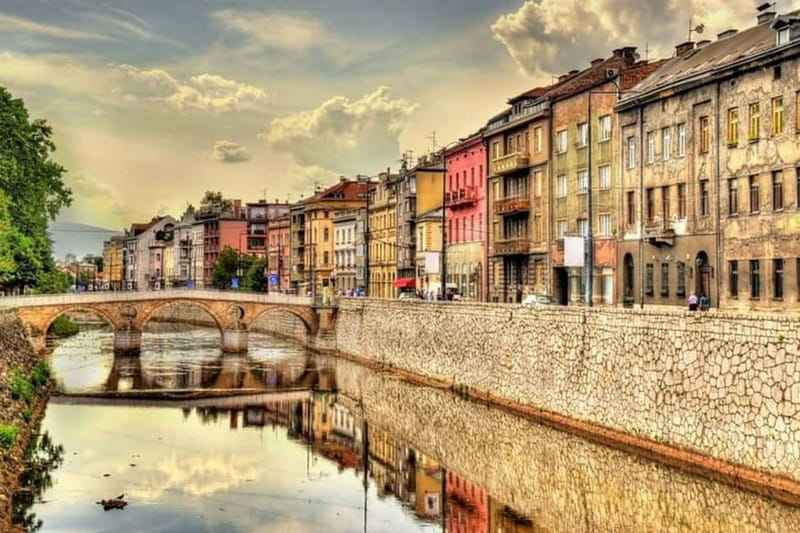
The route then turns to the Mausoleum of Princip Gavrilo near the Latin Bridge. This is one of the most historically charged points in Sarajevo. The assassination associated with this location helped set off the chain of events that began World War I.
A guide is valuable here because the story can become too simple. The Latin Bridge is often presented as a single dramatic moment, but the wider political situation was far more complicated. The tour gives you a place and a starting point for understanding that larger story.
The provided stop information also names Saint Mark Cemetery. Since this is part of the stated route, ask your guide how it fits with the day’s sequence and what part of the cemetery’s history will be covered. With a short tour, the explanation may be brief, but it adds another layer to Sarajevo’s religious and political past.
Sarajevo City Hall and the Yellow Bastion
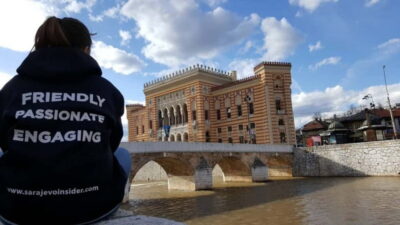
Sarajevo City Hall is one of the city’s major architectural sights. Its appearance gives you another sharp change from the Ottoman center, and it helps show how Sarajevo developed under Austro-Hungarian rule.
The guide includes a visit and explanation, which is important because the building’s value is not only visual. Its place in Sarajevo’s civic life gives you a clearer sense of how the city changed over time. If you have a particular interest in the building, mention it when the tour begins.
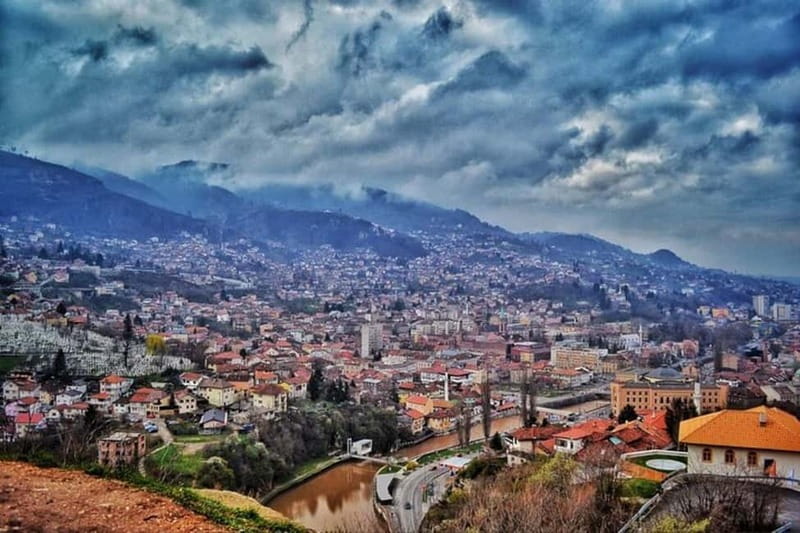
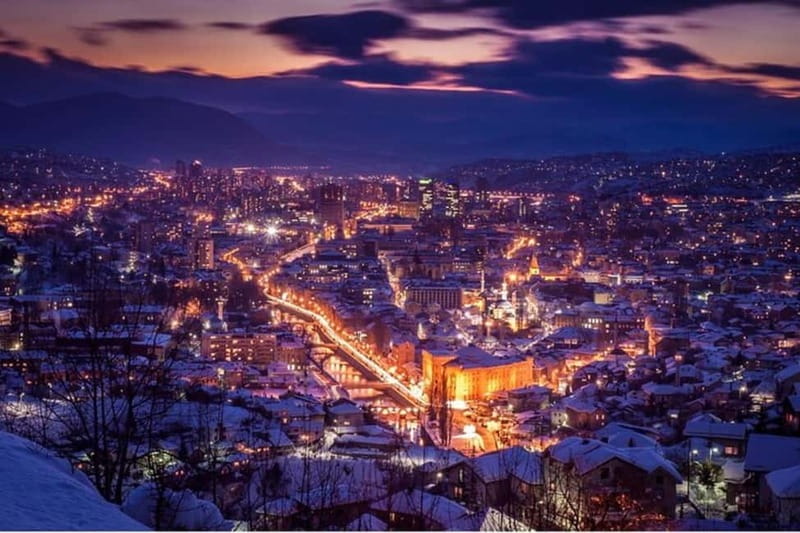
The Yellow Bastion provides one of the route’s best chances to look across Sarajevo. From here, the city’s setting becomes easier to understand, and the tight old center can be viewed as part of a much larger urban area.
This stop may be the most physically demanding part for some people because the route reaches a higher viewpoint. The experience is listed as wheelchair accessible, but you should still confirm the exact route and access needs with the provider before booking. The guide can also advise on the pace.
The viewpoint is a good reason to keep the camera ready, but do not let it become only a photo stop. Ask the guide to point out the parts of the city connected to the places you have already visited. That turns the view into a useful recap.
Sebilj and Pijaca Markale
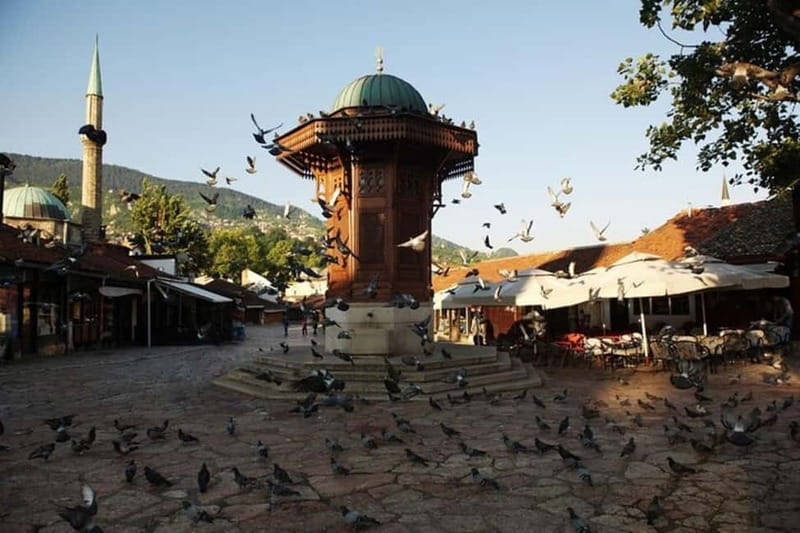
Sebilj, the famous fountain in the old bazaar area, brings the tour back toward one of Sarajevo’s best-known public spaces. It is a natural point for photographs, but it also works as a meeting place between the old market streets and the wider center.
Nearby Pijaca Markale, including the Yellow Market and the Largest Rose of Sarajevo, gives the route a more serious tone. The market is part of everyday city life, while the rose-shaped memorial marks the city’s wartime suffering.
This combination is powerful because it places ordinary commerce beside remembrance. You can move from market activity to a memorial connected with the siege of Sarajevo, seeing how the city carries daily life and painful memory in the same neighborhood.
The route description also includes the Jewish Museum of Bosnia and Herzegovina in Jewish Park and the Sephardi synagogue as part of the broader experience. The listed sequence ends back at Vladislava Skarića 5 after Sebilj, so I would ask the provider before booking if the Jewish Museum and synagogue are included in your exact two-hour route or are available as a customized addition.
That question matters. Sarajevo’s Jewish heritage is an important part of the city’s story, but the number of stops described is ambitious. A private tour lets you set priorities, yet you may need to choose between depth at several sites and a quick look at all of them.
What $82 buys you
At $82 per person, this is not a bargain walking tour. The price makes more sense if you value a private guide who can shape the experience around your interests.
You are paying for an exclusive group, English-language guidance, route customization, and help booking tickets for visits you want to make. Public transport and walking are included, except where a selected option says otherwise. Food and drinks are not included.
For a couple or family, the cost may feel reasonable because you are not sharing the guide’s attention. You can ask about Sarajevo’s religious communities, the World War I connection, wartime memorials, or practical city advice without competing with a large group.
For a solo visitor, $82 is a larger spend. I would book it if you want a personal introduction and plan to use the guide’s advice for the rest of your stay. If you prefer to walk independently and read up beforehand, the value is less clear.
The tour received a five out of five rating from two bookings. That is encouraging, but it is also a small sample. One verified booking from Monica in the United States specifically praised Enes as informative, funny, and kind. Those qualities matter on a history-heavy walk, since a warm guide can keep serious subjects approachable.
How to get the best two hours
Tell the guide your priorities at the beginning. The route covers religious architecture, Ottoman commerce, World War I, Yugoslav history, wartime memory, Jewish heritage, and city views. You cannot give every topic equal time in two hours.
If this is your first visit, I would ask for a balanced overview with extra time at the Yellow Bastion, Latin Bridge, and the Ottoman center. If you have already seen the main sights, use the private format to focus on Jewish history, Sarajevo’s religious communities, or local suggestions for the rest of your stay.
Start with comfortable walking shoes. Even though the activity is listed as wheelchair accessible, the old center and elevated viewpoint deserve a practical conversation about access before you arrive.
I would also schedule this tour early in your Sarajevo visit. The guide’s advice about other things to do is more useful when you still have time to follow it. You can return to the bazaar, market, museum, or religious sites that caught your attention.
Free cancellation up to 24 hours before the tour and the option to reserve now and pay later make planning easier. Starting times vary, so you need to check availability for your date.
Who should book this Sarajevo walk?
I think this tour suits you best if you want a private introduction with a flexible focus. It works well for couples, families, and small groups who prefer questions and conversation over a fixed script.
It is also a good fit if you want Sarajevo’s story presented as one connected account. The route moves from Ottoman streets to Christian cathedrals, public memorials, Austro-Hungarian architecture, Jewish heritage, and viewpoints over the city.
You may want something else if you prefer long museum visits, extensive time inside every religious building, or a slow photography walk. The two-hour schedule is full, and some places may receive only a short explanation.
Should you book it?
Book this tour if personal attention matters to you and $82 per person fits your budget. The route gives you a useful first look at Sarajevo’s many communities and historical periods, while the private format lets you ask for practical advice and adjust the emphasis.
I would not book it expecting a complete study of every landmark. Choose your top two or three interests before meeting the guide, and ask how the Jewish Museum, Sephardi synagogue, cemetery, and interior visits fit into the exact plan. With that preparation, this can be a focused and worthwhile start to Sarajevo.
FAQ
Where does the tour begin?
Meet your English-speaking guide in front of Hotel Europe at Vladislava Skarića 5 in Sarajevo.
How long does the tour last?
The walking tour lasts two hours.
Is this a private tour?
Yes. The tour is for a private group, and no one else will be added to your group.
Can the tour be customized?
Yes. The experience includes customization, so you can discuss which interests and visits matter most to you.
What language does the guide speak?
The live tour guide speaks English.
Are food, drinks, and tickets included?
Food and drinks are not included. The team can help you book tickets for desired visits, but ticket arrangements should be discussed with the provider.
Newest around Sarajevo
- Understanding Srebrenica Genocide + Lunch with Local Family★ 4.9 · 14 reviews
- Private Full Day Safari Tour★ 5.0 · 8 reviews
- Sarajevo: Trebević Mountain Summit Hiking Tour★ 4.2 · 2 reviews
- From Sarajevo: Kozice Waterfalls Hiking Experience in Nature★ 5.0 · 2 reviews
- Sarajevo Under Siege: A War History Tour★ 5.0 · 10 reviews
- Mysterious Visoko Pyramids Driving and Walking Tour★ 5.0 · 7 reviews
- WAR TUNNEL – Sarajevo’s only way of a communication during the WAR – Top secret★ 5.0 · 12 reviews
- Ultimate Gastro Experience★ 4.5 · 14 reviews
Walking Tours, compared.
Private Walking Tour, Food Tasting and Bosnian Coffee in Sarajevo
Read our review →
Browse the lists this tour appears in