
Review · WALKING TOURS
Sarajevo Grand Walking Tour
Sarajevo reveals its secrets on foot. This three-hour walk links the Latin Bridge, Ottoman mosques, churches, markets, and wartime memorials into one clear story of a city shaped by many peoples. I like the wide historical range, from the Ottoman era to Yugoslavia and the 1992 to 1995 war, and I like the personal touch many guides bring to difficult subjects. The main drawback is simple: you cover a lot of ground, and some stops receive only a few minutes.
I would book this early in your stay. Guides such as Ilma, Hana, Suad, Emina, Denis, Haris, Alem, Kenan, Fariz, Masha, and Elvis have been praised for making complex events easy to follow, answering questions, and sharing useful food and coffee tips. The group can reach up to 30 people, so your experience may feel lively or less personal, depending on the day.
In This Review
- Key points about the Sarajevo Grand Walking Tour
- Why this is a smart first look at Sarajevo
- From the Latin Bridge to At Mejdan Park
- Churches, the brewery, and Sarajevo’s stubborn spirit
- Kovači Cemetery and the difficult memory of war
- Baščaršija, metalwork, and the best-known fountain
- Gazi Husrev Bey’s Mosque and the city’s meeting point
- The cathedral district and Markale Market
- Ending at the Eternal Flame
- Price, group size, and walking effort
- Who should book the Sarajevo Grand Walking Tour?
- FAQ
- How long is the Sarajevo Grand Walking Tour?
- What language is the tour offered in?
- How much does the tour cost?
- Where does the tour begin?
- Where does the tour end?
- What is included in the tour?
- Is lunch included?
- Are coffee and tea included?
- How large can the group be?
- Can I cancel for a full refund?
Key points about the Sarajevo Grand Walking Tour
- One walk covers Sarajevo’s main historical layers: Ottoman, Austro-Hungarian, Jewish, Catholic, Orthodox, Yugoslav, and modern Bosnian life all appear along the route.
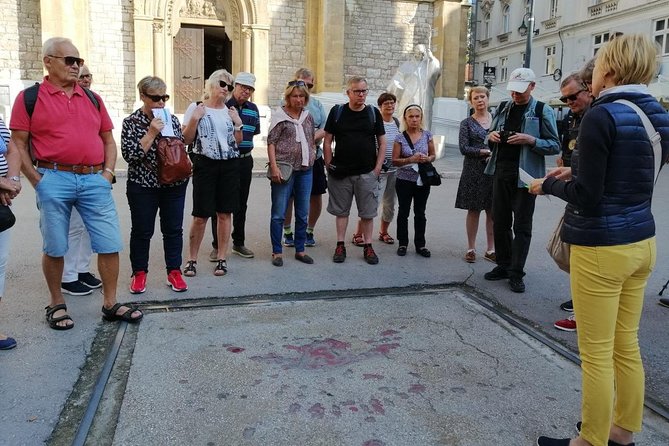
- The Latin Bridge opens with a world-changing event: You visit the site linked to the assassination of Archduke Franz Ferdinand, the spark that helped set World War I in motion.
- The Old Town section is the tour’s heart: Baščaršija, Kazandžiluk Street, Sebilj Fountain, Morića Han, and Gazi Husrev Bey’s Mosque give you Sarajevo at its most atmospheric.
- The guide matters greatly: Strong guides have used personal stories, humor, and clear explanations to make dates and political events easier to understand.
- It is good value at $20.57: For about three hours, you receive a guide and city map while seeing many major sights without separate entrance charges listed for the stops.
- Plan for a real walk: The route is described as easy and mostly flat, but the number of stops and three-hour duration call for comfortable shoes and weather-ready clothing.
Why this is a smart first look at Sarajevo
Sarajevo is not a city you understand by seeing one landmark. Its character comes from the way different faiths, empires, and political systems occupy the same few streets. This tour gives you that basic map, both in geography and in time.
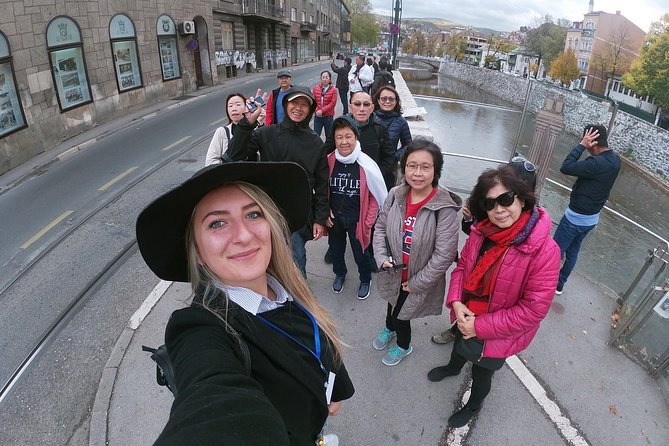
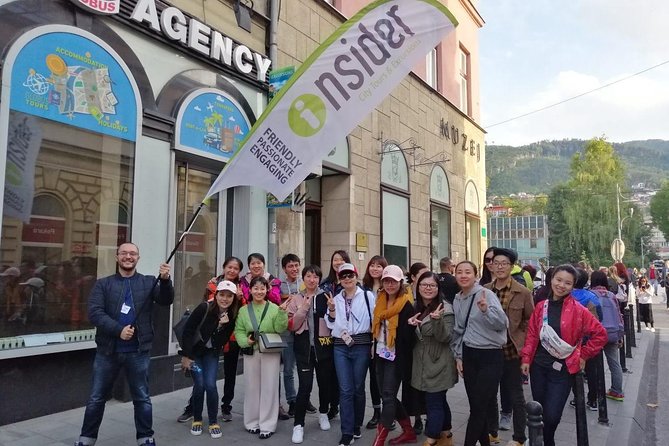
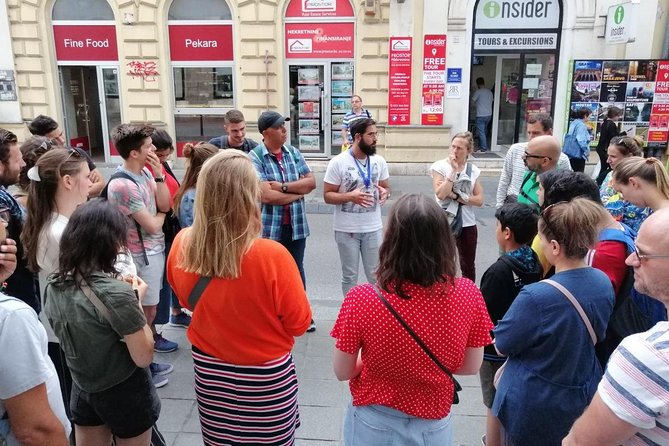
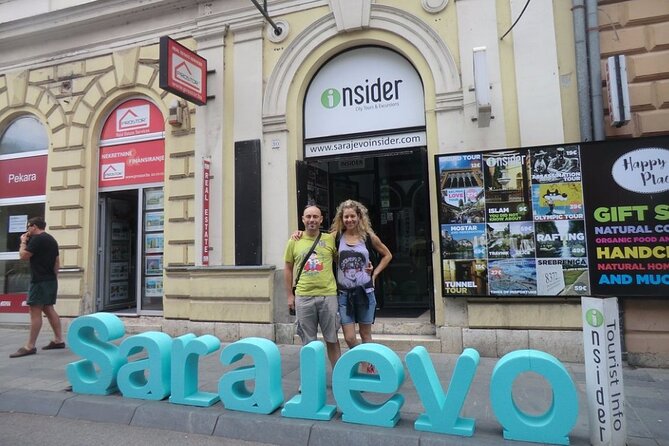
You begin near Zelenih beretki 30, at the Sarajevo Insider office, and return to the same meeting point. That makes the tour easy to fit into a first full day, especially if you want a useful orientation before setting off on your own.
The route moves through the city center on foot. You are not simply checking off monuments. You are learning why an Ottoman mosque can sit close to a Catholic church, a synagogue, and an Orthodox cathedral. That mix is one of Sarajevo’s defining qualities.
The tour is offered in English, with several departure options. Confirmation arrives when you book, and free cancellation is available until 24 hours before the start time. Bad weather or an unmet minimum group size can lead to a new date or a full refund.
More Walking Tours in Sarajevo
- Sarajevo: Grand Walking Tour Through Time and Cultures
★ 4.8 · 1,236 reviews - Sarajevo: 2 Hours Old Town Walking Tour With Local Guide
★ 5.0 · 505 reviews - Private Walking Tour, Food Tasting and Bosnian Coffee in Sarajevo
★ 5.0 · 255 reviews
From the Latin Bridge to At Mejdan Park
The Latin Bridge is a powerful place to begin. Here, you hear about the assassination of Archduke Franz Ferdinand, an event tied to the outbreak of World War I. The stop lasts about 12 minutes, enough time for the guide to explain the event without turning the introduction into a long lecture.
This is also where a good guide can show you how Sarajevo’s local story connects to world events. The strongest tours do not treat the assassination as an isolated fact. They explain its place in the political tensions of the period and set up the larger story of Sarajevo as a meeting point between empires and peoples.
A short pause at At Mejdan Park follows. The park sits by the Miljacka River and offers a quieter view of the city. The stop is listed at only three minutes, so expect a quick piece of context rather than time to sit and relax.
You then reach the Emperor’s Mosque, described as Sarajevo’s oldest mosque. The scheduled visit is brief, about two minutes, but it introduces the Ottoman foundation of the city and gives your guide a chance to explain Islamic heritage in Bosnia and Herzegovina.
One useful strength of the tour is its attention to faith and daily life. A guide such as Merjim has been praised for explaining Muslim practice in a way that helped a visitor understand a tradition they had not encountered clearly before. That kind of conversation can be more useful than a list of architectural dates.
Churches, the brewery, and Sarajevo’s stubborn spirit
The Franciscan Church of Saint Anthony adds a Catholic chapter to the route. Its neo-Gothic design makes a sharp visual contrast with the Ottoman buildings nearby. The stop lasts about two minutes, so you will mainly receive an exterior explanation unless your guide adjusts the pace.
Next comes the Sarajevo Brewery, one of Bosnia’s oldest industrial complexes. The tour connects the brewery with traditional beer production and the city’s industrial development. Again, the planned stop is short, but it helps prevent the tour from becoming only a parade of religious buildings.
The route also includes the Bosnian House Bicakcic-Hadzisabanovic, described as a modernist architectural site with links to Sarajevo’s past. The schedule does not give this stop a timed visit, so treat it as a passing point or a brief explanation rather than a full interior tour.
Then comes the House of Spite, one of Sarajevo’s most memorable stories. The building was rebuilt brick by brick after its owner refused to surrender the site for the construction of City Hall. The story captures something important about Sarajevo: history here is often told through personality, pride, and stubborn humor, not only through rulers and wars.
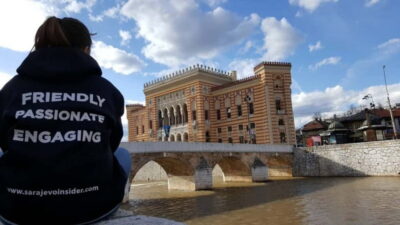
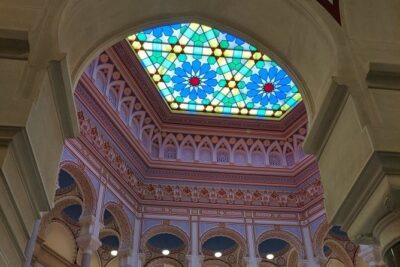
City Hall receives about 10 minutes, making it one of the more substantial stops. This neo-Moorish building reflects the Austro-Hungarian period and the government’s attempt to create an architectural style that blended European and Islamic references. It is an excellent place to see how Sarajevo’s appearance changed after Ottoman rule.
Kovači Cemetery and the difficult memory of war
The walk continues through Kovači Cemetery, a national memorial honoring Bosnia’s defenders from the 1992 to 1995 war. The scheduled stop is about three minutes, but the subject carries far more weight than the clock suggests.
A guide’s personal experience can make this part especially affecting. One guide was praised for being old enough to remember the war and for presenting Sarajevo’s recent past with both honesty and hope for the country’s future. Another guide shared family perspectives connected to the conflict.
You should not expect a full war-history tour here. The Grand Walking Tour gives you context, key sites, and a starting point for further visits. If the war period is your main reason for coming to Sarajevo, you may want to add a dedicated Tunnel of Hope or war-focused tour separately. This city walk gives that subject space, but it also covers several centuries before and after it.
Kovači Street brings you back into everyday city life. Its Ottoman-era feel and local shops show how history remains part of the working city rather than something sealed away in a museum.
Same corner of the country, a different kind of day:
- Sarajevo: Mostar, Konjic, Blagaj Tekke, Pocitelj & Waterfall
★ 4.9 · 1,666 reviews - Fall of Yugoslavia, Sarajevo War Tour with Tunnel of Hope Museum and Frontlines
★ 5.0 · 1,314 reviews - Sarajevo: Mostar, Konjic, Sufi House, Pocitelj & Kravice Falls
★ 5.0 · 1,179 reviews - Sarajevo: Tunnel Museum Yugoslavia War Tour with War Veteran
★ 5.0 · 1,111 reviews
Baščaršija, metalwork, and the best-known fountain
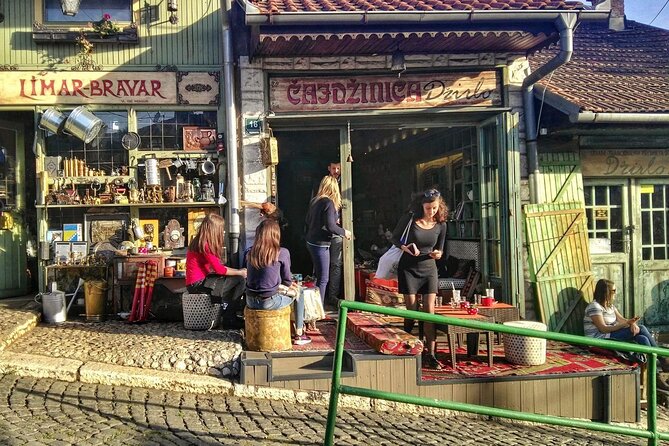
Baščaršija is the center of the Old Town and one of the longest stops, at about 15 minutes. Here, your guide helps you read the layout of Sarajevo’s old marketplace, with its narrow streets, small businesses, and traditional craft traditions.
Kazandžiluk and Bravadžiluk Streets add texture to the walk. Kazandžiluk is associated with copper and metalwork, while Bravadžiluk is tied to food. You spend around 10 minutes in this area, which gives you enough time to notice the crafts and make a mental note of where you may want to return later.
The Sebilj Fountain is a classic Sarajevo photo stop. The tour explains the local belief that anyone who drinks its water will return to Sarajevo. You are also given time to take in the square and watch the movement around this famous meeting point.
Morića Han, the last Ottoman inn in Sarajevo, offers another look at the old trading city. The five-minute stop is short, yet the site helps you picture merchants, travelers, and goods moving through Sarajevo during the Ottoman period.
This part of the tour is where practical food advice can pay off. Guides have recommended places for cevapi, coffee, and other local dishes, and several visitors found those suggestions useful during the rest of their stay. Ask questions while you are here, since the guide may point out places you would otherwise pass without noticing.
Gazi Husrev Bey’s Mosque and the city’s meeting point
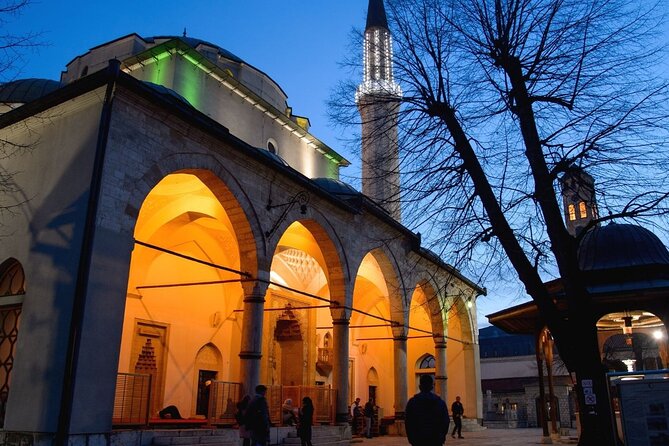
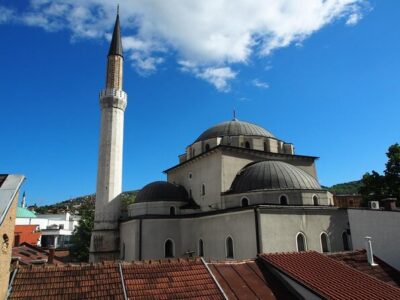
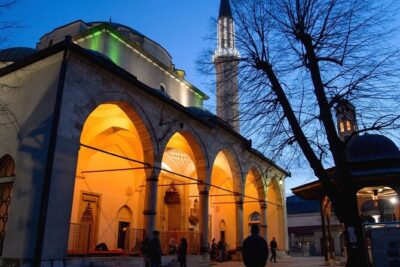
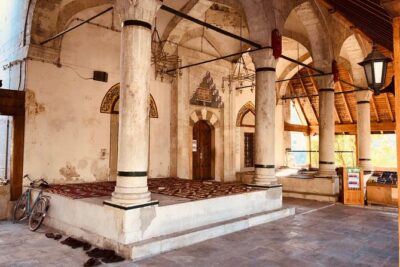
Gazi Husrev Bey’s Mosque is one of the major stops, with about 10 minutes planned. Built in the 16th century, it is one of the clearest expressions of Ottoman Sarajevo. Your guide can explain its religious role, design, and place in the wider life of the Old Town.
Please remember that a mosque is an active place of worship. Dress and behavior should be respectful, and the exact access may depend on conditions at the time. The tour information lists the stop, but it does not promise a full interior visit.
The Sarajevo Meeting of Cultures is a small marker with a big idea. It identifies the point where the Ottoman-style Old Town gives way to the Austro-Hungarian center. In just a few steps, the street scene changes, making this one of the best places to understand Sarajevo’s East and West contrast.
The Museum of the Jews of Bosnia and Herzegovina, located in the Old Jewish Temple, brings Sephardic Jewish history into the story. The stop also refers to the Sarajevo Haggadah, a famous and valuable manuscript connected with the city’s Jewish community.
You spend about five minutes here. That is enough for an introduction, not a full museum visit. If the Haggadah or Jewish Sarajevo interests you, plan a separate museum visit when you have more time.
The cathedral district and Markale Market
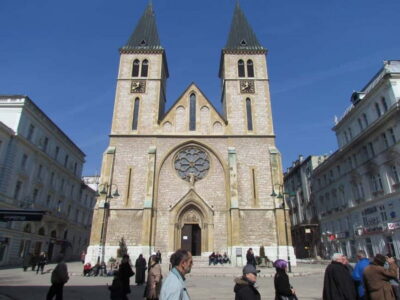
The Cathedral of the Sacred Heart is Sarajevo’s major Catholic cathedral and is often compared with Notre Dame because of its scale and appearance. The five-minute stop gives you a chance to see how Catholic life fits into the city’s wider religious pattern.
The Serbian Orthodox Cathedral follows with another five-minute visit. Its domes and interior murals add a very different artistic style. Together, these two churches and the nearby mosques and synagogue make the religious diversity of central Sarajevo unusually easy to see.
The tour does not pretend that this history is always peaceful or simple. Sarajevo’s different communities have shared streets, culture, and commerce, but they have also endured severe conflict. A good guide helps you hold both facts at once, without reducing the city to either a cheerful postcard or a war memorial.
At Markale City Market, you get a more ordinary view of Sarajevo. The market is a place for local food and daily trade, but it also carries painful wartime memory because of attacks during the 1990s conflict. The five-minute stop is brief, yet the market connects major political events with the lives of ordinary people.
Ending at the Eternal Flame
The final stop is the Eternal Flame, a World War II memorial that honors remembrance and survival. It is a fitting ending because the tour has moved through several periods of outside rule, conflict, and rebuilding.
By this point, you have seen Sarajevo’s central historical arc: Ottoman foundations, Austro-Hungarian change, religious pluralism, Jewish heritage, Yugoslav and wartime legacies, and modern Bosnian identity. You will not master every detail in three hours, but you should leave with a much better sense of how the pieces fit.
The route’s pace is one of its strengths. Several stops last only two to five minutes, while major places such as the Latin Bridge, City Hall, Baščaršija, and Gazi Husrev Bey’s Mosque receive more attention. That keeps the walk moving, though anyone hoping for long interior visits may find it too quick.
Price, group size, and walking effort
At $20.57 per person, this is a strong-value introduction to Sarajevo. You receive an English-speaking guide and a city map, and the route takes in a large number of major sights. Lunch, coffee, tea, entrance charges, and taxes are not included, so budget separately for anything you choose to visit or consume afterward.
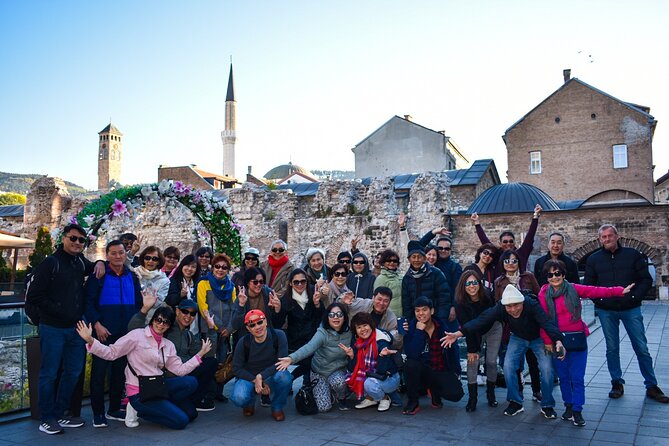
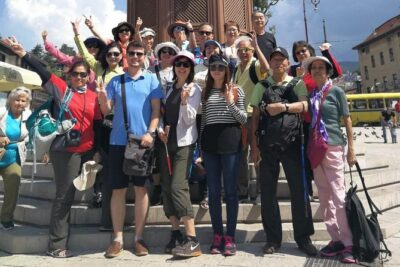
The maximum group size is 30. That is not a tiny private walk, and hearing every explanation may be harder in a large group, particularly on busy streets. On quieter dates, the group may be much smaller, even down to one or two people. A private upgrade is available if you want more control over timing and questions.
Private tours may suit families, photographers, or anyone with a specific interest in Ottoman architecture, Jewish heritage, religious history, or the 1990s war. A small public group should work well if you mainly want orientation and a clear story at a low price.
The walk is described as easy and mostly flat, but three hours on city streets still calls for comfortable shoes. Bring a warm layer or rain protection. One guide specifically advised dressing warmly, and another adapted the route when rain arrived near the end.
Who should book the Sarajevo Grand Walking Tour?
You should book it if this is your first time in Sarajevo and you want the city explained rather than simply photographed. It suits curious adults, couples, families with older children, and anyone who likes history tied to real streets and buildings.
I would especially recommend it for people who want more than a narrow focus on the 1992 to 1995 war. The tour covers the Ottomans, Austria-Hungary, Yugoslavia, religion, trade, World War I, World War II, and modern Bosnia. That breadth is its biggest strength.
You may want another option if you dislike group walks, need long stops at each monument, or want a tour devoted only to the siege and war years. For most visitors, though, the blend of history, architecture, personal stories, and practical advice makes this an economical way to get your bearings.
The published score is 4.9 from 232 ratings, with 98 percent recommending it. The strongest praise centers on the guides’ clear storytelling, personal insight, flexibility, and food recommendations. One less positive experience found the guide too mechanical during a solo booking, a useful reminder that the human element can vary.
FAQ
How long is the Sarajevo Grand Walking Tour?
The tour lasts approximately three hours.
What language is the tour offered in?
The tour is offered in English.
How much does the tour cost?
The listed price is $20.57 per person.
Where does the tour begin?
It begins at Sarajevo Insider, City Tours and Excursions, at Zelenih beretki 30, Sarajevo 71000, Bosnia and Herzegovina.
Where does the tour end?
The walk ends back at the meeting point.
What is included in the tour?
A guide and a city map are included.
Is lunch included?
No. Lunch is not included.
Are coffee and tea included?
No. Coffee and tea are not included.
How large can the group be?
The maximum group size is 30 people.
Can I cancel for a full refund?
Yes. You can cancel at least 24 hours before the start time for a full refund. Cancellations or changes made less than 24 hours before the start are not accepted for a refund. The tour may also be moved or refunded if poor weather or an unmet minimum group size causes cancellation.
Newest around Sarajevo
- Understanding Srebrenica Genocide + Lunch with Local Family★ 4.9 · 14 reviews
- Private Full Day Safari Tour★ 5.0 · 8 reviews
- Sarajevo: Trebević Mountain Summit Hiking Tour★ 4.2 · 2 reviews
- From Sarajevo: Kozice Waterfalls Hiking Experience in Nature★ 5.0 · 2 reviews
- Sarajevo Under Siege: A War History Tour★ 5.0 · 10 reviews
- WAR TUNNEL – Sarajevo’s only way of a communication during the WAR – Top secret★ 5.0 · 12 reviews
- Mysterious Visoko Pyramids Driving and Walking Tour★ 5.0 · 7 reviews
- Ultimate Gastro Experience★ 4.5 · 14 reviews
Walking Tours, compared.
Private Walking Tour, Food Tasting and Bosnian Coffee in Sarajevo
Read our review →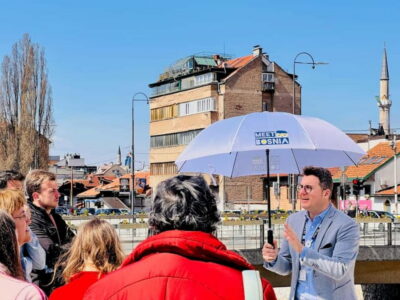
Browse the lists this tour appears in