
Review · WALKING TOURS
Discover Sarajevo Walking Tour with Local Guide
Sarajevo reveals its story one street at a time. This two-hour walk brings you from the Ottoman lanes of Baščaršija to Austro-Hungarian monuments, with stops at mosques, churches, a synagogue, the Latin Bridge, and the famous Meeting of Cultures marker. I like the low $12.07 price and the chance to see Sarajevo’s many faiths and empires in one compact route. I also like that the tour includes a certified English-speaking guide and bottled water.
The main tradeoff is pace. The schedule allows about ten minutes at most stops, so you get a clear introduction rather than a long visit inside each building. Several sites also list admission as not included, and you need a moderate level of fitness for two hours on city streets.
In This Review
- Six Things That Make This Sarajevo Walk Worth Your Time
- Starting on Ferhadija Street
- Gazi Husrev-beg Mosque and Sarajevo’s Ottoman Core
- Sebilj, Pigeons, and the Coppersmith Street
- Sarajevo City Hall and the Austro-Hungarian Turn
- The Latin Bridge and the Event That Changed Europe
- The Bezistan, Churches, and a City of Many Faiths
- Meeting of Cultures, Where the Route Comes Together
- What the $12.07 Price Really Buys You
- The Guides Make the Difference
- Who Should Book This Walking Tour?
- My Verdict on the Sarajevo Walking Tour
- FAQ
- Where does the Sarajevo walking tour start?
- Where does the tour end?
- How long does the tour last?
- What language is the tour offered in?
- What is included in the price?
- Are food and drinks included?
- Are entrance fees included?
- How many people can join the tour?
Six Things That Make This Sarajevo Walk Worth Your Time
- A remarkable mix of cultures: The route covers Ottoman, Austro-Hungarian, Orthodox, Catholic, and Jewish landmarks.
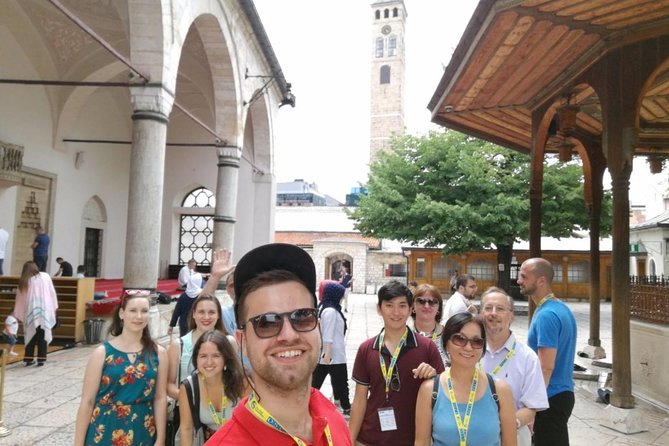
- A strong local element: Guides such as Samira, Enes, Layla, and Senka have been praised for personal stories, local ties, humor, and clear English.
- The Latin Bridge story: You learn how the assassination of Archduke Franz Ferdinand and Sophie changed world history.
- A useful first look at Baščaršija: Sebilj Fountain, Kazandžiluk, Morica Han, and the covered bazaar make the old market district easier to understand.
- A compact two-hour format: It fits well on a first day in Sarajevo, before you explore individual sites at your own pace.
- A small-group setting: The group can include up to 20 people, which is intimate enough for questions but not necessarily private.
Starting on Ferhadija Street
The walk begins at Info Bosnia Tourist Information Center, at Velika avlija Laure Papo Bahorete 2. The center sits on Ferhadija, Sarajevo’s main pedestrian street, right beside the Sarajevo Meeting of Cultures marker.
This is a smart place to start. You are close to the point where Sarajevo’s Western-style city center gives way to the Ottoman market quarter. The route then returns here at the end, so you do not need to learn a new pickup point or arrange transport back to your hotel.
The tour is offered in English, and confirmation arrives when you book. Since it is booked on average ten days ahead, I would reserve before your Sarajevo stay if your dates are fixed. The listed maximum is 20 people. That is still a manageable number, though you should not expect the feel of a private walk unless your group happens to be small.
More Walking Tours in Sarajevo
- Sarajevo: Grand Walking Tour Through Time and Cultures
★ 4.8 · 1,236 reviews - Sarajevo: 2 Hours Old Town Walking Tour With Local Guide
★ 5.0 · 505 reviews - Private Walking Tour, Food Tasting and Bosnian Coffee in Sarajevo
★ 5.0 · 255 reviews
Gazi Husrev-beg Mosque and Sarajevo’s Ottoman Core
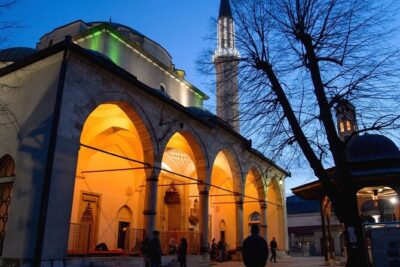
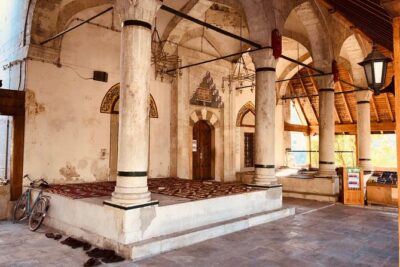
The first major stop is Gazi Husrev-beg Mosque, the largest historic mosque in Bosnia and Herzegovina. Built in 1530 and 1531 in an Early Istanbul style, it was the central building of Gazi Husrev-beg’s charitable foundation, known as a waqf.
Your guide points out the scale of the building, including its 23-meter dome and 45-meter minaret. One especially unusual detail is that it was the first mosque in the world to be illuminated by electricity. That small fact helps connect the building’s old Ottoman setting with Sarajevo’s later role as a city open to new technology.
You have about ten minutes here. Admission is not included, so do not assume the walk provides entry to the mosque. The short stop is best for orientation and exterior details. If you want to study the interior, check the opening rules and return later.
Next comes Morica Han, Sarajevo’s only surviving caravanserai. Built in 1551, it once offered rooms for up to 300 people and space for 70 horses. This was a working roadside inn for merchants and their animals, not a quiet boutique hotel in the modern sense.
The building burned in 1957 and was restored between 1971 and 1974. That history matters because the courtyard you see today is both an old Ottoman commercial space and a reconstruction. Admission is free, and ten minutes is enough to take in the shape of the courtyard and understand how trade worked in Sarajevo.
Sebilj, Pigeons, and the Coppersmith Street
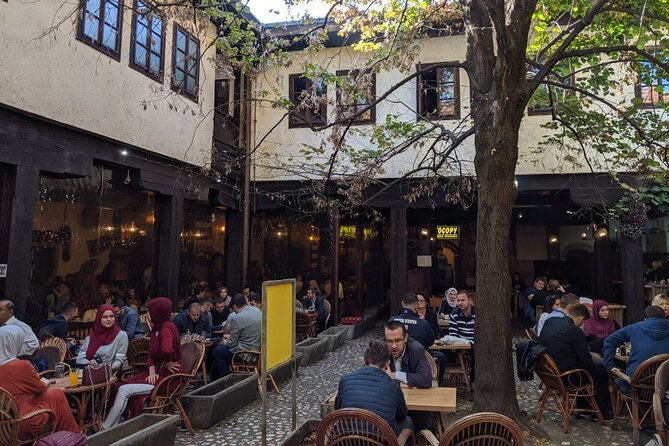
Sebilj Fountain gives you one of Sarajevo’s most familiar scenes. The Neo-Ottoman fountain, made of stone and wood, sits at the center of Baščaršija, in a square often called the Square of Pigeons.
The first Sebilj was built by Mehmed Pasha Kukavica in 1753. The fountain was later moved, and the present location dates from a relocation by Austrian architect Alexander Wittek in 1891. That mix of Ottoman design and Austro-Hungarian-era planning is typical of Sarajevo. Even a fountain can show the city’s layered past.
The stop is free and lasts about ten minutes. It is a good place to pause for photographs, but the real value comes from the explanation of how the square fits into the old market district. Keep an eye on your belongings around the pigeons and crowds, and do not linger so long that you lose the group.
From Sebilj, the route continues down Kazandžiluk, Sarajevo’s famous coppersmith street. The name refers to the old craft of making copperware. You may find the street more interesting when your guide explains the work behind the displays, rather than treating it as just a shopping lane.
This is one of the stops where the tour’s local voice matters. Samira has been praised for knowing people along the old town streets and for explaining the community around them. That kind of connection can give the market quarter a more human feel than a list of dates and building names.
Sarajevo City Hall and the Austro-Hungarian Turn
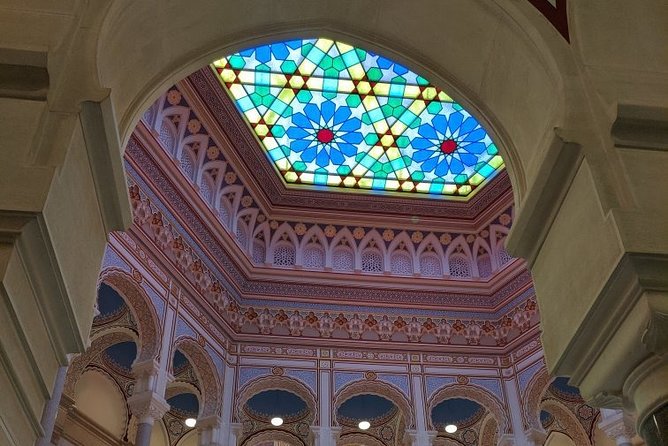
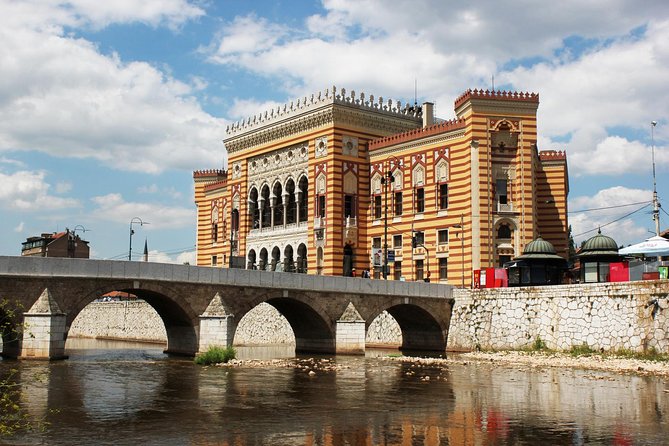
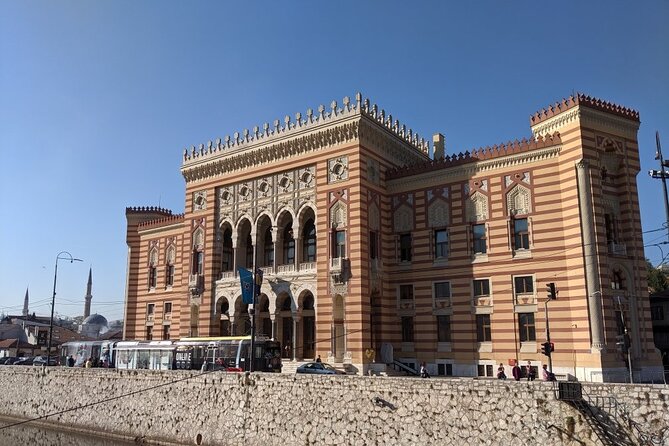
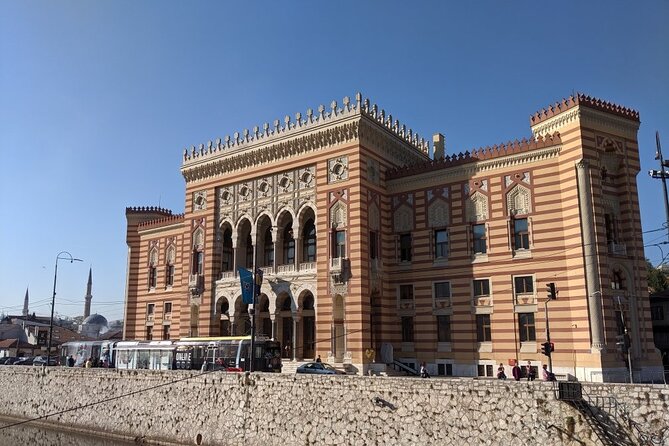
Sarajevo City Hall, known as Vijećnica, is the most imposing Austro-Hungarian building on the route. Completed in 1896, it uses Neo-Moorish architecture inspired by Islamic art in Spain and North Africa.
The building helps you see how the Austro-Hungarian period tried to create a distinct visual identity in Sarajevo. It is European in its civic purpose, but its decorative language looks toward the Islamic world. That contrast is one reason the city center feels so different from one block to the next.
Admission is not included, so the walk focuses on the outside and the historical explanation. You get about ten minutes. If the building interests you, note it as a possible return visit rather than expecting a full interior tour during this experience.
The route then reaches the Emperor’s Mosque, the first mosque built in Sarajevo by Isa-bey. This stop brings you back to the city’s earlier Ottoman foundations. Admission is listed as free, and the visit lasts about ten minutes.
The value here is comparison. After seeing City Hall, you can look at the Emperor’s Mosque with a clearer sense of the different periods that shaped Sarajevo. The tour does not treat Ottoman and Austro-Hungarian Sarajevo as separate cities. It shows how they occupy the same streets.
Same corner of the country, a different kind of day:
- Sarajevo: Mostar, Konjic, Blagaj Tekke, Pocitelj & Waterfall
★ 4.9 · 1,666 reviews - Fall of Yugoslavia, Sarajevo War Tour with Tunnel of Hope Museum and Frontlines
★ 5.0 · 1,314 reviews - Sarajevo: Mostar, Konjic, Sufi House, Pocitelj & Kravice Falls
★ 5.0 · 1,179 reviews - Sarajevo: Tunnel Museum Yugoslavia War Tour with War Veteran
★ 5.0 · 1,111 reviews
The Latin Bridge and the Event That Changed Europe
At the Latin Bridge, the guide discusses the assassination of Archduke Franz Ferdinand and Sophie. The location beside the bridge is tied to an event that changed the course of world history.
This is likely the most important historical explanation on the walk, but it is also a place where context matters. The stop is not just about identifying a corner and repeating a famous date. A good guide helps you place the event within Sarajevo’s political and cultural setting.
Enes Popara has been praised for his storytelling, humor, and excellent English, and this is the kind of stop where those skills can make a real difference. Two hours is a short time for Sarajevo’s complicated past, so a guide who can explain clearly without turning the talk into a lecture is a major benefit.
Admission is not included, and you have about ten minutes. The route keeps moving, so take note of the location if you want to return for a longer look or further reading.
The Bezistan, Churches, and a City of Many Faiths
Gazi-Husrev Beg’s Bezistan is a covered bazaar built during the same period as Tašlihan, a stone inn later destroyed during the Austro-Hungarian period. The Bezistan gives you another view of Sarajevo as a trade center, where covered shopping spaces and inns supported merchants passing through the city.
Admission is free. The stop helps connect the grand religious buildings with everyday commerce. Sarajevo’s story is not only about rulers and battles. It is also about markets, crafts, lodging, and the people who used these spaces.
The Serbian Orthodox Cathedral, officially the Congregational Church of the Holy Mother, is the largest Orthodox church in Sarajevo. Built during the Ottoman period, it adds another layer to the city’s religious mix.
Admission is not included, and the visit lasts about ten minutes. You should see this stop as part of the route’s larger purpose: Sarajevo is not represented by one faith or one architectural style. The walk places the Orthodox cathedral close to the mosque, Catholic cathedral, Jewish site, and Ottoman market quarter.
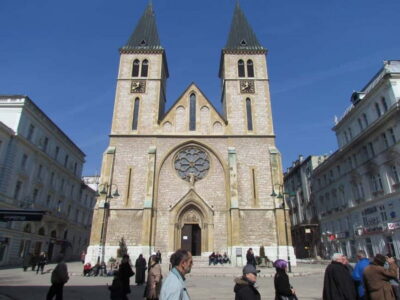
Katedrala Srca Isusova, the Cathedral of the Sacred Heart of Jesus, was one of the first major European-style buildings in Sarajevo. The stop is free and takes about ten minutes.
The cathedral gives you another useful comparison with City Hall. Its form reflects European Catholic design, while the surrounding city carries strong Ottoman and Balkan influences. I like this part of the walk because the architecture does not need much imagination. The changes in style are visible as you move through the center.
The Jewish Museum of Bosnia and Herzegovina occupies the old Jewish Temple, also known as the Sephardic Synagogue. It is described as the first and oldest synagogue built in Sarajevo.
Admission is not included, so you may only receive an exterior explanation during the tour. Still, its inclusion is important. The stop keeps Sarajevo’s Jewish past from being treated as a footnote, and it strengthens the tour’s central idea: several religious and cultural traditions meet within a compact urban area.
Meeting of Cultures, Where the Route Comes Together
The final stop is Sarajevo Meeting of Cultures, the marker beside the starting point. It identifies the point where East meets West, and it is one of the clearest places to understand Sarajevo’s visual character.
You have about five minutes here. That may sound brief, but by this point you have already walked from Ottoman courtyards and market streets to Austro-Hungarian civic buildings and European-style churches. The marker works as a simple final lesson after seeing the contrast in person.
The tour ends back at Info Bosnia Tourist Information Center. That makes the route easy to use as a first-day introduction. Afterward, you can return to the Baščaršija market, visit a building where admission was not included, or continue along Ferhadija without worrying about finding your way back to the start.
What the $12.07 Price Really Buys You
At $12.07 per person, this is inexpensive for a two-hour guided walk through Sarajevo’s central historic districts. The value is not in paid entry to attractions. It is in the guide’s explanations, route planning, and ability to link separate buildings into one story.
You receive a certified guide and a bottle of water. Food and other drinks are not included. Several stops list admission as not included, so budget a little extra if you decide to enter those sites later.
The strongest value comes when you use the walk as an introduction rather than your only sightseeing activity. You learn which places deserve a second visit, understand the basic timeline, and get practical advice from a local guide. Senka, for example, has been praised for explaining the city while offering useful advice about the area. That can save you time during the rest of your stay.
The Guides Make the Difference
The guide quality appears to be the central strength of this experience. Samira has been praised for her warmth, local connections, and ability to explain the old town community. Enes has been singled out for his humor, delivery, strong English, and pride in his native Sarajevo.
Layla has been praised for giving clear insight into the city’s past, while Senka has been noted for practical advice and explanations of Sarajevo’s cultural mix. You cannot choose a specific guide from the information provided, so the experience may vary in style. The consistent point is that the walk depends heavily on the person leading it.
That is not a flaw unique to this tour. Any city walk can feel flat with a guide who only recites facts. Here, the best reported qualities are personal storytelling, local knowledge, friendly conversation, and the ability to make a complex subject easy to follow.
Who Should Book This Walking Tour?
I would recommend it to first-time visitors, history-minded people, and anyone who wants a quick introduction before exploring alone. It also suits solo visitors who want company for their first look at the old town, as well as couples and small groups who prefer a guide to wandering without context.
The route is especially useful if you have only a short stay in Sarajevo. In two hours, you see the major central markers and learn where Ottoman, Austro-Hungarian, Orthodox, Catholic, and Jewish stories meet.
You should think twice if you want long interior visits, extensive shopping time, or a slow photographic walk. The itinerary gives roughly ten minutes to most stops, and a group of up to 20 people can make extended questions harder. Moderate physical fitness is required, and smart casual dress is requested, particularly because the route includes religious buildings.
Free cancellation is available when you cancel at least 24 hours before the local start time. Changes made inside that period are not accepted, and the experience requires a minimum number of participants. If that minimum is not met, you are offered another date or experience, or a full refund.
My Verdict on the Sarajevo Walking Tour
Book this tour if you want a friendly, low-cost way to get your bearings and understand Sarajevo’s unusual blend of cultures. The route is broad, the price is fair, and the best guides bring personal warmth to places that could otherwise feel like a string of monuments.
I would not book it as a substitute for visiting every interior or studying each site in detail. I would book it early in your stay, carry comfortable shoes, listen closely at the Latin Bridge, and mark the places you want to revisit. For $12.07, it gives you a useful framework for seeing Sarajevo with more sense of place.
FAQ
Where does the Sarajevo walking tour start?
It starts at Info Bosnia Tourist Information Center at Velika avlija Laure Papo Bahorete 2, on Ferhadija pedestrian street beside Sarajevo Meeting of Cultures.
Where does the tour end?
The activity ends back at the meeting point in front of Info Bosnia Tourist Information Center.
How long does the tour last?
The tour lasts approximately two hours.
What language is the tour offered in?
The tour is offered in English.
What is included in the price?
The price includes a certified guide and one bottle of water.
Are food and drinks included?
Food and drinks are not included unless specifically stated. The included bottle of water is provided as part of the tour.
Are entrance fees included?
Some stops list admission as not included, including Gazi Husrev-beg Mosque, Sarajevo City Hall, Latin Bridge, the Serbian Orthodox Cathedral, and the Jewish Museum of Bosnia and Herzegovina. Other listed stops are free.
How many people can join the tour?
The maximum group size is 20 people.
Newest around Sarajevo
- Understanding Srebrenica Genocide + Lunch with Local Family★ 4.9 · 14 reviews
- Private Full Day Safari Tour★ 5.0 · 8 reviews
- Sarajevo: Trebević Mountain Summit Hiking Tour★ 4.2 · 2 reviews
- From Sarajevo: Kozice Waterfalls Hiking Experience in Nature★ 5.0 · 2 reviews
- Sarajevo Under Siege: A War History Tour★ 5.0 · 10 reviews
- Mysterious Visoko Pyramids Driving and Walking Tour★ 5.0 · 7 reviews
- WAR TUNNEL – Sarajevo’s only way of a communication during the WAR – Top secret★ 5.0 · 12 reviews
- Ultimate Gastro Experience★ 4.5 · 14 reviews
Walking Tours, compared.
Private Walking Tour, Food Tasting and Bosnian Coffee in Sarajevo
Read our review →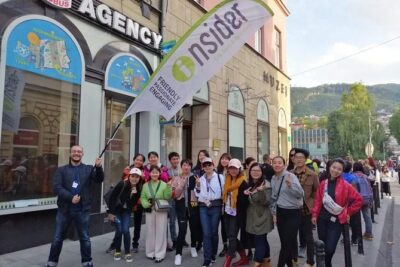
Browse the lists this tour appears in