
Review · WALKING TOURS
Inspiring Story of Sarajevo – Private Walking Tour
Sarajevo remembers out loud. This private walk links places where art, memory, and peace still shape daily life, giving you more than a quick tour of monuments. I like the focus on human stories, and I like having a local guide for a subject that deserves care. The main consideration is that the War Childhood Museum admission, around €5, costs extra.
I also like the private format, since your group can ask questions without being folded into a large crowd. The route is in English and ends in a city park, a pleasant change after several serious stops. The published rating is 5 out of 5 from two ratings, but the small sample means I would treat that as encouraging rather than final proof.
In This Review
- Key points about this Sarajevo walking tour
- Why this private Sarajevo walk is worth your morning
- Starting at Sarajevo War Theatre on Gabelina 16
- One hour inside the War Childhood Museum
- The Eternal Flame and Sarajevo’s public memory
- Ending quietly at Veliki Park
- What the private format changes
- Timing, walking, and practical planning
- Price and value for a serious history walk
- Who should book this experience
- Should you book the Inspiring Story of Sarajevo walk?
- FAQ
- How long does the Inspiring Story of Sarajevo tour last?
- Is this a private tour?
- What language is the tour offered in?
- Where does the tour start?
- Where does the tour end?
- Is admission to the War Childhood Museum included?
Key points about this Sarajevo walking tour
- The Sarajevo War Theatre opens the tour with living culture, showing how performance can carry a city’s painful memories and hopes.
- The War Childhood Museum gives the clearest human focus, using children’s experiences to explain what war changes in ordinary life.
- The Eternal Flame connects the route to the Second World War, honoring those who died and celebrating liberation.
- Veliki Park provides a quiet finish, with greenery and open space after an emotionally demanding walk.
- A private English-speaking guide keeps the pace personal, and only your own group takes part.
- The roughly three-hour route is easy to plan, with no transport required between the listed stops.
Why this private Sarajevo walk is worth your morning

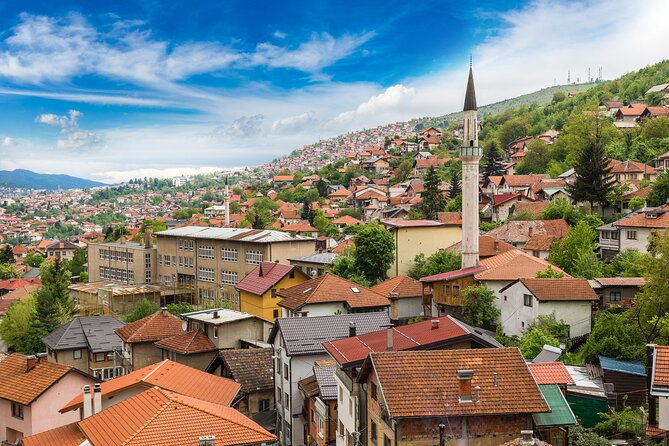
Sarajevo can be difficult to read at street level. A modern café, a busy road, and an old monument may sit within a few minutes of one another, but the meaning is not always obvious. This tour gives you a clear path through several places tied to war, remembrance, art, and recovery.
I find the private structure especially useful here. You are not just walking past a plaque while a guide races ahead. You can stop to ask how a place fits into Sarajevo’s story, or ask for more detail when a subject catches your attention. The only group on the activity is yours, so the experience should feel more like a guided conversation than a fixed lecture.
The route lasts about three hours. The listed time at the four stops adds up to roughly two hours and 40 minutes, leaving the remaining time for walking, transitions, and discussion. That is a comfortable length for a focused city walk. You get enough time to think about each site without giving up an entire day.
The subject matter is serious. This is not the right choice if you want only colorful streets, food stops, or light sightseeing. It is a good fit if you want Sarajevo explained through personal experience and public memory.
More Walking Tours in Sarajevo
- Sarajevo: Grand Walking Tour Through Time and Cultures
★ 4.8 · 1,236 reviews - Sarajevo: 2 Hours Old Town Walking Tour With Local Guide
★ 5.0 · 505 reviews - Private Walking Tour, Food Tasting and Bosnian Coffee in Sarajevo
★ 5.0 · 255 reviews
Starting at Sarajevo War Theatre on Gabelina 16
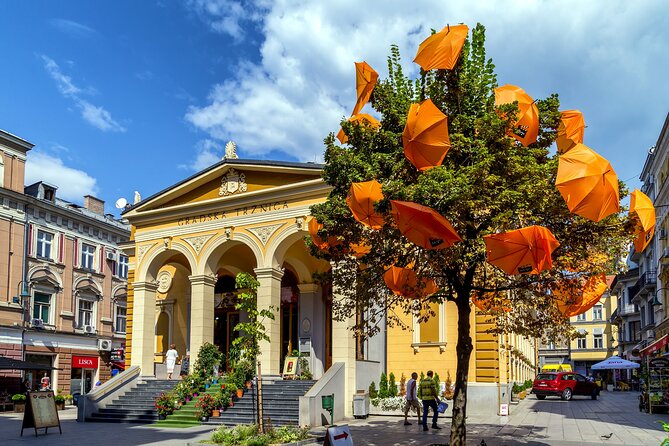
The tour begins at Sarajevo War Theatre, at Gabelina 16. That is a fitting first stop because it introduces the idea that culture is not an ornament added after difficult times. In Sarajevo, theatre can be part of how people hold on to identity, expression, and hope.
You have about 40 minutes here, with admission included. The focus is on the theatre’s role during a turbulent period and on the way performances can express both pain and the wish for a better future. I appreciate this opening because it avoids starting with a list of dates. Instead, it asks you to consider what people protect when normal life is under threat.
Your guide’s explanation matters most at this point. The building itself may not tell you everything you need to know from the outside, and the value comes from understanding why the theatre carries such emotional weight. A strong guide can connect the place to the city’s wider story without turning it into a dry history lesson.
One published comment praised the guide for being extremely well informed and said the old town was the main focus. That detail is useful: if your main interest is Sarajevo’s central historic area, confirm the emphasis with your guide at the start. The route includes several important central places, but this is not presented as a full old-town tour.
One hour inside the War Childhood Museum
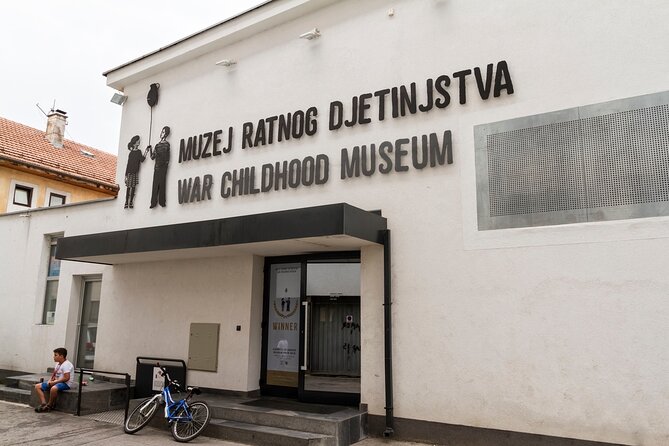
The War Childhood Museum is the central stop, with about one hour allowed. Admission is not included and costs around €5, so keep a little cash or payment option available for that extra charge.
This museum changes the scale of the story. Instead of dealing only with armies, political decisions, and famous dates, it looks at war through childhood. That means the focus shifts to ordinary objects, memories, and the ways young people experience events they did not choose.
I value this stop because it gives the tour its most personal angle. A city’s past can feel distant when explained only through monuments. A child’s point of view makes the effects of conflict easier to grasp: school, play, family life, fear, and the small objects that can become important during frightening years.
Plan to give yourself the full hour. You could walk through quickly, but that would miss the point. This is a place for careful looking and quiet thought, not a stop to rush through while checking the time. The museum may feel more emotionally intense than the other locations, so you should be ready for a slower pace.
The extra fee is modest compared with the cost of a private guide, and I think it adds real value to the experience. Still, it is worth knowing in advance that the advertised tour price does not cover it. If you are traveling with children, the subject may prompt questions, so consider how much wartime detail will suit your family.
The museum also helps balance the theatre stop. At the theatre, you consider public expression and collective resilience. Here, you look at the private side of conflict. Together, the two stops prevent Sarajevo’s story from becoming only a series of military or political events.
The Eternal Flame and Sarajevo’s public memory
The route continues to Vječna vatra, or the Eternal Flame. You have about 40 minutes here, and there is no admission charge.
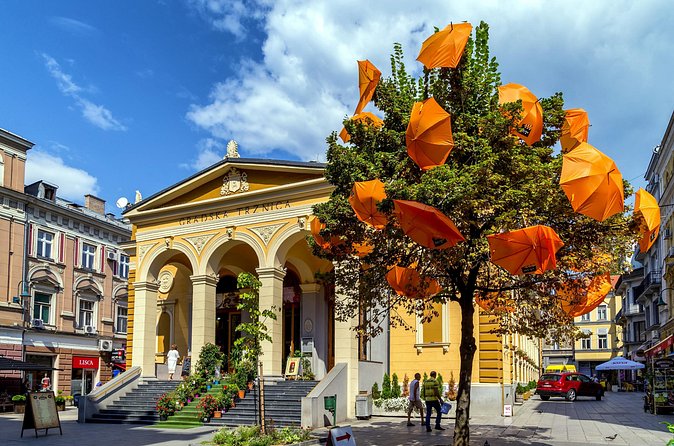
The flame commemorates the victims of the Second World War and symbolizes liberation and peace. It is a public marker in the heart of Sarajevo, so this part of the walk connects the city’s past to a place people encounter in everyday life. You are not visiting a remote memorial removed from the city. You are seeing remembrance placed in a central urban setting.
I like the way this stop broadens the tour. The War Childhood Museum deals with personal memory, while the Eternal Flame represents official public remembrance. The two forms of memory can sit side by side without saying exactly the same thing.
Your guide can also help you understand why this monument matters beyond its physical form. Without context, an eternal flame can seem familiar, even predictable. With context, it becomes part of Sarajevo’s effort to honor the dead and mark the return of peace.
The 40-minute timing gives room for explanation and questions. It may be more time than you need to look at the flame itself, but the stop is not only about taking a photograph. Use the time to ask how this memorial fits into the city’s wider pattern of remembrance.
Because the route is a walking tour, you also experience the shift from one kind of place to another. The theatre, museum, and memorial are not isolated attractions. Moving between them helps you see how Sarajevo places art, private memory, and civic commemoration within the same central area.
Same corner of the country, a different kind of day:
- Sarajevo: Mostar, Konjic, Blagaj Tekke, Pocitelj & Waterfall
★ 4.9 · 1,666 reviews - Fall of Yugoslavia, Sarajevo War Tour with Tunnel of Hope Museum and Frontlines
★ 5.0 · 1,314 reviews - Sarajevo: Mostar, Konjic, Sufi House, Pocitelj & Kravice Falls
★ 5.0 · 1,179 reviews - Sarajevo: Tunnel Museum Yugoslavia War Tour with War Veteran
★ 5.0 · 1,111 reviews
Ending quietly at Veliki Park

The last stop is Veliki Park, at Trampina 4. About 40 minutes are planned here, and admission is free.
After the War Theatre, the museum, and the Eternal Flame, a park is a sensible ending. Veliki Park offers greenery and a pause from the city’s harder subjects. I like that the tour does not finish at another monument with one final solemn speech. It leaves you with room to breathe.
The park is described as a calm green space in the middle of Sarajevo. You can use this final portion to gather your thoughts, ask follow-up questions, or simply enjoy a quieter setting. The contrast matters. A tour about war and memory should not leave you rushing directly into your next appointment.
The end point is useful for planning, too. You finish at Veliki Park rather than returning to the theatre. That means you should arrange your day around the final location. The tour does not include transport back to the starting point, but the route is near public transportation, according to the supplied details.
The final stop also gives the walk a clear emotional shape. It begins with culture, moves into childhood memory, pauses at a national memorial, and ends in open space. I would not call that a light itinerary, but it is thoughtfully paced.
What the private format changes

A private tour is more than a smaller head count. It gives you control over the conversation. If you already know the basic outline of Sarajevo’s 20th-century story, you can ask for context rather than repeat facts. If you are new to the subject, you can slow down and request explanations without feeling you are holding up a busload of people.
The guide is a professional local guide, and the tour is offered in English. One positive account specifically praised the guide’s command of the subject. No guide’s name is provided, so you cannot request a particular person in advance based on the information available.
The private format may also suit families, couples, and small groups with different interests. One person may want more time at the museum, while another may prefer to discuss the theatre or memorial. Your guide can respond to those interests more easily than a large scheduled group can.
There is a trade-off. Private tours usually make the most sense when the cost is shared among several people. For a solo visitor, the price may feel less attractive than a group walk, though the personal attention can still be valuable.
Group discounts are available. Since the amount is not provided, ask for the exact rate before booking if you are traveling with several people. The private arrangement is likely to offer better value for a small group than for one person paying alone.
Timing, walking, and practical planning
The experience lasts approximately three hours and is conducted on foot. The starting address is Sarajevo War Theatre, Gabelina 16, Sarajevo 71000. The ending address is Veliki Park, Trampina 4, Sarajevo 71000.
The tour is near public transportation, which makes it easier to fit into a day of sightseeing. You should still allow a little extra time to find the starting point, since the theatre address is specific and the activity does not begin at the final park.
The listed details say most people can participate. No special physical requirement is given. As with any three-hour city walk, wear comfortable shoes and plan for changing weather, but the supplied information does not promise a fully sheltered route.
Good weather is required. If poor weather forces cancellation, you will be offered another date or a full refund. You can cancel for a full refund up to 24 hours before the start time. Inside that 24-hour window, refunds are not available, and changes are not accepted.
The tour is mobile-ticket friendly, and confirmation is provided at booking. Those details keep the practical side simple, but I would still save the start address and arrival time on your phone before leaving.
Price and value for a serious history walk

The tour price itself is not supplied, so I cannot give you a precise cost comparison. The extra museum fee is around €5, which is small in relation to the overall experience and should not be a surprise if you budget for it.
The real value comes from the guide and the private format. You are paying for interpretation across four connected places, not simply admission to attractions. The theatre and memorial are free, while the museum has a modest charge, so much of the price supports the guide’s time and local knowledge.
I would judge the value by your interests. If you want a casual introduction to Sarajevo’s main sights, a free self-guided walk may be enough. If you want help understanding how art, childhood, remembrance, and peace connect, a private tour earns its keep more easily.
The route also saves planning time. You do not need to decide which sites belong together or work out how to explain them to your companions. The guide provides the thread, while you bring your own questions.
Who should book this experience
I would recommend this walk to first-time visitors who want Sarajevo’s recent past explained with care. It also suits returning visitors who have seen the main streets but want a more focused look at memory and recovery.
It is a particularly good choice for:
- Couples or small groups who prefer a private conversation.
- Visitors interested in museums, memorials, and local culture.
- Families with older children who can engage with difficult subjects.
- People who want an English-language walk lasting about half a day.
- Anyone who prefers a thoughtful route over a checklist of landmarks.
I would hesitate if your priority is food, architecture, shopping, or a broad survey of the entire city. The route has an old-town connection, but the stated focus is not a complete tour of every major sight. I would also think twice if you find war museums emotionally difficult.
Should you book the Inspiring Story of Sarajevo walk?
Book it if you want a personal, serious introduction to Sarajevo through four places with different roles. The War Theatre shows cultural endurance, the War Childhood Museum brings the story down to a child’s level, the Eternal Flame represents public remembrance, and Veliki Park gives you a calm place to finish.
The best reason to choose it is the private guide. You get time for questions, a route shaped around your group, and a subject that benefits from local explanation. The main cautions are the extra museum fee, the need for good weather, and the fact that the small number of published ratings gives only limited evidence.
For a small group with an interest in Sarajevo’s wartime memory, I would put this high on the list. For a visitor seeking a light or all-purpose city tour, choose something broader.
FAQ
How long does the Inspiring Story of Sarajevo tour last?
The tour lasts approximately three hours.
Is this a private tour?
Yes. Only your group participates in the activity.
What language is the tour offered in?
The tour is offered in English.
Where does the tour start?
It starts at Sarajevo War Theatre, Gabelina 16, Sarajevo 71000, Bosnia and Herzegovina.
Where does the tour end?
It ends at Veliki Park, Trampina 4, Sarajevo 71000, Bosnia and Herzegovina.
Is admission to the War Childhood Museum included?
No. Admission is not included and costs around €5.
Newest around Sarajevo
- Understanding Srebrenica Genocide + Lunch with Local Family★ 4.9 · 14 reviews
- Private Full Day Safari Tour★ 5.0 · 8 reviews
- Sarajevo: Trebević Mountain Summit Hiking Tour★ 4.2 · 2 reviews
- From Sarajevo: Kozice Waterfalls Hiking Experience in Nature★ 5.0 · 2 reviews
- Sarajevo Under Siege: A War History Tour★ 5.0 · 10 reviews
- Mysterious Visoko Pyramids Driving and Walking Tour★ 5.0 · 7 reviews
- WAR TUNNEL – Sarajevo’s only way of a communication during the WAR – Top secret★ 5.0 · 12 reviews
- Ultimate Gastro Experience★ 4.5 · 14 reviews
Walking Tours, compared.
Private Walking Tour, Food Tasting and Bosnian Coffee in Sarajevo
Read our review →
Browse the lists this tour appears in