
Review · HISTORICAL TOURS
SARAJEVO STREET ART TOUR (art, history & mystery) – sARTajevo!
Look up, Sarajevo has stories on its walls. This small-group walk links murals, stickers, and painted buildings with the city’s past and present, and I especially like the personal insight from guides such as Alan, Ado, and Mak and the way the tour reaches art you could easily miss on your own. I also like the maximum group size of five, which should make questions and discussion easy. The main consideration is that the street-art selection is limited, so anyone expecting a long gallery-style route may find the content a little narrow.
At about two to three hours, this is a gentle evening introduction to Sarajevo’s modern art scene. It costs $30.04 per person, which is fair if you value explanation and local context more than a simple walk between landmarks. The tour is in English, begins at 6:00 pm, and returns to its starting point.
In This Review
- What makes this Sarajevo walk worth your time
- Sarajevo seen through its walls
- Bentbaša: beginning with memory
- Papagajka and Sarajevo’s first street-art festival
- The Academy of Fine Arts: grand design beside small marks
- Aria: Mr. Chat, Singer, and a gallery connection
- Ferhadija and the mural remembering Srebrenica
- What the guide adds to the walk
- Is $30.04 good value?
- Timing, group size, and practical details
- Who should book this experience?
- Should you book the Sarajevo Street Art Tour?
- FAQ
- How much does the Sarajevo Street Art Tour cost?
- How long does the tour last?
- What time does the tour start?
- Where does the tour begin?
- Where does the tour finish?
- Is the tour offered in English?
- How many people can join the tour?
- Can I cancel for a full refund?
What makes this Sarajevo walk worth your time
- A mural about Srebrenica adds serious historical weight to the route.
- Papagajka connects Sarajevo with its first street-art festival and local wall art.
- The Academy of Fine Arts brings architecture, stickers, and art history together.
- Mr. Chat, Singer, and Gallery Boris Smoje show different sides of the city’s creative life.
- A group capped at five keeps the walk personal and easy to follow.
- The tour works especially well for people who know little about street art.
Sarajevo seen through its walls
Sarajevo is easy to approach through its famous sights: the old bazaar, religious buildings, bridges, and hills. This tour asks you to look again at the less formal parts of the city. A painted wall, a sticker near a grand building, or a mural tucked behind a pedestrian street becomes a clue to how Sarajevo remembers, argues, creates, and carries on.
I like that the art is not treated as decoration alone. The guide explains each work in detail and places it within Sarajevo’s artistic and historical setting. That matters here, because the city’s walls can carry messages about loss, identity, public memory, humor, and daily life all at once.
This is not a museum tour transferred outdoors. You are walking between ordinary city spaces, with no admission fee at the stops. Some works may be modest in scale or easy to overlook, so the guide’s eye is a large part of what you are paying for.
The small group makes a real difference. With no more than five people, you should be able to hear clearly and ask why a work was made, how it fits the city, or what details deserve a second look. The experience is also suitable if you are new to street art. One especially useful outcome is that you may start noticing small details afterward, including recurring visual signs such as blue flowers.
More History Tours in Sarajevo
- Sarajevo Full Day Tour: History, Culture, Nature, War & Olympics
★ 5.0 · 27 reviews - Sarajevo genuine walking tour: Steps through history
★ 5.0 · 22 reviews - BOSNIAN PYRAMIDS TOUR (nature, history & archeology)
★ 5.0 · 17 reviews
Bentbaša: beginning with memory
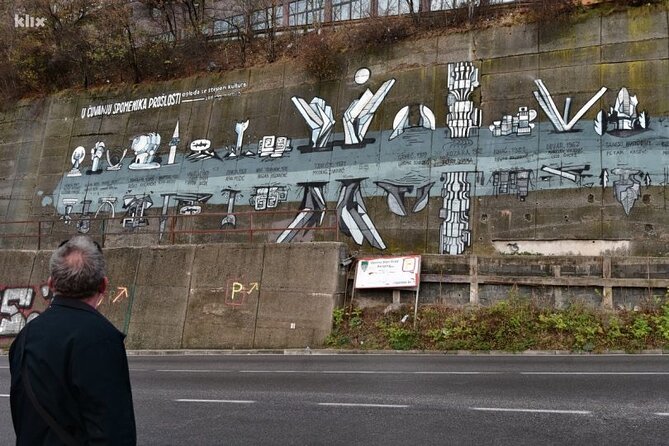
The walk starts at Đulagina 2 and heads toward Bentbaša, where the first mural carries the title In the preservation of monuments of the past. The title sets the tone. This is street art concerned with memory and the way a city protects, changes, or reinterprets what came before.
You can expect roughly 20 minutes here. Admission is free, and the value comes from the guide’s explanation rather than from a formal display or plaque. This is a useful first stop because it gives you a way to read the rest of the route. Instead of asking only whether a mural looks attractive, you begin asking what it preserves and whom it addresses.
The stop may feel brief if you want a long discussion of every visual detail. Still, the compact timing helps keep the walk moving, and it avoids turning the evening into a lecture. Bring your attention to the guide’s interpretation, since the work itself may not explain its full meaning at street level.
Papagajka and Sarajevo’s first street-art festival
The second stop is Copy Papagajka, an art building also known as Papagajka, or Perrot. The building is linked with Sarajevo’s first street-art festival, and its walls provide more examples of local public art.
This is one of the more distinctive parts of the route. Papagajka is not simply another painted surface. It represents a moment when street art gained a more organized place in the city, while still keeping its connection to public space. The guide can show you how festival work and informal wall art relate to each other.
Plan on about 20 minutes. That is enough for an introduction, but not enough to examine every possible piece in a large area. The experience depends on the guide pointing out the important examples and explaining what you might otherwise walk past.
I would pay close attention here if you are curious about how a local art scene develops. The stop gives the tour a useful link between individual artists, shared projects, and the city’s wider creative life.
The Academy of Fine Arts: grand design beside small marks
The Academy of Fine Arts is scheduled for about 30 minutes, making it the longest stop on the first part of the route. This is a good place to connect formal art with the quick, temporary, and often unofficial character of street work.
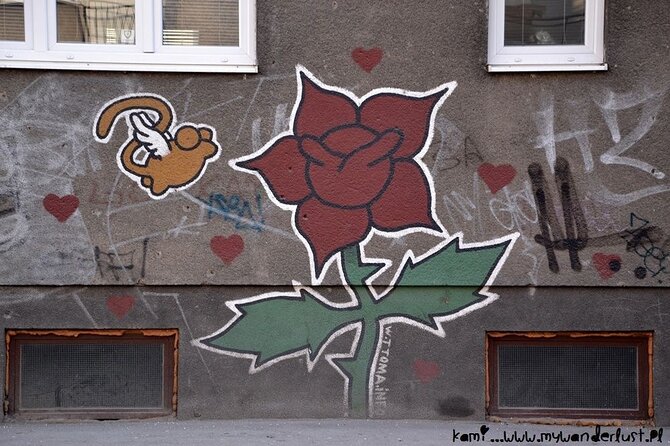
The building is described as one of Sarajevo’s most beautifully designed objects, so the stop is not only about stickers or painted walls. The guide uses art examples to explain Sarajevo’s past, then demonstrates and interprets sticker art. That contrast is useful: one form of expression is built into a major architectural setting, while the other may occupy a small patch of urban space.
Sticker art can be easy to miss. You might pass it without realizing that it belongs to a wider local conversation. A good guide helps you slow down and read these smaller interventions as part of the city rather than as random decoration.
This stop also gives the tour visual variety. After murals and festival-related work, you get architecture, small-scale pieces, and a broader discussion of how art appears in public. If you prefer only large, colorful murals, the sticker section may seem less dramatic. If you want to understand how a city’s art scene works at different scales, it is one of the more useful sections.
Same corner of the country, a different kind of day:
- Sarajevo: Mostar, Konjic, Blagaj Tekke, Pocitelj & Waterfall
★ 4.9 · 1,666 reviews - Fall of Yugoslavia, Sarajevo War Tour with Tunnel of Hope Museum and Frontlines
★ 5.0 · 1,314 reviews - Sarajevo: Grand Walking Tour Through Time and Cultures
★ 4.8 · 1,236 reviews - Sarajevo: Mostar, Konjic, Sufi House, Pocitelj & Kravice Falls
★ 5.0 · 1,179 reviews
Aria: Mr. Chat, Singer, and a gallery connection
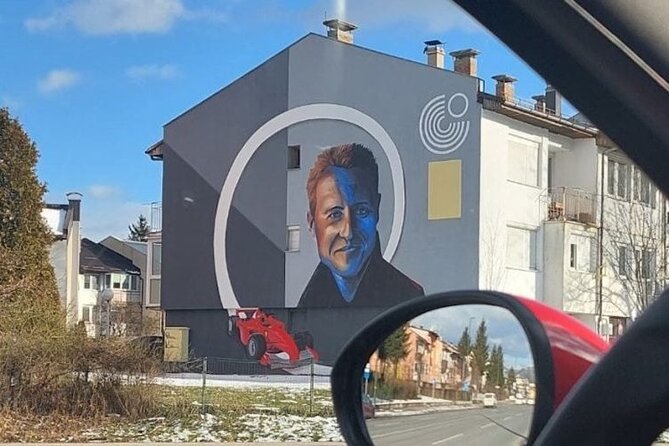
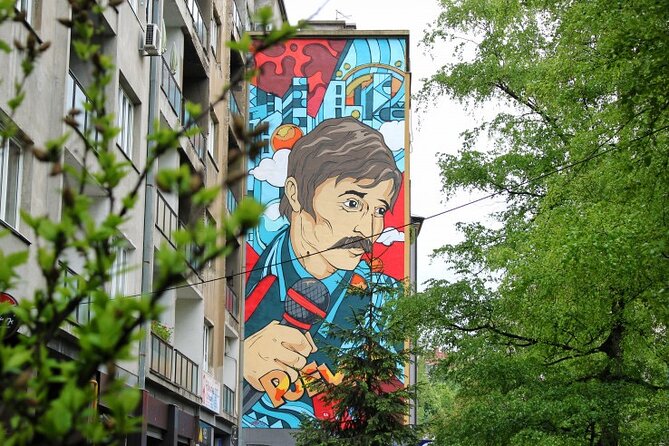
At Aria, the route brings together several distinct references: Mr. Chat, the mural Singer, known locally as Pjevač, and Gallery Boris Smoje. The stop lasts about 20 minutes.
Mr. Chat is a recognizable street-art concept, while Singer gives the route another specific mural to consider. Gallery Boris Smoje adds a link to a more conventional art setting. Taken together, these locations help show that Sarajevo’s creative life does not fit neatly into a single category.
I like this section because it broadens the definition of street art. You are not only looking at one kind of wall painting. You are also considering how public art, named artists, galleries, and local cultural spaces overlap.
The short stop means the guide will need to keep the explanation focused. That can be a benefit late in the walk, when too much detail becomes tiring. It also means you may want to ask questions as you go, especially if one work interests you more than the others.
Ferhadija and the mural remembering Srebrenica
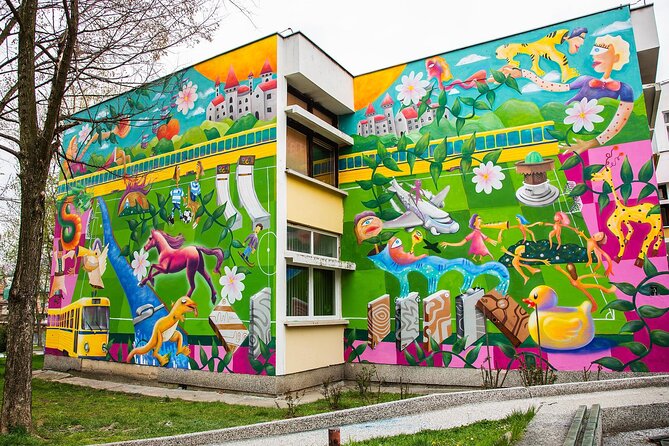
The final major stop is behind Ferhadija Pedestrian Street, where you see the mural Srebrenica 1992/1995. This is the most emotionally serious point on the route.
The mural brings Bosnia’s wartime memory into a public setting. A guide can help you understand how art gives shape to remembrance, but this is also a place to pause and look carefully rather than rush through a list of facts. The subject is painful, and the stop may feel heavier than the earlier sections on festivals, stickers, or named artists.
The scheduled time is about 30 minutes. That allows room for the mural itself and for an introduction to the surrounding graffiti scene. The guide presents the wider area as part of Sarajevo’s continuing street-art culture, not as a single memorial frozen outside ordinary life.
This balance is important. You see how memory shares space with shops, pedestrians, and daily routines. Sarajevo’s past is not kept in one distant place. It appears beside the streets people use now.
What the guide adds to the walk
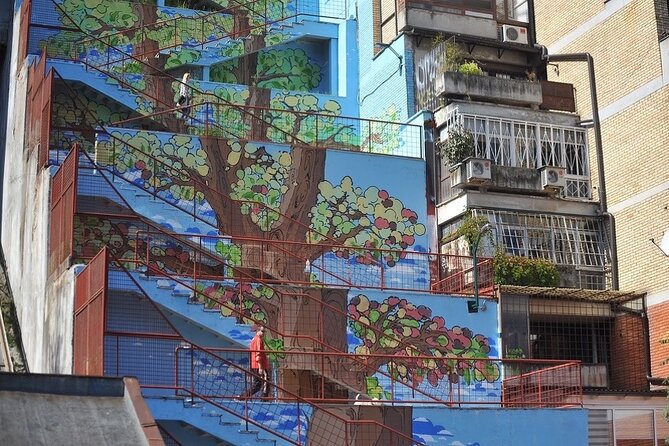
The strongest part of this experience is the human explanation. A guide connected with the local art scene can identify work, explain background, and point out pieces that are not obvious from a standard sightseeing route. Alan has been praised for discussing his own art as well as the historical and artistic setting. Ado has been described as offering clear English and strong knowledge of Sarajevo. Mak has been praised for explaining the early development of street art to someone with no artistic background.
The guide may vary, so you should not book solely for one named person unless the provider confirms who will lead your departure. Still, the comments associated with Alan, Ado, and Mak point to the same useful quality: this is intended to be a personal, spoken interpretation rather than a memorized sequence of sights.
That is especially helpful if you are not an art specialist. You do not need to know artistic terms before you arrive. The tour is designed to give you a starting point, and you can ask basic questions without feeling out of place.
The guide also gives you a better sense of Sarajevo as a lived-in city. You are not only seeing monuments. You are learning how people use walls to express ideas, preserve memory, mark identity, and take part in local culture.
Is $30.04 good value?
At $30.04 per person, the tour is not the cheapest way to walk around Sarajevo. You can see many public walls without paying an admission fee. The real question is how much help you want finding and interpreting them.
I consider the price reasonable for three reasons. First, the group is limited to five people. Second, the route covers several areas and named works that you might not locate on your own. Third, the guide provides historical and artistic context, which is the part a map or quick internet search cannot fully replace.
The value is lower if you only want to photograph murals or if you expect a large collection of works. One direct assessment of the experience found the route worthwhile but suggested that its structure and content could be developed further because Sarajevo has more street art to cover. That is a fair caution.
Think of this as a focused introduction, not a complete survey of every painted wall in town. If the tour helps you notice art during the rest of your stay, the price becomes easier to justify.
Timing, group size, and practical details
The walk begins at 6:00 pm and lasts approximately two to three hours. The evening timing should suit you if you want to spend the day on Sarajevo’s major sights and finish with something less conventional.
The tour is offered in English and begins and ends at Đulagina 2, Sarajevo 71000. It is near public transportation, and all listed stops have free admission. Since the route is on city streets, comfortable walking shoes are a sensible choice, though the supplied details do not specify the exact distance or terrain.
A mobile ticket is provided, and confirmation arrives at booking. Service animals are allowed, and most people can take part. The maximum of five is worth noting because small groups can make a major difference on a discussion-based walk.
Free cancellation is available if you cancel at least 24 hours before the 6:00 pm start time. Changes or cancellations inside that window are not accepted for a refund. The tour also requires a minimum number of participants, and if that minimum is not met, you are offered another date or experience, or a full refund.
Who should book this experience?
I would choose this walk if you want to see Sarajevo beyond its standard sightseeing circuit. It suits you especially well if you like local culture, public art, difficult history, or small-group tours where you can ask questions.
It is also a strong choice for anyone who does not consider themselves artistic. The guide’s job is to make the work readable, not to assume that you already understand street-art history. Several parts of the route connect naturally with ordinary city life, so you get a better sense of Sarajevo today as well as Sarajevo in the past.
Families, couples, solo visitors, and small friend groups can all fit the format, since most people can participate and the group is capped at five. You should be comfortable spending two or three hours walking through urban areas, but the exact accessibility details are not provided.
I would look elsewhere if you want a broad catalogue of murals, a formal museum experience, or a tour focused only on architecture. The route has a serious historical section and a clear art focus, but it is not designed to cover every corner of Sarajevo’s street-art scene.
Should you book the Sarajevo Street Art Tour?
Book it if you want a thoughtful introduction to Sarajevo’s modern wall art and the stories attached to it. The best reasons are the small group, the English-speaking local guidance, the hard-to-find works, and the strong connection between art and memory.
Go with realistic expectations. You are not paying for a huge number of murals. You are paying for two to three hours of guided looking, from Bentbaša and Papagajka to the Academy of Fine Arts, Aria, and the Srebrenica mural behind Ferhadija.
For me, that is the tour’s appeal. It shows a side of Sarajevo that a standard list of monuments cannot provide. If you want to understand how art helps a city remember, change, and speak in public, this $30.04 walk is a worthwhile addition to your Sarajevo plans.
FAQ
How much does the Sarajevo Street Art Tour cost?
The price is $30.04 per person.
How long does the tour last?
The experience lasts approximately two to three hours.
What time does the tour start?
The tour starts at 6:00 pm.
Where does the tour begin?
The meeting point is Đulagina 2, Sarajevo 71000, Bosnia and Herzegovina.
Where does the tour finish?
The tour ends back at the meeting point.
Is the tour offered in English?
Yes. The tour is offered in English.
How many people can join the tour?
The group has a maximum of five participants.
Can I cancel for a full refund?
Yes, if you cancel at least 24 hours before the experience start time. Cancellations made less than 24 hours before the start are not refunded.
Newest around Sarajevo
- Understanding Srebrenica Genocide + Lunch with Local Family★ 4.9 · 14 reviews
- Private Full Day Safari Tour★ 5.0 · 8 reviews
- Sarajevo: Trebević Mountain Summit Hiking Tour★ 4.2 · 2 reviews
- From Sarajevo: Kozice Waterfalls Hiking Experience in Nature★ 5.0 · 2 reviews
- Sarajevo Under Siege: A War History Tour★ 5.0 · 10 reviews
- Mysterious Visoko Pyramids Driving and Walking Tour★ 5.0 · 7 reviews
- WAR TUNNEL – Sarajevo’s only way of a communication during the WAR – Top secret★ 5.0 · 12 reviews
- Ultimate Gastro Experience★ 4.5 · 14 reviews
Historical Tours, compared.
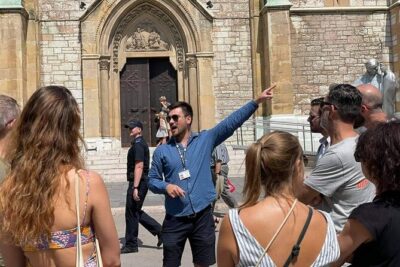
Sarajevo Full Day Tour: History, Culture, Nature, War & Olympics
Read our review →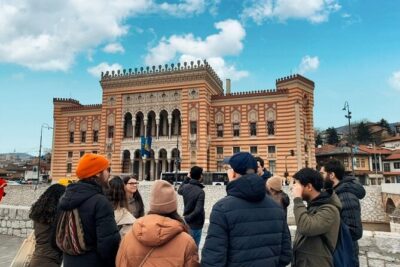
Sarajevo genuine walking tour: Steps through history
Read our review →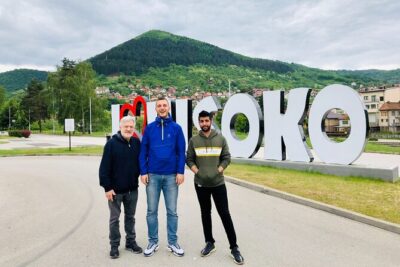
BOSNIAN PYRAMIDS TOUR (nature, history & archeology)
Read our review →
Browse the lists this tour appears in