
Review · CITY TOURS
Sarajevo: City Tour with Bosnian coffee ritual ☕️
Sarajevo tells centuries of stories in a short walk. This four-part city tour links the Bosnian kingdom, Ottoman Sarajevo, Austro-Hungarian rule, Yugoslavia, and the city’s religious communities with stops for Bosnian coffee, baklava, cheese, and cured meats. It is a useful first look at Sarajevo because it combines major sights with everyday traditions.
I especially like the small maximum of eight people, which should make it easier to ask questions and keep pace with the guide. I also like the local tastings, particularly the coffee ritual and the visit to a working coppersmith. The main consideration is time: 210 minutes covers a lot, so some stops may feel more like guided introductions than long museum visits.
In This Review
- Key points to know before you book
- Starting beside Sacred Heart Cathedral
- From Jewish Sarajevo to the Meeting of Cultures
- Gazi Husrev-beg Mosque and Ottoman Sarajevo
- Baklava, bakery treats, and the taste of Sarajevo
- Baščaršija and the craft of Kazandžiluk
- Learning the Bosnian coffee ritual
- City Hall and Latin Bridge
- Market Hall, local food, and the city’s everyday life
- Eternal Flame and the two cathedrals
- Is $38 good value for 210 minutes?
- Who will enjoy this Sarajevo tour most?
- Should you book the Sarajevo coffee and city tour?
- FAQ
- How long does the Sarajevo city tour last?
- Where does the tour begin?
- Where does the tour end?
- What languages are available?
- Is Bosnian coffee included?
- What food tastings are included?
Key points to know before you book
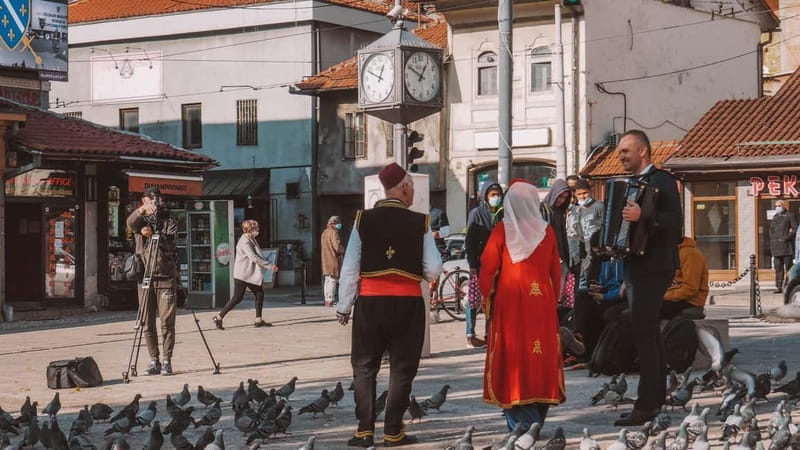
- A compact tour of Sarajevo’s major eras: You move from the Slavs and medieval Bosnia through Ottoman and Austro-Hungarian rule, the World Wars, and Yugoslavia.
- Traditional coffee is part of the lesson: You do not simply receive a drink. You learn how Bosnian coffee is prepared and served, along with local coffee customs.
- Food tastings add real local flavor: Expect baklava, another Bosnian dessert, and samples of local cheeses and cured meats.
- The copper workshop gives Baščaršija a human face: You see traditional craft techniques at a local coppersmith’s shop.
- The route explains Sarajevo’s religious mix: A mosque, Jewish heritage site, Catholic cathedral, Orthodox church, and other landmarks help explain the city’s nickname, the Jerusalem of Europe.
- The $38 price covers several extras: For a three-and-a-half-hour small-group walk, the included coffee, sweets, market samples, and workshop visit add useful value.
Starting beside Sacred Heart Cathedral
The meeting point is beside the statue of Pope John Paul II, right next to Sacred Heart Cathedral. This is a practical place to begin because the cathedral helps set the tone for Sarajevo’s layered identity from the first few minutes.
You are not starting with a single historical period. Instead, the tour places Catholic Sarajevo beside Ottoman, Jewish, and Orthodox traditions. That mixture is central to understanding the city, and it gives the opening stop more purpose than a simple photo opportunity.
The tour ends back at Sacred Heart Cathedral, so you begin and finish in the same area. That makes the experience easy to fit into a day of sightseeing, especially if you want a broad orientation before exploring on your own.
The guide speaks English, German, Bosnian, Croatian, or Serbian. Since the group is limited to eight participants, you should have a better chance of getting explanations tailored to your questions than you would on a large coach tour.
More City Tours in Sarajevo
- ROSES OF SARAJEVO (Official WAR + CITY tour)- Story of a Survivor
★ 5.0 · 770 reviews - Sarajevo: Guided City Highlights Tour with Sarajevo Tunnel
★ 4.8 · 79 reviews - Sarajevo: Sarajevo City Market, Old Town Food Tasting Tour
★ 4.9 · 69 reviews
From Jewish Sarajevo to the Meeting of Cultures
The Museum of the Jews of Bosnia and Herzegovina is one of the most meaningful stops. A guided visit here gives you a way to understand the Jewish presence in Sarajevo as part of the city’s wider social story, not as an isolated subject.
The stop is paired with Sarajevo Meeting of Cultures, a marked point where different architectural and cultural zones come close together. You will see why the city is often called the Jerusalem of Europe. The phrase refers to Sarajevo’s close mix of Muslim, Jewish, Catholic, and Orthodox traditions.
This part of the walk asks you to pay attention to how quickly the city’s character changes. The value is less about collecting dates and more about seeing how different communities have shaped the same urban center.
The guide’s approach is designed to keep the history conversational rather than lecture-heavy. That matters in Sarajevo, where the timeline can become crowded with kingdoms, empires, wars, and political changes. You get the main ideas without needing to memorize a long list of rulers.
Gazi Husrev-beg Mosque and Ottoman Sarajevo
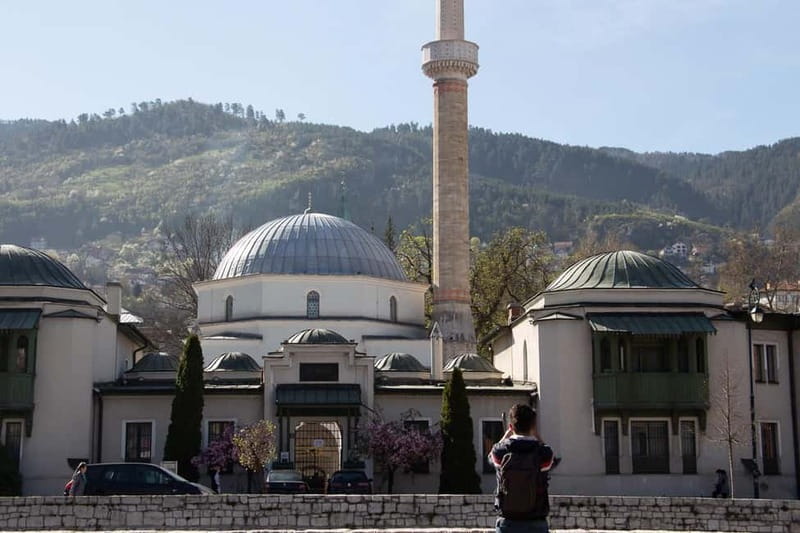
The guided visit to Gazi Husrev-beg Mosque brings you into the heart of Sarajevo’s Ottoman story. It is one of the important landmarks in Baščaršija, and it gives the tour a clear sense of how Islamic institutions shaped the old city.
You can expect the guide to explain the mosque’s place in Sarajevo rather than treating it only as an architectural stop. This is where the tour’s broad historical structure begins to make sense. The Ottoman period is not presented as a disconnected chapter, but as a force that still influences the streets, shops, food, and coffee customs you encounter later.
You should dress and behave respectfully when visiting a mosque. The supplied information does not specify clothing rules, entry conditions, or whether every interior area is accessible during each departure, so your guide will be the best source for those details on the day.
The mosque stop is especially useful if you are new to Sarajevo. It gives context before you enter the old market streets, where copperware, sweets, coffee, and traditional foods can otherwise seem like separate attractions.
Baklava, bakery treats, and the taste of Sarajevo
Food is used here as part of the cultural explanation. At a local bakery, you sample a Bosnian treat, and later you try baklava from a traditional producer. You also receive a beloved Bosnian dessert, though the exact dessert is not named in the available details.
That uncertainty is worth noting if you have allergies or strong dietary limits. The tour includes foods, but it does not promise substitutions or list ingredients. You can ask the guide before tasting if you need to avoid particular ingredients.
Baklava is more than a quick sweet stop. It connects naturally with the Ottoman influence already discussed at the mosque and in Baščaršija. Tasting it after hearing about the city’s past gives you something concrete to remember.
The bakery and traditional producer also support the tour’s focus on ordinary Sarajevo. You are not only looking at grand buildings. You are sampling food that belongs to the city’s daily and festive culture.
More Food & Wine Tastings in Sarajevo
- Private Walking Tour, Food Tasting and Bosnian Coffee in Sarajevo
★ 5.0 · 255 reviews - 🍽️ Sarajevo Food Tour: Eat where the locals eat
★ 5.0 · 10 reviews - Half-Day Grbavica Food Tour in a Small Group
★ 5.0 · 6 reviews - Sarajevo Rakija Tasting Tour & Local Bites 🥃
★ 5.0 · 4 reviews
Baščaršija and the craft of Kazandžiluk
Baščaršija is the old market district and one of the essential stops in Sarajevo. The guided walk here helps you read the district as more than a shopping area. Its streets carry the Ottoman imprint, while its shops keep older trades visible.
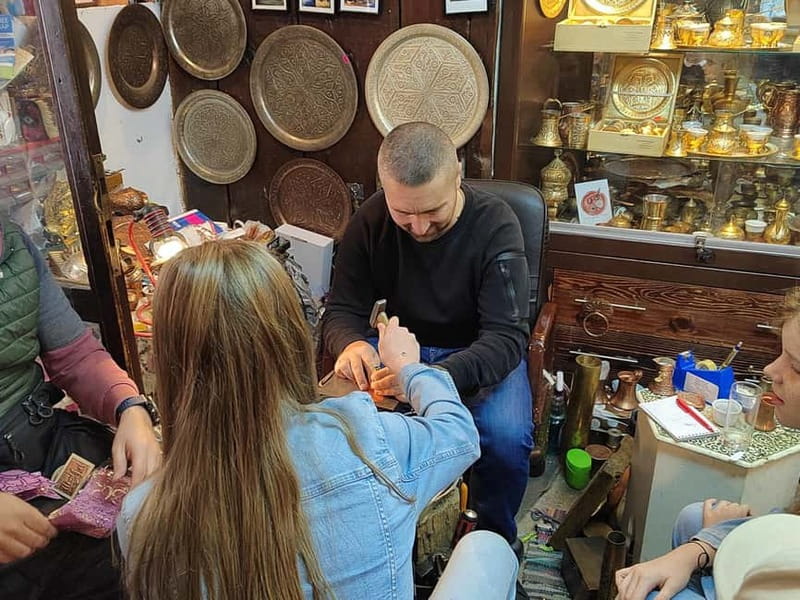
Kazandžiluk is the copper artisans’ market, and the local workshop visit is one of the tour’s strongest features. You get to see a coppersmith at work and learn about methods passed down through generations.
For me, this is the sort of stop that makes a city tour worthwhile. A display of finished copper objects tells you what can be bought. Watching the maker work tells you how the tradition survives.
The workshop visit also gives you a chance to see the human skill behind the souvenirs. If you want to buy something, you can browse with a better understanding of the labor involved. The available information does not say that a purchase is included, so treat shopping as optional and separate from the tour price.
Because Baščaršija is a market district, there should be plenty to look at even if you are not interested in buying crafts. Still, the group will continue according to the guide’s schedule, so this is not designed as a long independent shopping session.
Learning the Bosnian coffee ritual
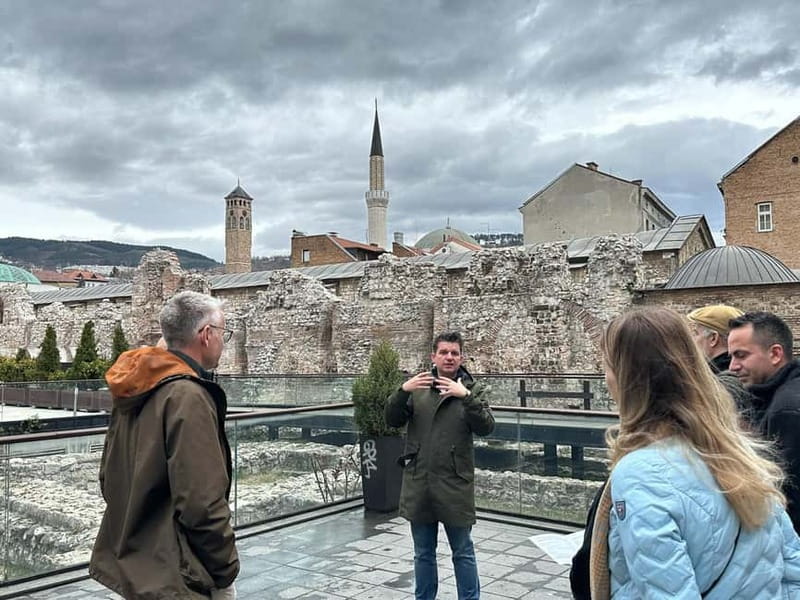
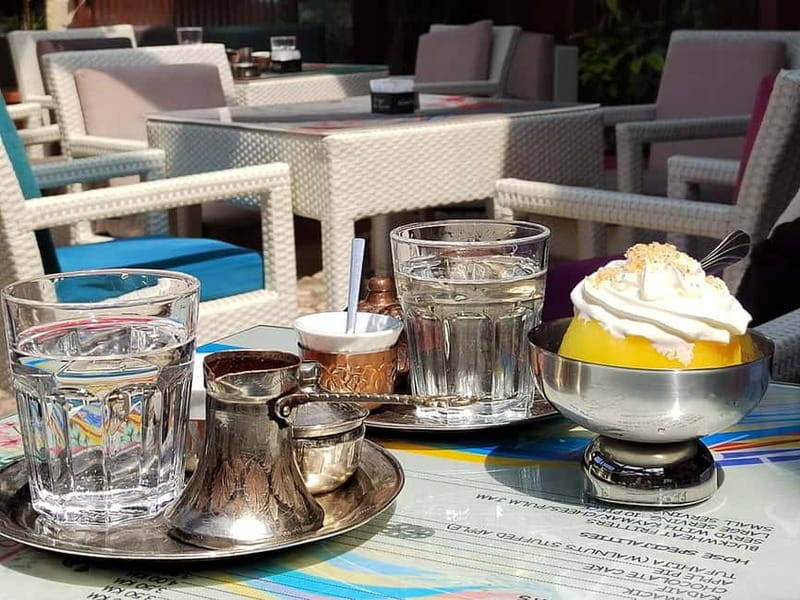
The coffee tasting takes place at a local café, and it is more than a caffeine break. You receive a cup of Bosnian coffee prepared and served in the traditional way, while the guide explains local coffee culture.
Bosnian coffee is described as strong and sweet, and coffee is presented as a regular part of social life. The ritual gives you a window into how people meet, pause, and spend time together. You also learn about three kinds of coffee people drink at home.
This is an excellent addition to a city tour because it slows the pace. Sarajevo’s history can feel heavy, with its empires, world wars, and political upheavals. A café stop lets you connect that history with a living custom.
The phrase Bosnian coffee ritual can sound more formal than the experience may be. You should expect a tasting and an explanation, not a full coffee workshop or a meal. Food and drinks beyond the listed inclusions are not covered.
If you do not normally drink strong coffee, ask about the preparation before you take a full cup. The tour description emphasizes its strength, so this is not presented as a mild café drink.
City Hall and Latin Bridge
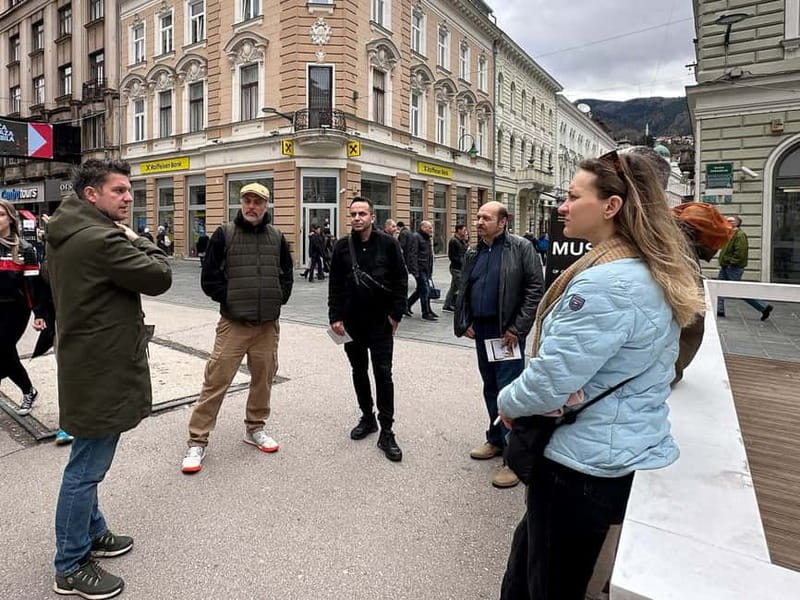
Sarajevo City Hall is another important landmark on the route. The guided stop connects the city to the Austro-Hungarian period and gives you a different architectural setting from the Ottoman market district.
The shift from Baščaršija’s traditional streets to City Hall helps you see how Sarajevo changed under Austro-Hungarian rule. You are not confined to one historical mood. The tour shows how successive powers left different marks on the same city.
Latin Bridge carries the tour into the period before the First World War. It is closely associated with the assassination of Archduke Franz Ferdinand and the chain of events that followed. Your guide can connect the bridge to the World War I story while keeping the explanation tied to the place beneath your feet.
These stops are valuable because they prevent Sarajevo’s past from becoming a general history lecture. You stand at locations where major changes are linked to real streets and crossings.
The tradeoff is that the city has too much history for a single visit to explain every detail. The guide’s job is to give you a clear framework, then leave you with enough direction to explore museums and monuments in greater depth later.
Market Hall, local food, and the city’s everyday life
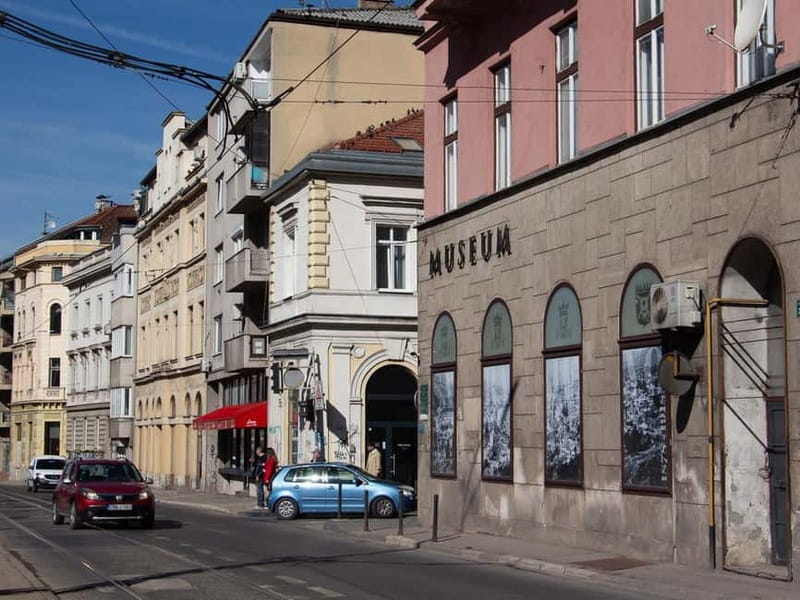
At Sarajevo City Market Hall, you receive a guided introduction followed by samples of local cheeses and cured meats. This is a welcome change from landmark viewing because it shows how residents shop and eat.
The market tasting is included, but other food and drinks are not. If you want a larger snack or meal, plan to pay separately. The supplied details do not name the specific cheeses or meats, so you should treat the tasting as a small sample rather than a full food tour.
I like the market stop because it balances the grand historical subjects. Mosques, cathedrals, bridges, and city halls explain public history. Cheese, cured meat, and bakery goods show how culture appears at the table.
The market may also be useful for deciding what to try later. Your guide can explain what you are tasting and point out traditional products, giving you more confidence if you return to shop on your own.
Eternal Flame and the two cathedrals
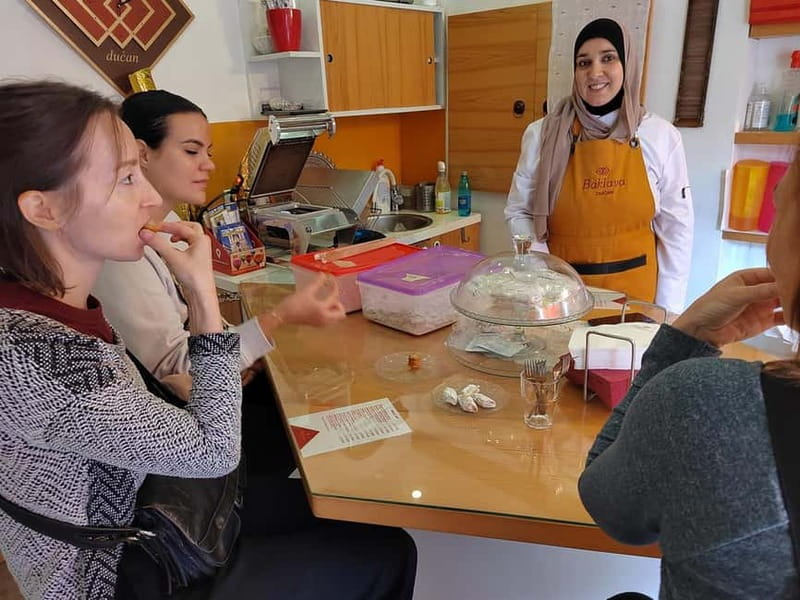
The Eternal Flame is the final historical landmark before the tour returns to the cathedral area. It adds another layer to the story of Sarajevo and its wartime memory.
The route also includes the Cathedral Church of the Nativity of the Theotokos, an Orthodox church. Set alongside Sacred Heart Cathedral, the Jewish museum, and Gazi Husrev-beg Mosque, this stop makes the city’s religious variety visible rather than abstract.
You will not simply hear that Sarajevo has several faith traditions. You will visit places connected with those traditions. That is why the tour earns its focus on Sarajevo as the Jerusalem of Europe.
The Catholic cathedral at the beginning and end gives the route a neat shape. You start with the city’s religious mix, move through its market, craft, food, and political history, then return to the same area with a more complete picture.
Is $38 good value for 210 minutes?
At $38 per person, this is a good-value introduction if you want several experiences combined into one half-day walk. The price includes a live guide, major landmarks, traditional Bosnian coffee, baklava, another dessert, market samples, and a coppersmith workshop visit.
You are not paying only for a list of sights. You are paying for the explanations that connect them. A self-guided walk could take you past Gazi Husrev-beg Mosque, Latin Bridge, City Hall, the Eternal Flame, Baščaršija, and the cathedrals, but it would not automatically explain the relationships among them or include the tastings.
The small group is important to the value. With no more than eight participants, the experience is intended to be intimate and interactive. That makes the price more reasonable than a basic large-group orientation.
The limitation is depth. Three and a half hours is enough for a strong introduction, not a complete study of Sarajevo’s museums, wars, architecture, and religious communities. If you want extended time inside each site or a full meal, you will need additional visits and spending.
Free cancellation up to 24 hours before the start and the option to reserve now and pay later add flexibility. These policies are useful if your plans are still changing, but they do not alter what is included during the tour.
Who will enjoy this Sarajevo tour most?
I would recommend it to first-time visitors who want a clear framework for Sarajevo before exploring alone. It also suits people who value food, coffee, traditional crafts, and local stories as much as famous buildings.
The tour is a good fit if you enjoy asking questions and prefer a small group. The available languages are English, German, Bosnian, Croatian, and Serbian, so check the chosen departure language when booking.
You may want a different experience if you prefer to spend a long time at one museum, shop independently, or focus only on wartime history. This tour covers many themes, and its strength is the range.
Wear something suitable for a multi-stop city walk and plan to follow the guide’s pace. The details do not specify accessibility arrangements, walking distance, or interior entry conditions, so ask the provider if those points matter to you.
Should you book the Sarajevo coffee and city tour?
Book it if you want a compact, human-scale introduction to Sarajevo that joins history with food and craft. The coffee ritual, copper workshop, baklava, and market samples give the tour character beyond standard sightseeing.
I would be especially happy to take this early in a Sarajevo stay. It can help you understand Baščaršija, choose foods to try later, and place the city’s religious and political landmarks in context.
Skip it if you want a slow museum day or a specialized tour devoted to one period. For most first visits, though, $38 is fair for 210 minutes, a maximum group of eight, and several included cultural experiences.
FAQ
How long does the Sarajevo city tour last?
The tour lasts 210 minutes, or three and a half hours.
Where does the tour begin?
You meet the guide next to the statue of Pope John Paul II, beside Sacred Heart Cathedral.
Where does the tour end?
The tour returns to Sacred Heart Cathedral.
What languages are available?
The live tour guide is available in German, English, Bosnian, Croatian, and Serbian.
Is Bosnian coffee included?
Yes. The tour includes one cup of Bosnian coffee prepared and served traditionally, along with an explanation of the coffee ritual.
What food tastings are included?
The tour includes baklava from a traditional producer, another Bosnian dessert, and samples of local cheeses and cured meats at the city market. Food and drinks not specifically mentioned are not included.
Newest around Sarajevo
- Understanding Srebrenica Genocide + Lunch with Local Family★ 4.9 · 14 reviews
- Private Full Day Safari Tour★ 5.0 · 8 reviews
- Sarajevo: Trebević Mountain Summit Hiking Tour★ 4.2 · 2 reviews
- From Sarajevo: Kozice Waterfalls Hiking Experience in Nature★ 5.0 · 2 reviews
- Sarajevo Under Siege: A War History Tour★ 5.0 · 10 reviews
- Mysterious Visoko Pyramids Driving and Walking Tour★ 5.0 · 7 reviews
- WAR TUNNEL – Sarajevo’s only way of a communication during the WAR – Top secret★ 5.0 · 12 reviews
- Ultimate Gastro Experience★ 4.5 · 14 reviews
City Tours, compared.
ROSES OF SARAJEVO (Official WAR + CITY tour)- Story of a Survivor
Read our review →
Guided City Highlights Tour with Sarajevo Tunnel
Read our review →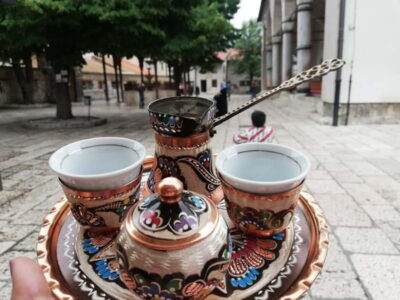
Sarajevo City Market, Old Town Food Tasting Tour
Read our review →
Half Day Trip to Kravice Waterfalls From Mostar with City Voucher
Read our review →
Private group city tour of Mostar and the Old Bridge
Read our review →Browse the lists this tour appears in