
Review · OLD TOWN WALKS
Old Town Sarajevo Walking Tour
Sarajevo’s story fits into a walk. This 150-minute tour links Baščaršija’s Ottoman lanes with the Austro-Hungarian center, so you get more than a quick look at pretty streets. I like the carefully chosen mix of mosques, churches, a synagogue, market halls, and war history. I also like the small human details, from coppersmiths at work to coffee at Morića Han.
The main consideration is pace. You cover many sights in two and a half hours, with several stops lasting only a few minutes. If you want long museum visits or quiet time inside each building, this tour may feel brisk. Still, at $17 per person, it offers strong value for a first look at Sarajevo.
In This Review
- Key points to know before you book
- Starting beside Sarajevo City Hall
- Kazandžiluk and the working Ottoman bazaar
- Morića Han, coffee, and the old trading world
- Gazi Husrev-beg Mosque and the Islamic heart of Old Town
- Latin Bridge and the shot that changed Europe
- Bezistan and the Meeting of Cultures
- Jewish, Catholic, and Orthodox Sarajevo
- Sarajevo’s Austro-Hungarian promenade and market hall
- The Bosnian War and Siege of Sarajevo
- How the guide affects the experience
- Is $17 a fair price?
- Who should book this Sarajevo walk?
- Should you book the Old Town Sarajevo Walking Tour?
- FAQ
- Where does the Old Town Sarajevo Walking Tour meet?
- How long does the tour last?
- What is the price?
- What language is the tour offered in?
- Is hotel pickup included?
- Is food included?
- Is the tour wheelchair accessible?
- Can I cancel for a full refund?
- Can I reserve now and pay later?
Key points to know before you book
- Two Sarajevos in one walk: The route moves from Ottoman Baščaršija to the Austro-Hungarian streets near Latin Bridge.
- A serious history lesson: You hear how the 1914 assassination helped trigger World War I, then connect that story to the Bosnian War and the Siege of Sarajevo.
- Real craft and old commerce: Kazandžiluk shows Sarajevo’s coppersmith tradition, while Morića Han recalls the city’s role as a trading center.
- Many faiths, one compact center: The tour includes the Gazi Husrev-beg Mosque, the Museum of the Jews of Bosnia and Herzegovina, an Orthodox church, and the Sacred Heart Cathedral.
- Guides make the difference: Recent departures praised guides named Kiki and Elvis for making the city’s cultural background clear and personal.
- Simple logistics: You meet across the river from City Hall, pay no hotel pickup fee because pickup is not offered, and can cancel up to 24 hours ahead.
Starting beside Sarajevo City Hall
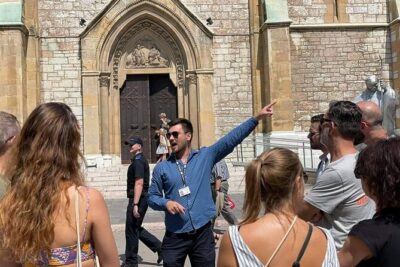
The meeting point is on the square across the river from Sarajevo City Hall, also known as Vijećnica. The listed starting address is Veliki Alifakovac 1. This is a useful place to begin because the city’s Ottoman center lies just ahead, while City Hall itself introduces the later European chapter of Sarajevo.
The guide leads you on foot, so wear comfortable shoes. The route is in the Old Town and central streets, with frequent stops for explanation. The activity is listed as wheelchair accessible, though you should still expect historic streets and buildings rather than a purpose-built modern attraction.
There is no hotel pickup. Food is not included, but a coffee tasting is part of the stop at Morića Han. Tips are also not included, so bring some local cash if you want to thank the guide.
More Old Town Walks in Sarajevo
- Sarajevo: 2 Hours Old Town Walking Tour With Local Guide
★ 5.0 · 505 reviews - Sarajevo: Old Town Walking Tour with Local Guide
★ 4.9 · 211 reviews - Sarajevo Grand Tour: Old Town, War Tunnel, Olympic Sites & More
★ 5.0 · 73 reviews
Kazandžiluk and the working Ottoman bazaar
The first major stretch takes you into Kazandžiluk, Sarajevo’s traditional coppersmith street. This is not just a row of souvenir shops. The point of the stop is to see the craft itself and understand how trade shaped the Old Town.
You might see coppersmiths presenting their work, with metal objects tied to Sarajevo’s long commercial tradition. The exact shop activity can vary, but the street gives you a clear sense of how the bazaar still connects modern life with Ottoman-era trades.
From here, you reach Baščaršija Square and the Sebilj fountain. The fountain is one of Sarajevo’s familiar meeting points, and the tour connects it with the merchants and townspeople who have gathered here for centuries. You may also have the chance to taste its water, a small ritual that makes the square feel less like a photo stop and more like part of daily city life.
I find this opening effective because it gives you texture before dates. You see where people worked, traded, drank water, and met. That helps the later history make sense.
Morića Han, coffee, and the old trading world
Morića Han is one of the route’s most useful stops. This preserved 16th-century Ottoman inn once served merchants and visitors who needed a place to stay and conduct business. Along with the Gazi Husrev-beg Bezistan, it shows that Baščaršija was not simply a market for local shoppers. It was part of a wider trading network.
The stop lasts about 20 minutes and includes coffee tasting. That pause matters. Sarajevo’s coffee culture is one of the easiest ways to understand the city’s social rhythm, and a short tasting gives you a chance to slow down before the next series of landmarks.
The setting also helps you read the architecture. The old inn and shopping spaces were built for practical use, with commerce and lodging close together. You do not need to be an architecture expert to notice the difference between this Ottoman plan and the formal European streets you visit later.
One limitation is that 20 minutes is not enough for a lengthy exploration. I would treat Morića Han as an introduction, not a full cultural workshop.
Gazi Husrev-beg Mosque and the Islamic heart of Old Town
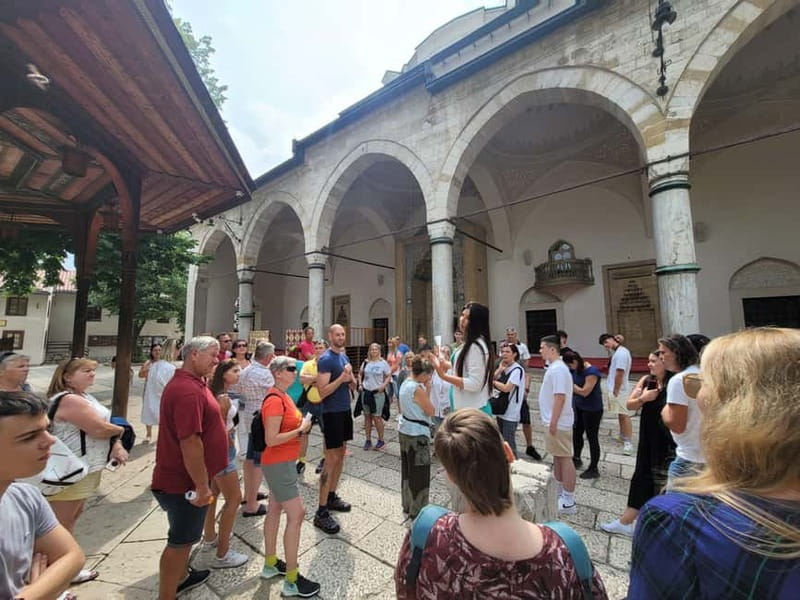
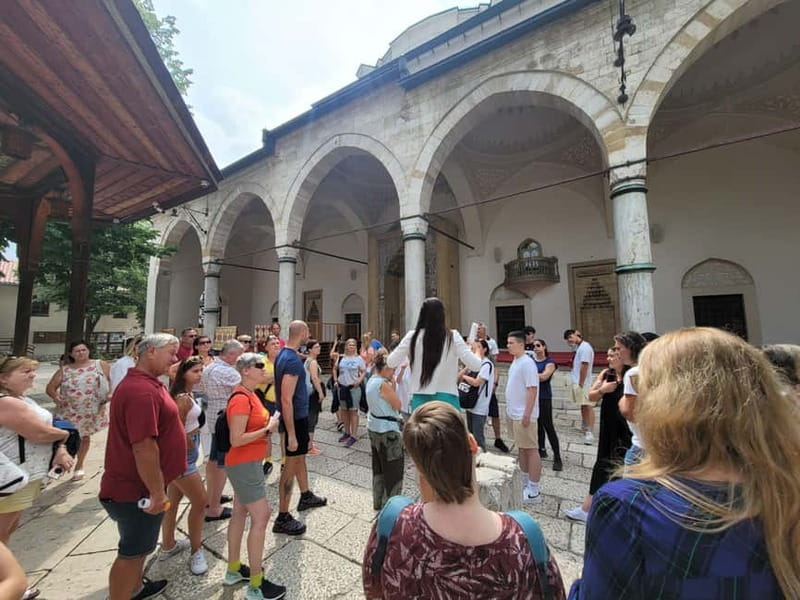
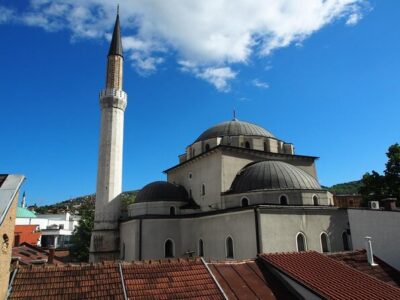
The Gazi Husrev-beg Mosque is the central religious landmark of the Ottoman section. The tour includes a guided visit, giving you more context than you would get by walking past the entrance alone.
The mosque is important not only as a religious building, but also as part of the wider urban system around it. Sarajevo’s Ottoman center grew around worship, study, trade, lodging, and public services. The guide helps connect those parts, so you can see the district as a functioning city rather than a collection of old buildings.
You should dress and behave respectfully at religious sites. The schedule allows about 15 minutes here, which is enough for an introduction and basic sightseeing but not a long independent visit.
The nearby Clock Tower gets only a brief pass-by. That is sensible on a compact walking tour, since the tower is part of the old city’s visual identity but not a full stop on its own.
More Walking Tours in Sarajevo
- Sarajevo: Grand Walking Tour Through Time and Cultures
★ 4.8 · 1,236 reviews - Private Walking Tour, Food Tasting and Bosnian Coffee in Sarajevo
★ 5.0 · 255 reviews - Sarajevo Grand Walking Tour
★ 5.0 · 232 reviews - Sarajevo Essential Full Walking Tour
★ 5.0 · 198 reviews
Latin Bridge and the shot that changed Europe
Latin Bridge is the tour’s most famous historical stop. In 1914, Archduke Franz Ferdinand and his wife Sophie were assassinated near this location. The event helped trigger World War I, and the guide explains how a local act in Sarajevo became part of a conflict that reshaped Europe.
This is where a live guide adds real value. The basic fact is easy to find, but the setting gives it weight. You are standing beside a bridge in an ordinary city street, not in a grand battlefield or palace. The contrast makes the chain of events easier to grasp.
The stop lasts about 10 minutes. That is enough for the story and the location, but not enough for a full museum visit. If this is the part of Sarajevo you most want to study, plan extra time elsewhere in the city.
I like that the tour does not treat the assassination as Sarajevo’s only story. It places World War I within a larger walk that includes centuries of Ottoman life, religious coexistence, the Austro-Hungarian period, the Winter Olympics of 1984, and the Bosnian War.
Bezistan and the Meeting of Cultures
The Gazi Husrev-beg Bezistan is another reminder that shopping was central to the old city. This covered market space belongs to the Ottoman commercial quarter and provides a useful counterpoint to the open-air lanes around Baščaršija.
After that, the tour reaches the Sarajevo Meeting of Cultures marker. This is one of the clearest orientation points on the route. It marks the shift between the Ottoman and Austro-Hungarian parts of central Sarajevo.
The change can feel surprisingly quick. One moment you are among narrow lanes, craft shops, and mosque courtyards. Soon the streets become more European in design, with grander facades and a different civic mood. The tour makes this change visible instead of presenting the Old Town as one uniform district.
For me, this is one of the best reasons to choose the walk. You learn to read Sarajevo by its street plan and buildings, not only by memorizing names.
Jewish, Catholic, and Orthodox Sarajevo
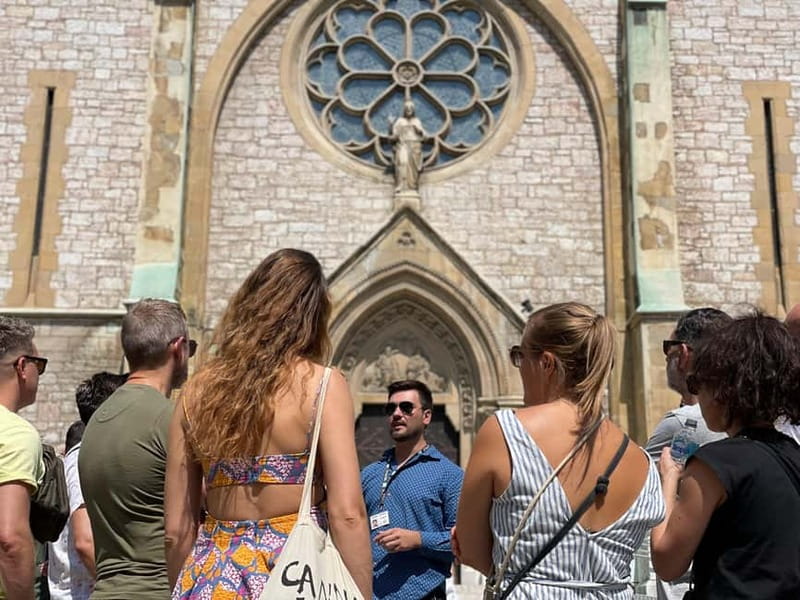
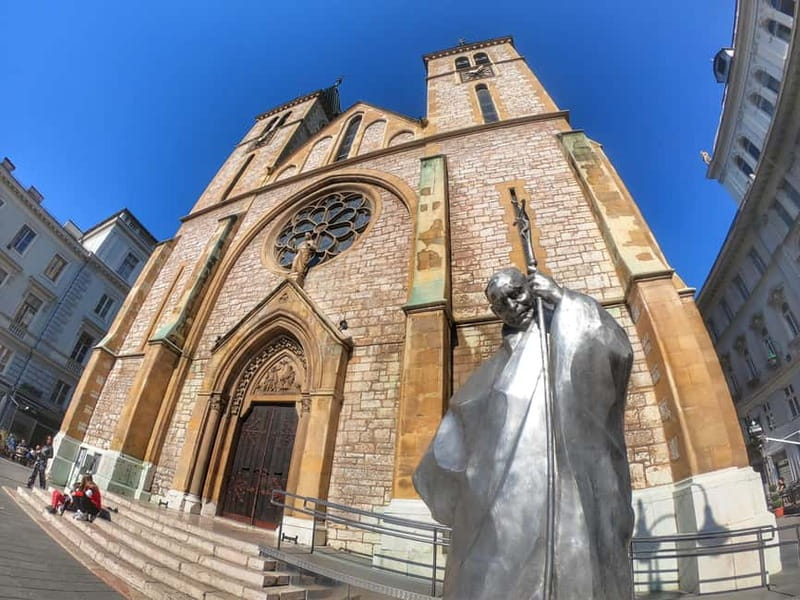
The tour gives unusual attention to Sarajevo’s religious variety. You visit the Museum of the Jews of Bosnia and Herzegovina, the Sacred Heart Cathedral, and the Cathedral Church of the Nativity of the Theotokos. The broader route also includes a synagogue and an Orthodox church in its cultural explanation.
The Jewish museum adds an important layer to the city’s story. It helps show that Sarajevo’s identity cannot be reduced to one empire, one faith, or one period. The visit lasts about 15 minutes, so expect a focused introduction rather than a long museum session.
The Sacred Heart Cathedral provides the Catholic part of the route. Its presence near Islamic, Jewish, and Orthodox places of worship makes the city’s religious mix easy to understand on foot. The visit lasts about 10 minutes.
The Cathedral Church of the Nativity of the Theotokos receives roughly five minutes. That is a short visit, but it rounds out the tour’s purpose. You are not simply seeing the largest or most famous building in each tradition. You are being shown how different communities shaped the same urban center.
Because the stops are short, listen closely to the guide. The value comes from the connections between the sites. On your own, you might see four attractive buildings. With context, you see a city formed by overlapping communities and changing political powers.
Sarajevo’s Austro-Hungarian promenade and market hall
The route continues along the main promenade and includes the City Market Hall. These stops show the European chapter of Sarajevo after Ottoman rule, when Austro-Hungarian planners added new civic buildings, streets, and public spaces.
The market hall is practical as well as historic. It helps you see how food trade and city life continued as Sarajevo changed in style. The tour does not leave you in an old quarter preserved only for display. It shows a city where historical buildings still sit within everyday routines.
The Winter Olympics of 1984 also form part of the guide’s wider discussion. Even though the listed route does not identify a separate Olympic venue, the topic adds another important chapter. Sarajevo was known internationally for sport before the war, and that memory helps explain the scale of the city’s later trauma.
The Bosnian War and Siege of Sarajevo
The discussion of the Bosnian War and Siege of Sarajevo gives the walk its most difficult section. The details are not just an old chapter in a textbook. They remain part of the city’s modern identity, and a good guide can explain the conflict without reducing Sarajevo to sorrow alone.
The tour places the siege alongside the city’s older history. That balance matters. You see a Sarajevo that survived war, but you also see a city of craftsmen, worshippers, merchants, students, shoppers, and coffee drinkers.
Do not expect a full war museum experience from this walk. The tour provides an introduction and local context rather than an extended examination of military events. If you want more, Sarajevo has separate museums and memorial sites that deserve additional time.
This part may feel emotionally heavy, especially after the lighter bazaar and coffee stops. That is not a flaw, but you should know the tour asks you to move between beauty and painful memory within the same morning or afternoon.
How the guide affects the experience
A walking tour like this succeeds or fails with its guide. The route contains many names and dates, but the strongest part is the explanation of how the pieces fit together.
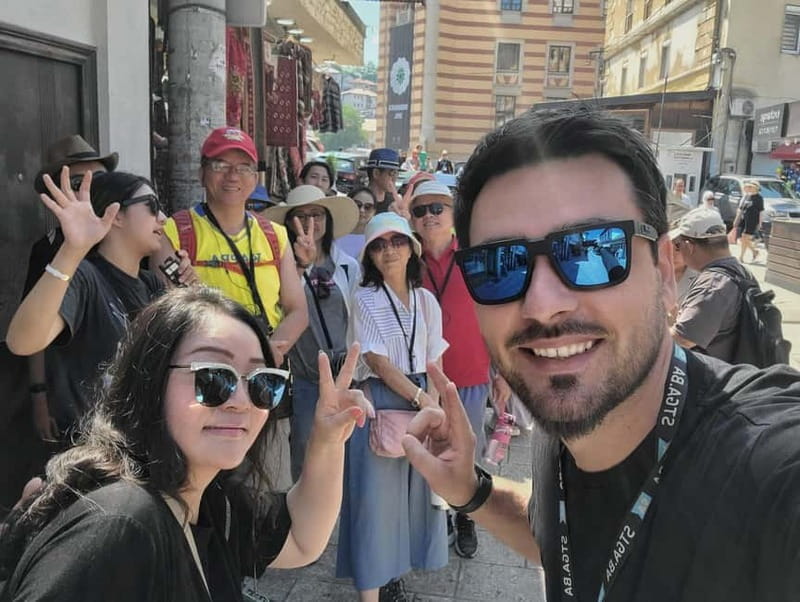
Recent guide feedback singled out Kiki and Elvis for their warm, personal presentation. Elvis was praised for putting his heart into the stories, while Kiki was described as a delight with an impressive command of Sarajevo’s background. The guide may not be one of those two on your departure, but those comments point to the quality you should hope for: clear explanations, cultural sensitivity, and stories that connect buildings to people.
English is the stated tour language. The activity has received a perfect 5.0 rating from five submitted ratings, which is encouraging but also a small sample. I would take it as a positive sign, not a guarantee that every guide or group will match the same experience.
Is $17 a fair price?
At $17, I consider this a good-value introduction to Sarajevo. You get 150 minutes with an English-speaking guide, a long route through the Old Town and European center, several guided visits, and coffee tasting at Morića Han.
The value is strongest if you are new to Sarajevo. In one booking, you get the basic city map in your head, the major historical turning points, and enough religious and architectural context to explore further on your own.
The price does not cover food, hotel pickup, or gratuity. Those exclusions are ordinary for a walking tour, but budget for them. The tour is also not a substitute for entrance-heavy sightseeing or a dedicated war-history excursion.
I would book it early in a Sarajevo visit. The guide can help you understand where the Ottoman quarter ends, where the Austro-Hungarian center begins, and which museums or buildings deserve a longer return visit.
Who should book this Sarajevo walk?
I recommend it most for first-time visitors, history-minded people, and anyone who wants a clear introduction without spending a full day inside museums. It also suits you if you enjoy religious architecture, city planning, local crafts, and short cultural encounters.
It may be less suitable if you dislike walking, want a slow photography outing, or prefer one subject explored in great depth. The schedule moves steadily, and several stops are brief.
Families with older children may find the mix of bridges, markets, mosques, churches, and war stories more engaging than a standard monument tour. The listed accessibility is wheelchair friendly, though the historic character of the Old Town means you may still want to confirm any specific mobility needs before booking.
Should you book the Old Town Sarajevo Walking Tour?
Yes, if you want a compact and affordable first portrait of Sarajevo. The best reason to book is the route itself: Ottoman commerce, Islamic architecture, Austro-Hungarian planning, the assassination near Latin Bridge, religious diversity, the Winter Olympics, and the Siege of Sarajevo all appear in one connected walk.
Go in knowing that the tour is an overview. You will not spend an hour at every church, market, or museum. But for $17, the guide gives you a useful framework, and you can return to the places that catch your attention.
Choose this tour early in your stay, wear comfortable shoes, and keep an open mind for the serious parts. If your guide brings the same warmth credited to Kiki and Elvis, Sarajevo’s streets should feel like a conversation rather than a checklist.
FAQ
Where does the Old Town Sarajevo Walking Tour meet?
The meeting point is on the square across the river from Sarajevo City Hall, also called Vijećnica. The listed starting location is Veliki Alifakovac 1.
How long does the tour last?
The tour lasts 150 minutes, or two and a half hours.
What is the price?
The price is $17 per person.
What language is the tour offered in?
The tour is offered in English with a live English-speaking guide.
Is hotel pickup included?
No. Hotel pickup is not included, so you should make your own way to the meeting point.
Is food included?
Food is not included. Coffee tasting at Morića Han is included as part of the scheduled visit.
Is the tour wheelchair accessible?
Yes. The activity is listed as wheelchair accessible.
Can I cancel for a full refund?
Yes. You can cancel up to 24 hours in advance for a full refund.
Can I reserve now and pay later?
Yes. The booking option allows you to reserve your place and pay later.
Newest around Sarajevo
- Understanding Srebrenica Genocide + Lunch with Local Family★ 4.9 · 14 reviews
- Sarajevo: Trebević Mountain Summit Hiking Tour★ 4.2 · 2 reviews
- Private Full Day Safari Tour★ 5.0 · 8 reviews
- From Sarajevo: Kozice Waterfalls Hiking Experience in Nature★ 5.0 · 2 reviews
- Sarajevo Under Siege: A War History Tour★ 5.0 · 10 reviews
- Mysterious Visoko Pyramids Driving and Walking Tour★ 5.0 · 7 reviews
- WAR TUNNEL – Sarajevo’s only way of a communication during the WAR – Top secret★ 5.0 · 12 reviews
- Ultimate Gastro Experience★ 4.5 · 14 reviews
Old Town Walks, compared.
Sarajevo Grand Tour: Old Town, War Tunnel, Olympic Sites & More
Read our review →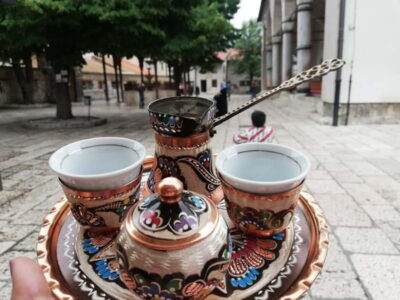
Sarajevo City Market, Old Town Food Tasting Tour
Read our review →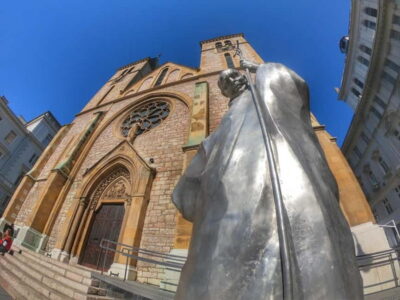
Sarajevo Grand Tour: 5 Hours Old Town, War Tunnel, Olympics
Read our review →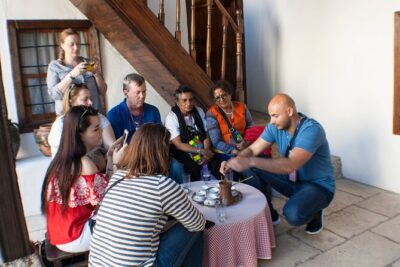
Sarajevo Old Town: Bosnian Coffee, Baklava & Panoramic Views
Read our review →Browse the lists this tour appears in