
Review · SARAJEVO TOURS
From Sarajevo: Višegrad, Andrićgrad, Drvengrad & Šargan tour
Some day trips cross a whole border.
This long outing from Sarajevo takes you through eastern Bosnia and into western Serbia, linking the UNESCO-listed Mehmed Paša Sokolović Bridge, Kusturica’s unusual film villages, and the famous Šargan Eight railway. I like the way a driver handles the border crossing and long mountain roads, leaving you free to watch the Drina valley and Tara foothills. I also like the small group size, capped at seven people, which makes the day more personal than a large coach trip. The main drawback is clear: this is a very full 10 to 12 hours, and two of the stops are purpose-built attractions rather than old settlements that grew naturally.
If you enjoy scenery, regional history, film culture, and unusual transport, this is one of the most ambitious day trips you can make from Sarajevo. Guides such as Kristijan, Amir, Kenny, Kenan, and Ejup have been praised for their clear English, warmth, flexibility, and ability to make the long drives worthwhile. Still, you should choose this trip for its wide sweep across the region, not for a slow, deep visit to any one place.
In This Review
- Key points before you book
- Why this Sarajevo day trip is worth considering
- Višegrad and the 1577 bridge over the Drina
- Andrićgrad, a film village beside the river
- Crossing into Serbia and the Mokra Gora valley
- The Šargan Eight railway, the day’s most unusual ride
- Drvengrad and the €3 question
- Dobrun Monastery closes the route
- What the guides add to a long day
- Drawbacks you should weigh honestly
- Who should book this experience?
- Should you book the Višegrad and Serbia day trip?
- FAQ
- Where does the tour start?
- Is hotel pickup available?
- How long does the experience last?
- Does the tour cross into Serbia?
- Is the Šargan Eight train included?
- Is Drvengrad admission included?
- Are food and drinks included?
- How many people can join the tour?
- What is the cancellation policy?
Key points before you book
- A cross-border day from Sarajevo: You see Višegrad in Bosnia and Herzegovina, then continue into Serbia’s Mokra Gora area.
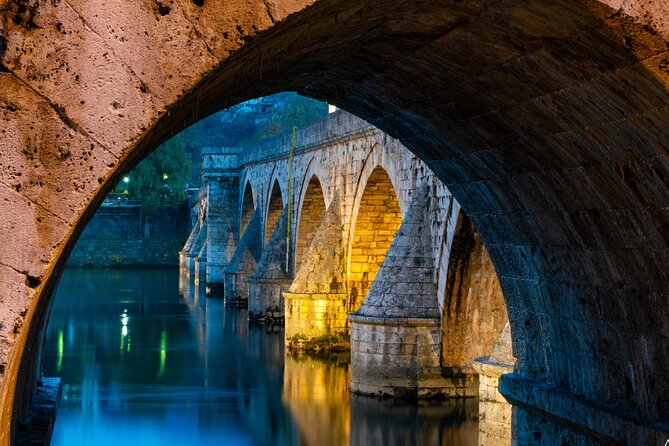
- The bridge is the strongest historical stop: The Mehmed Paša Sokolović Bridge dates from 1577 and entered the UNESCO World Heritage List in 2007.
- The Šargan Eight train costs extra: The optional ride is not included, with a listed price of 1,200 Serbian dinars, or about €10.
- Drvengrad and Andrićgrad are modern creations: Both are linked to filmmaker Emir Kusturica, so expect designed spaces rather than ordinary historic towns.
- A small group helps on a long day: The vehicle carries no more than seven people, with hotel pickup possible outside Sarajevo’s Old Town.
- Allow extra money for stops: Food, drinks, Drvengrad admission at €3, the train, and personal purchases are separate from the $80.46 tour price.
Why this Sarajevo day trip is worth considering
Sarajevo is a rewarding city, but its position makes it a useful base for seeing much more of Bosnia and the nearby Serbian border region. This tour uses that advantage well. Instead of spending a day managing winding roads, navigation, parking, and a border crossing, you ride in an air-conditioned vehicle with a driver-guide.
The price of $80.46 per person is fair for the distance covered, particularly if you are traveling alone or as a couple and do not want to arrange a private car. The package includes fuel, the vehicle, a driver-guide, and pickup and drop-off. It also includes complimentary bottles of water at the start.
The value depends on your style. You get a broad regional overview, not a relaxed village day. The drive is part of the experience, but it also takes time. If you want a leisurely morning in Višegrad alone, this is too packed. If your Sarajevo visit is short and you want to add Serbia without changing hotels, it makes good sense.
The tour normally begins at 8:00 a.m. in front of Meet Bosnia Tours at Gazi Husrev Begova 75, near the crossing of Mula Mustafe Bašeskije. Pickup can be arranged from another location if you are staying outside the Old Town area. The tour returns to the same meeting point.
Other Sarajevo trips worth an open tab:
- Sarajevo: Mostar, Konjic, Blagaj Tekke, Pocitelj & Waterfall
★ 4.9 · 1,666 reviews - Fall of Yugoslavia, Sarajevo War Tour with Tunnel of Hope Museum and Frontlines
★ 5.0 · 1,314 reviews - Sarajevo: Grand Walking Tour Through Time and Cultures
★ 4.8 · 1,236 reviews
Višegrad and the 1577 bridge over the Drina
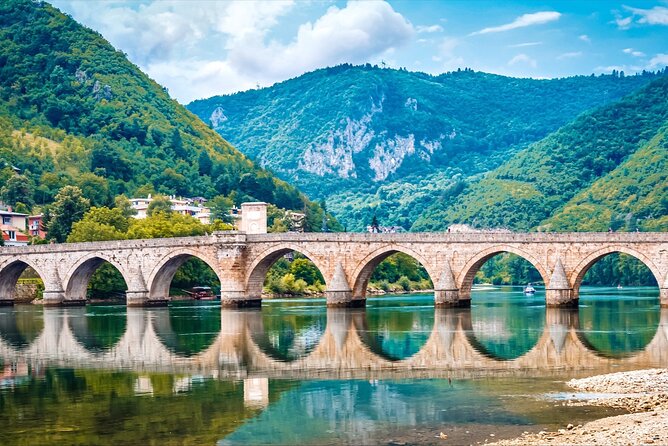
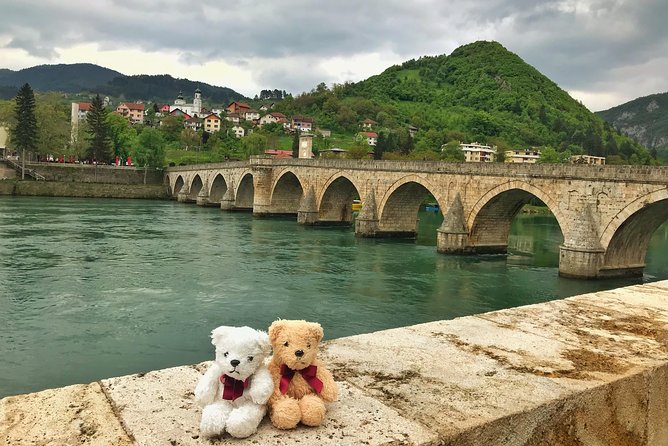
The Mehmed Paša Sokolović Bridge is the emotional center of the day. It crosses the Drina River in Višegrad and was completed in 1577 by Mimar Sinan, the Ottoman court architect, on the order of Grand Vizier Mehmed Paša Sokolović. UNESCO added it to its World Heritage List in 2007.
You have about 45 minutes here. That is enough to walk along the bridge, look at its stone arches and river setting, and hear the historical background from your guide. It is also a good place for photographs, especially in changing weather. One January visit featured morning fog, mountains, and fresh snow, conditions that made the bridge feel especially striking.
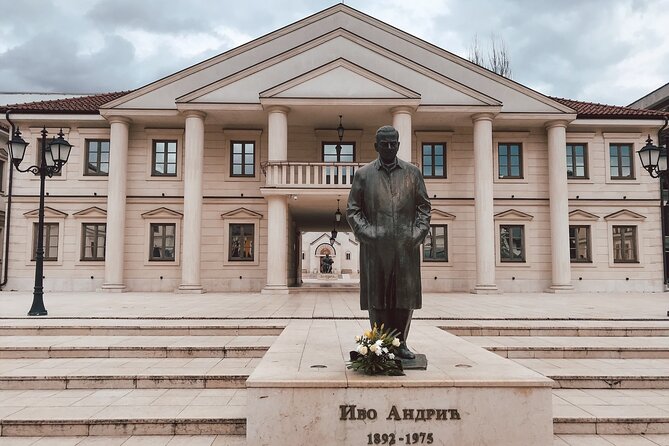
The bridge has a strong literary connection too. It is the subject of Ivo Andrić’s novel The Bridge on the Drina, the work that earned him the Nobel Prize in Literature. If you have read the book, this stop carries extra weight. The tour becomes more than a photo break because the bridge links architecture, empire, fiction, and the difficult history of the region.
You should keep your expectations measured. Forty-five minutes is not enough for a full study of Višegrad, and the bridge itself is the main focus. The reward is seeing an important monument in its river setting, then hearing the story from a guide who can connect the site to the wider area.
Andrićgrad, a film village beside the river
A short ride or walk from the bridge brings you to Andrićgrad, a purpose-built settlement connected with Emir Kusturica. It stretches from the bridge toward the meeting point of the Drina and Rzav rivers and was created as a setting for a film based on Andrić’s The Bridge on the Drina.
You have about 30 minutes here. That is enough to see the main design, take photographs, and understand how the village fits into the bridge and river setting. The architecture draws on several regional and historical styles, giving the place a theatrical quality.
That theatrical quality is both the attraction and the limitation. Andrićgrad is not a medieval town preserved intact. It was made from scratch for cultural and film purposes. I find it interesting as a piece of modern Serbian and Bosnian cultural history, but you may find it less satisfying if you are looking for an ordinary community or an untouched historic quarter.
The short visit works well. You get the idea without losing too much time from the Serbian section of the tour. Your guide can also help explain the link between Andrić, the bridge, and Kusturica’s work, which gives the stop more meaning than a quick walk through decorated streets.
Crossing into Serbia and the Mokra Gora valley
The route then crosses into Serbia and reaches Mokra Gora, a mountain valley between Tara and Zlatibor. The Mokra Gora and Šargan nature park covers about 10,813 hectares, and the area is known for its open mountain views and wooded slopes.
This is where the tour becomes especially scenic. You can expect a change in pace from the stone bridge and built attractions to broad views around the eastern foothills of Tara Mountain. The drive itself matters here. Since someone else is handling the road, you can look out instead of concentrating on turns and traffic.
The tour description emphasizes an easy border crossing, but you should still carry the travel documents required for entry into Serbia. The supplied details do not specify document rules for your nationality, so check them before booking. Border conditions can affect a tightly timed day.
Mokra Gora is not presented as a long hiking stop. You see the area from the vehicle and during brief visits. That makes the outing suitable for scenic sightseeing, but not for anyone hoping to explore the park on foot.
Same corner of the country, a different kind of day:
- Sarajevo: Mostar, Konjic, Sufi House, Pocitelj & Kravice Falls
★ 5.0 · 1,179 reviews - Sarajevo: Tunnel Museum Yugoslavia War Tour with War Veteran
★ 5.0 · 1,111 reviews - ROSES OF SARAJEVO (Official WAR + CITY tour)- Story of a Survivor
★ 5.0 · 770 reviews - Sarajevo: Tunnel of Hope Tour – Survival and Resilience
★ 4.8 · 630 reviews
The Šargan Eight railway, the day’s most unusual ride
The Šargan Eight is the most distinctive part of the Serbian section. This narrow-gauge railway climbs quickly through the mountains using an unusual route that resembles the number eight. The engineering lets the train gain height over a short distance, and old locomotives and wagons along the line form an open-air display of railway history.
The scheduled stop is listed as about 30 minutes, while the actual train ride is optional. You decide on the spot if you want to join, and the ticket is not included in the tour price. The listed charge is 1,200 Serbian dinars, or approximately €10, payable by card or cash.
This optional setup is useful. If the train is running and you want the full experience, you can pay separately. If you would rather save the money or protect your schedule, you can remain with the walking portion of the stop. I would budget for the ride if railway history or mountain scenery interests you, since it is the most unusual activity of the day.
Timing is important. One January visit worked especially well because the train was operating after the New Year period and snow began falling during the ride. That kind of weather can make the trip memorable, but conditions and seasonal operation are not guaranteed by the tour details. Another practical issue is possible queuing, which can reduce the time available elsewhere.
Drvengrad and the €3 question
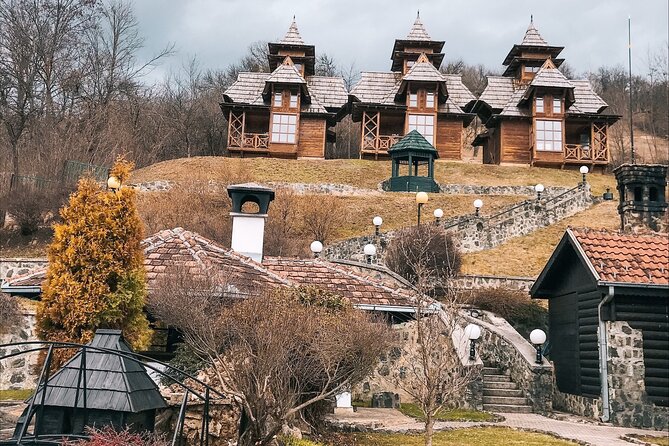
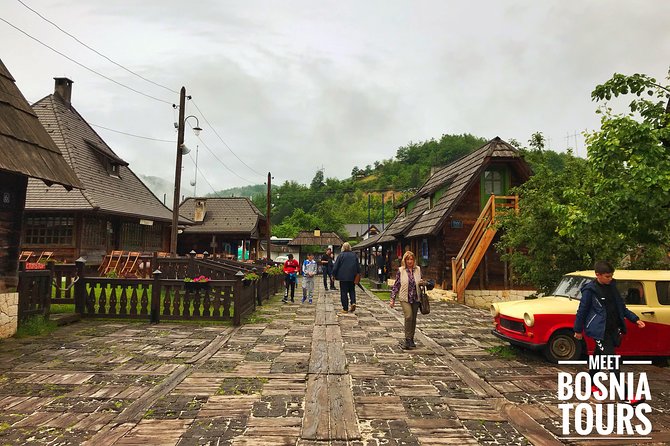
Drvengrad, also called Mećavnik or Wooden Town, is another project associated with Emir Kusturica. It was built on Mećavnik Hill using log cabins brought from the surrounding region. The oldest cabins used in the village are said to be about 90 years old.
You have around 90 minutes here, usually including free time for lunch. The village sits between a traditional settlement, a film set, and a cultural resort. Cabins rest on stone bases, with cellars adapted to the hillside. The layout feels carefully planned, yet it uses regional building forms rather than modern hotel architecture.
The entrance fee is not included. The listed price is €3 per person. Food and drinks are also separate, so this is the main place to plan a meal and keep some local currency or a payment card ready.
Drvengrad divides opinion for a simple reason: it is authentic in materials but artificial in purpose. The cabins are real regional structures, but the village was assembled as a creative project. I think it works best if you treat it as an eccentric cultural attraction, not as a preserved old village.
The 90-minute break gives you time to walk without being rushed, eat, and take in the setting. It is also a useful rest after the drive and railway stop. If you found Andrićgrad too manufactured, Drvengrad may feel like more of the same. If you enjoy cinema, design, folk architecture, or unusual places, it can be one of the more entertaining stops.
Dobrun Monastery closes the route
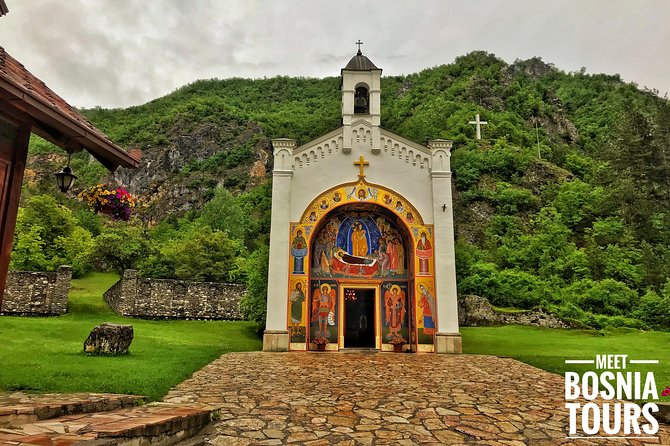
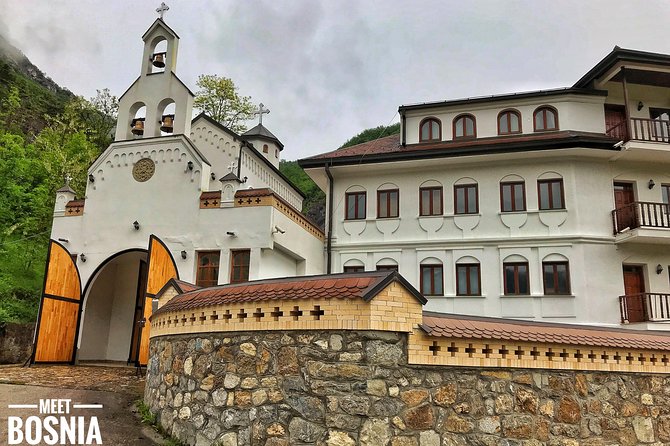
The final listed stop is Dobrun Monastery, built in 1343 in a mountain setting near Višegrad. It is described as one of the oldest monasteries in the country.
The visit lasts about 20 minutes. That is a short stop, but it gives the day a quieter religious and historical ending after the larger attractions in Višegrad and Serbia. You can see the monastery and its setting without needing to commit to a long museum visit.
Because the stop is brief, your guide’s explanation will shape your understanding of it. This is another reason the guide matters. Guides including Amir and Kenan have been praised for explaining both the places visited and the towns and countryside along the way. Ejup has also been praised for adapting the day to circumstances and making even the road sections interesting.
What the guides add to a long day
A 10 to 12 hour trip can feel tiring if the guide simply points out stops and watches the clock. Here, the guide is central to the value. The strongest feedback has focused on friendly, clear communication and strong English.
Kristijan was praised for making the bridge and snowy Šargan Eight ride special. Amir was described as friendly and well informed, with prompt support from the company before the trip. Kenny was praised for allowing the group to move at its own pace without a rushed feeling. Kenan was noted for explaining the places along the route as well as the stops themselves.
Ejup received especially warm praise for his broad knowledge, communication, enthusiasm, and ability to adjust to the group. These comments point to a useful strength: the experience is not only about arriving at famous names. Much of the day is spent driving through Bosnia and Serbia, so a guide who can explain what you are seeing makes a real difference.
The maximum group size is seven. That is small enough for questions and easier coordination at stops. It does not guarantee a private tour, but it should feel more manageable than a full-size bus.
Drawbacks you should weigh honestly
The biggest issue is the schedule. You leave at 8:00 a.m. and may return 10 to 12 hours later. Add a border crossing, mountain roads, several short stops, and optional train timing, and the day can feel full.
The second issue is the nature of the attractions. Andrićgrad and Drvengrad are constructed cultural sites. They are interesting, but they do not offer the same sense of age or daily life as an old town that developed over centuries. One particularly candid assessment found Višegrad and lunch by the Drina more rewarding than the two film villages and the railway stop.
The train can also create a time tradeoff. It is the highlight for some people, especially in snow or clear mountain weather. For others, the queue and extra cost may not feel worthwhile. The optional ticket lets you make that call yourself.
Finally, lunch is not included and the day covers a large area. I would bring water and a little money for food, even though complimentary water is provided at the start.
Who should book this experience?
I would choose this tour if you have limited time in Sarajevo and want one ambitious day that reaches both Bosnia and Serbia. It suits you if you enjoy scenic drives, historic monuments, film locations, railway engineering, and guides who explain the region as you go.
It is also a good fit if you do not want to rent a car or handle a cross-border route yourself. The included vehicle, driver, fuel, and pickup make the price easier to justify, especially for a solo visitor or small party.
I would skip it if you dislike long road days, want substantial walking time, or prefer natural and historic places over designed attractions. You might also prefer a different excursion if your main interest is wartime history or a slower visit focused only on eastern Bosnia.
Booking is flexible because free cancellation is available up to 24 hours before the start time. The tour requires a minimum number of participants, so a cancellation for that reason offers a different date or experience, or a full refund.
Should you book the Višegrad and Serbia day trip?
Book it if you want range. In one day, you see an Ottoman bridge tied to a Nobel Prize winning novel, a Serbian mountain park, two film villages, a historic railway, and a 14th-century monastery.
Do not book it expecting every stop to feel equally authentic. The bridge, river setting, mountain scenery, and Šargan Eight are the strongest reasons to go. Andrićgrad and Drvengrad are more polished and invented, but they add a distinctive cultural angle that you will not find on a standard Bosnia sightseeing route.
At $80.46, the tour offers solid value for the distance and small group format. Set aside about €13 or more for the listed Drvengrad and train fees, plus lunch. If your guide is as engaging as Kristijan, Amir, Kenny, Kenan, or Ejup, the long day becomes far more than a checklist of stops.
FAQ
Where does the tour start?
The usual meeting point is Meet Bosnia Tours at Gazi Husrev Begova 75 in Sarajevo, near the crossing of Mula Mustafe Bašeskije. The usual departure time is 8:00 a.m.
Is hotel pickup available?
Yes. Pickup can be arranged if you are staying outside the Old Town area of Sarajevo. The tour also returns to the original meeting point.
How long does the experience last?
The tour takes approximately 10 to 12 hours.
Does the tour cross into Serbia?
Yes. The route crosses from Bosnia and Herzegovina into Serbia and visits the Mokra Gora and Šargan area.
Is the Šargan Eight train included?
No. The train ride is optional and costs 1,200 Serbian dinars, or about €10 per person. Payment can be made by card or cash.
Is Drvengrad admission included?
No. The listed entrance fee for Drvengrad is €3 per person.
Are food and drinks included?
No. Food and drinks are separate. Complimentary bottles of water are provided at the start of the tour.
How many people can join the tour?
The maximum group size is seven people.
What is the cancellation policy?
You can cancel up to 24 hours before the start time for a full refund. Changes or cancellations made less than 24 hours in advance are not accepted for a refund.
Newest around Sarajevo
- Understanding Srebrenica Genocide + Lunch with Local Family★ 4.9 · 14 reviews
- Private Full Day Safari Tour★ 5.0 · 8 reviews
- Sarajevo: Trebević Mountain Summit Hiking Tour★ 4.2 · 2 reviews
- From Sarajevo: Kozice Waterfalls Hiking Experience in Nature★ 5.0 · 2 reviews
- Sarajevo Under Siege: A War History Tour★ 5.0 · 10 reviews
- Mysterious Visoko Pyramids Driving and Walking Tour★ 5.0 · 7 reviews
- WAR TUNNEL – Sarajevo’s only way of a communication during the WAR – Top secret★ 5.0 · 12 reviews
- Ultimate Gastro Experience★ 4.5 · 14 reviews
Sarajevo Tours, compared.
Mostar, Konjic, Blagaj Tekke, Pocitelj & Waterfall
Read our review →
Fall of Yugoslavia, Sarajevo War Tour with Tunnel of Hope Museum and Frontlines
Read our review →
Mostar, Konjic, Sufi House, Pocitelj & Kravice Falls
Read our review →
Tunnel Museum Yugoslavia War Tour with War Veteran
Read our review →
ROSES OF SARAJEVO (Official WAR + CITY tour)- Story of a Survivor
Read our review →
Tunnel Museum: Bosnian & Yugoslav Wars Tour with War Veteran
Read our review →Browse the lists this tour appears in