
Review · MOSTAR & KRAVICE WATERFALLS DAY TRIPS
Mostar Shelters tour in Mostar
Some parts of Mostar ask for a slower look. The Mostar Shelters tour takes you beyond the postcard view of the Old Bridge and into the wartime story of the city, using a mix of driving, short walks, photographs, and personal accounts. I like the excellent value, especially since the tour can last two to three hours and includes transport between sites. I also like the chance to ask direct questions of local guides such as Miran and Dario, who explain difficult events in a clear, personal way.
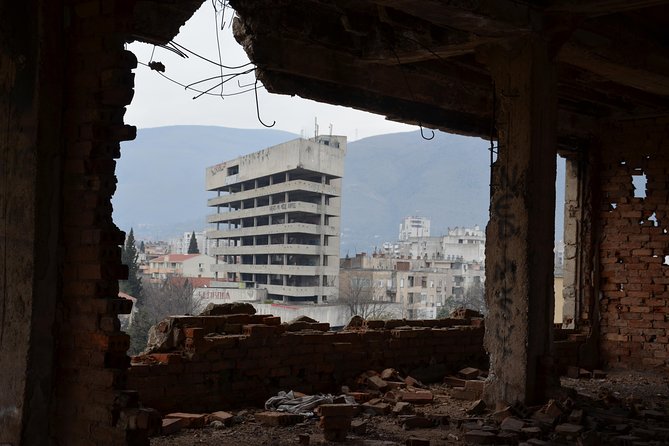
The main consideration is emotional: this is a serious tour about the Bosnian War from 1992 to 1995. You will see bullet-marked buildings, burnt houses, former artillery positions, trenches, and an urban front line. The walking is limited, but the subject matter is not light, so this fits people who want context rather than a cheerful sightseeing outing.
In This Review
- Key points to know before booking
- Why this tour matters in Mostar
- Starting at Onešćukova 32 at 5:00 pm
- The drive through Mostar’s wartime sites
- Artillery positions and trench lines
- Bullet holes, burned houses, and the urban front line
- The mountain viewpoint and the cross
- Miran and Dario’s guiding style
- Is $41.20 good value?
- Who should take the Mostar Shelters tour?
- What to bring and how to prepare
- Should you book Mostar Shelters?
- FAQ
- Where does the Mostar Shelters tour start?
- What time does the tour start?
- Where does the tour end?
- How long does the tour last?
- Is hotel pickup included?
- What language is the tour offered in?
- How does the tour travel between locations?
- What places does the tour visit?
- Is food or drink included?
- How many people can join the tour?
Key points to know before booking
- A two-part tour by van and on foot: Most of the route is by vehicle, with short walks at important locations.
- Mostar’s wartime story beyond the Old Town: You visit artillery positions, trench lines, front-line areas, and other sites tied to the conflict.
- Local guides make the difference: Miran and Dario use photographs, footage, and personal stories to explain events.
- A high viewpoint over Mostar: The tour includes a mountain viewpoint with the cross, offering a different look at the city.
- Small groups help the discussion: The maximum group size is 16 people, and the guide encourages questions.
- Good value at $41.20: Hotel pickup is included at selected hotels, and the tour is offered in English.
Why this tour matters in Mostar
Mostar is easy to reduce to one famous bridge, a few stone lanes, and riverside cafés. That view is beautiful, but it leaves out the bullet holes, burned buildings, divided neighborhoods, and recent memories that still shape the city.
The Mostar Shelters tour gives you a way to ask what happened to the buildings and people you see around town. Instead of leaving the war as a vague backdrop, the guide connects specific places with the fighting that reached the city during the Bosnian War.
I find that useful because Mostar’s damage is often visible but unexplained. A bullet-scarred wall tells you something happened, but not who was firing, where positions were located, how civilians lived through it, or what came afterward. This tour is designed to answer those questions without treating the subject as forbidden.
The tone is direct. No question is considered off limits, and the guide encourages you to ask when something is unclear. That matters in a place where the political and human story is complicated, and where a quick explanation can easily leave out too much.
More Waterfall Day Trips in Mostar:
- Dubrovnik: Kravica Waterfalls, Mostar and Pocitelj Day Trip
★ 4.5 · 3,045 reviews - From Mostar: Blagaj, Počitelj & Kravice Waterfalls Day Tour
★ 5.0 · 1,310 reviews - Discover Herzegovina Day Tour from Mostar: Kravice Waterfalls, Blagaj, Počitelj
★ 5.0 · 742 reviews
Starting at Onešćukova 32 at 5:00 pm
The listed meeting point is Onešćukova 32, Mostar 88000, with a start time of 5:00 pm. The tour ends back at the meeting point, which makes it fairly easy to fit into a day that already includes the Old Town and the bridge.
The late afternoon departure has practical advantages. You can spend the earlier part of the day seeing Mostar’s main sights, then use this tour to understand what lies beyond them. It also avoids making the war tour your first introduction to the city.
Hotel pickup is included for selected hotels, but you should confirm that your accommodation qualifies. If it does not, plan to reach Onešćukova 32 yourself. The tour is near public transportation, though the exact pickup arrangement depends on the hotel.
The minimum booking requirement is two people. The group can reach 16, which is still small enough for a personal conversation in most cases, though a full vehicle may feel less intimate than a private outing.
The drive through Mostar’s wartime sites
This is not a long walking route through the center. It is a half-driving, half-walking experience, although the available description and direct accounts indicate that most of the time is spent in the vehicle, with short walks at selected places.
That format is important. Mostar’s wartime sites are spread around the city and its surrounding heights. Driving lets you cover more ground than a standard walking tour, while the short stops give you time to look closely at buildings, positions, and views.
The tour visits prominent locations connected with the war, including artillery positions, trench lines, and an urban front line. The exact order can vary, and the tour description does not promise a fixed list of named stops. What you can expect is a route built around the physical evidence of the conflict rather than only a general lecture.
At each location, the guide explains what happened there and how people experienced the fighting. You may see places that are easy to pass without noticing, but the commentary gives them meaning. A damaged wall becomes part of a defensive line. A position on higher ground helps explain the military geography. A neighborhood street shows how close the conflict came to ordinary homes.
The vehicle also helps with the emotional rhythm of the tour. You are not walking for hours through destruction. Instead, you move between locations, listen, get out for a short look, and return to the vehicle for the next part of the story.
Artillery positions and trench lines
The artillery positions and trenches are among the most important parts of the route because they show how the fighting was organized in physical terms. You are not only hearing that Mostar was shelled. You are being taken to places connected with the firing and defense.
For many people, this makes the history easier to understand. Maps and dates can feel abstract, but a position on the ground gives you a sense of distance and direction. You can better understand how the city was exposed and why certain buildings or neighborhoods suffered damage.
The tour also helps connect military positions with civilian life. The purpose is not to turn old fortifications into dramatic props. It is to explain how these positions affected the people living below them and how the conflict changed daily routines.
You should expect the guide to use photographs and real footage during the explanations. Miran is specifically praised for taking time with these visual materials, while Dario is praised for making complicated material accessible through personal stories. Those tools are useful because they show the difference between Mostar before, during, and after the war.
Some sites may feel stark rather than polished. That is part of the point. This is not a museum where every object has a label and a protective case. The city itself is part of the evidence.
Same corner of the country, a different kind of day:
- From Mostar: Kravice Waterfalls, Blagaj, & Počitelj
★ 5.0 · 565 reviews - Herzegovina Day Tour from Mostar: Blagaj, Pocitej, Kravice falls (Join Us! :D)
★ 5.0 · 372 reviews - Mostar and Kravice Waterfalls Full-Day Tour from Split
★ 4.8 · 308 reviews - From Mostar: Kravice Waterfalls, Pocitelj & Blagaj Day Trip
★ 5.0 · 245 reviews
Bullet holes, burned houses, and the urban front line
The urban front-line sections may be the most affecting part of the tour. Mostar’s center still includes buildings marked by bullets and fire, and the guide explains how the fighting reached these urban areas.
I appreciate this focus because it keeps the story grounded in ordinary places. You are not only looking at a distant battlefield. You are seeing streets and buildings where people lived, worked, and tried to survive.
The tour addresses what happened during the fighting and what happened later. That second part matters. War history is not finished when the shooting stops. Buildings remain damaged, families are affected, and the meaning of a neighborhood can change for years.
The guides approach the subject with obvious feeling, but the supplied accounts also describe them as inviting and easy to question. That balance is valuable. A guide who recites dates without humanity can make the subject flat. A guide who relies only on emotion can leave you confused. Here, the best experience should give you both the wider account and the personal side.
You may find the explanations especially helpful if you already know something about the conflict but still have questions about Mostar’s particular experience. The city’s story is not simply a general lesson about the war in Bosnia and Herzegovina. The route focuses on how Mostar was affected and how its people lived through that period.
The mountain viewpoint and the cross
One of the tour’s visual highlights is a drive to the mountain viewpoint with the cross, where you can look across Mostar from above. This provides a welcome change after the close-up views of damaged buildings and defensive positions.
The view is not just a photo stop. From higher ground, the city’s shape becomes easier to read. You can see how neighborhoods sit around the river and how the surrounding heights relate to the city below. That physical view supports the guide’s explanation of why certain positions mattered.
The viewpoint also gives the tour some breathing room. Three hours of war discussion could feel heavy, but a pause above the city allows you to absorb what you have heard. The beauty of Mostar is still present, though it now sits beside a clearer understanding of what happened there.
Conditions at the viewpoint and the amount of time spent there are not specified, so you should treat it as one part of the route rather than a long scenic stop. The main purpose remains the wartime story.
Miran and Dario’s guiding style
The guides are a major reason to book this experience. Miran is praised for using photographs and real footage, answering questions, and explaining the subject with both heart and historical understanding. Dario is praised for taking a small group in a van, sharing personal stories, and explaining difficult material without making it dull.
Those details tell you what kind of tour this is. It is not simply an audio track delivered from the front of a vehicle. The guide is expected to interpret the sites, respond to questions, and help you make sense of a complicated recent past.
You may be able to take two related tours with the same company, including one called The Death of Yugoslavia. If you choose both, the subjects are described as complementary rather than repetitive. The Mostar Shelters tour focuses on the city’s wartime locations and siege, while the other experience addresses the wider breakup of Yugoslavia.
I would not assume that every departure has the same guide. The available information names both Miran and Dario, so your guide may depend on the date and schedule. Both are associated with strong praise for clear, personal explanations.
Is $41.20 good value?
At $41.20 per person, this tour offers solid value if you want more than a standard Old Town walk. The price includes a professional guide, live commentary in the vehicle, and hotel pickup from selected hotels.
The strongest value comes from the access to several locations in roughly two hours, or sometimes closer to three. Reaching artillery positions, trenches, urban front-line areas, and the mountain viewpoint independently would be difficult, especially if you do not know where to look or how each place fits the story.
The tour also saves you research time. You could read about the Bosnian War before arriving, but you would still need to connect the facts to Mostar’s streets and hills. A local guide does that work while you are on site.
Food and drinks are not included, but that is not a serious drawback for a two-hour activity. Eat before the 5:00 pm start or plan a meal afterward in Mostar. The larger issue is not cost. It is whether this subject matches the kind of experience you want.
For a person interested in recent European history, local memory, architecture damaged by war, or the human side of conflict, the price is reasonable. If you only have time for a quick look at the bridge and Old Town, the tour will take a significant portion of your day.
Who should take the Mostar Shelters tour?
I would recommend it to you if you want to understand Mostar rather than simply photograph it. It suits adults, history-minded visitors, and anyone who has looked at bullet holes or burned buildings and wanted to know the full story.
It is also a good choice if you prefer a guide who welcomes difficult questions. The tour does not appear to avoid sensitive subjects, and that directness can help you form a more informed view of the city.
Children can participate if accompanied by an adult, but parents should think about the material before booking. The subject is war, civilian suffering, destruction, and displacement. The tour is not presented as a family entertainment activity.
Most people can take part, and the experience includes short walks rather than a demanding hike. Still, you should be comfortable getting in and out of a vehicle and walking briefly at the stops. No specific accessibility details are provided, so ask the operator if you have mobility concerns.
The tour is offered in English. It is available multiple times during the day according to the tour information, though the specific departure given here is 5:00 pm. Confirmation arrives at booking, and free cancellation is available up to 24 hours before the start time.
What to bring and how to prepare
Bring water, since food and drinks are not included. Wear shoes suitable for short walks over uneven outdoor surfaces, although the route is not described as a strenuous hike.
Give yourself enough time to reach the meeting point if you are not receiving hotel pickup. A late arrival could be especially awkward because the group travels between sites, rather than remaining in one place.
You do not need to arrive with a detailed knowledge of the war. In fact, the guide’s explanations are meant to answer the basic questions as well as the more complicated ones. Still, knowing that the Bosnian War took place from 1992 to 1995 will help you place the tour in time.
Most important, arrive ready to listen. The strongest parts of this experience are not quick facts or dramatic photographs. They are the connections between the physical city, the military positions, and the people who lived through the conflict.
Should you book Mostar Shelters?
Yes, if you want the part of Mostar that the Old Bridge cannot explain. At $41.20, the combination of transport, local guidance, visual material, and access to wartime locations makes this one of the better-value ways to understand the city’s recent past.
Book it if you can handle a serious subject and have at least two people in your booking. Skip it if you want only relaxed sightseeing, shopping, and scenic views. For most history-minded adults, the tour adds meaning to everything else you see in Mostar, and the mountain view gives you a memorable final frame for a difficult story.
FAQ
Where does the Mostar Shelters tour start?
The tour starts at Onešćukova 32, Mostar 88000, Bosnia and Herzegovina.
What time does the tour start?
The listed start time is 5:00 pm.
Where does the tour end?
The activity ends back at the meeting point.
How long does the tour last?
The stated duration is approximately two hours. Direct accounts describe some departures lasting between two and three hours.
Is hotel pickup included?
Hotel pickup is included from selected hotels only. You should confirm whether your accommodation is covered.
What language is the tour offered in?
The tour is offered in English.
How does the tour travel between locations?
It is a combination of driving and walking. Most of the route is by vehicle, with short walks at several sites.
What places does the tour visit?
The route includes prominent wartime locations in Mostar, such as artillery positions, trench lines, urban front-line areas, and a mountain viewpoint with a cross.
Is food or drink included?
No. Food and drinks are not included in the tour price.
How many people can join the tour?
The maximum group size is 16 people, and at least two people are required per booking. Children must be accompanied by an adult.
Newest around Mostar
- Mostar Old Town Walking Tour – Best Seller★ 5.0 · 4 reviews
- Mostar Panorama Glass Bridge★ 4.0 · 2 reviews
- Wine Tasting & Private Walking Tour Mostar★ 5.0 · 5 reviews
- Private Transfer Mostar–Dubrovnik English Speaking Local Driver★ 5.0 · 13 reviews
- Private Transfer from Mostar to Split★ 5.0 · 3 reviews
- Stolac, the crossroads of civilisations, private walking tour.★ 5.0 · 9 reviews
- Biking in Mostar ,Ćiro trail Mostar-Čapljina★ 5.0 · 4 reviews
- Neretva kayak canoe safari★ 5.0 · 12 reviews
Mostar & Kravice Waterfalls Day Trips, compared.
Dubrovnik: Kravica Waterfalls, Mostar and Pocitelj Day Trip
Read our review →
Mostar, Konjic, Blagaj Tekke, Pocitelj & Waterfall
Read our review →
Blagaj, Počitelj & Kravice Waterfalls Day Tour
Read our review →
Mostar, Konjic, Sufi House, Pocitelj & Kravice Falls
Read our review →
From Dubrovnik: Mostar and Medjugorje Full-Day Tour
Read our review →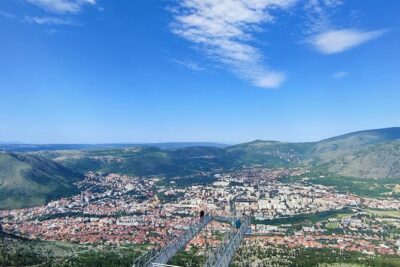
Discover Herzegovina Day Tour from Mostar: Kravice Waterfalls, Blagaj, Počitelj
Read our review →
Mostar, Konjic, Dervish House, Pocitelj & Kravica Falls
Read our review →Browse the lists this tour appears in